
Open Criticism and Freedom of Speech
-
This activity helps students identify Australia’s core civic values—such as equality, respect, freedom and responsibility—and apply them to everyday scenarios. Students discuss how these values guide behaviour, support democratic participation and connect to the rule of law.
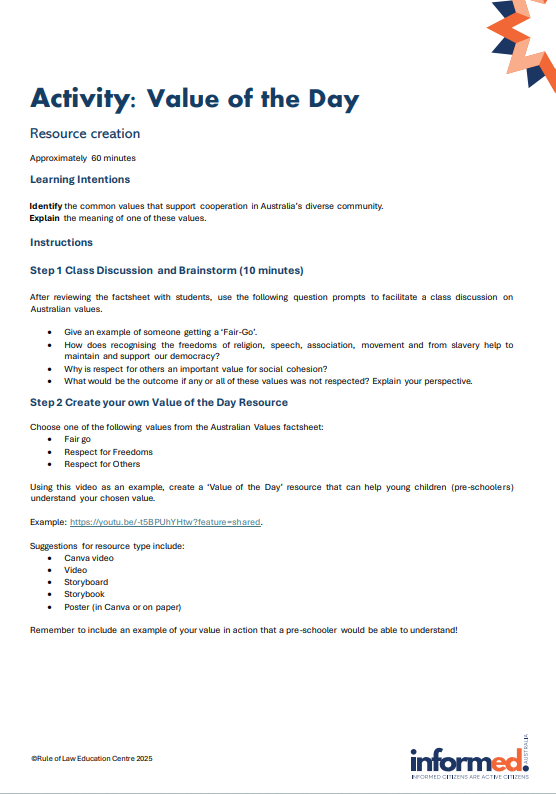
Exploring Australian Values Activity
Activity: Value of the Day Resource Creation
Approximately 60 minutes
Learning Intentions
Identify the common values that support cooperation in Australia’s diverse community.
Explain the meaning of one of these values.
Instructions
Step 1 Class Discussion and Brainstorm (10 minutes)
After reviewing the factsheet with students, use the following question prompts to facilitate a class discussion on Australian values.
Give an example of someone getting a ‘Fair-Go’.
How does recognising the freedoms of religion, speech, association, movement and from slavery help to maintain and support our democracy?
Why is respect for others an important value for social cohesion?
What would be the outcome if any or all of these values was not respected? Explain your perspective.
Step 2 Create your own Value of the Day Resource
Choose one of the following values from the Australian Values factsheet:
Fair go
Respect for Freedoms
Respect for Others
Using this video as an example, create a ‘Value of the Day’ resource that can help young children (pre-schoolers) understand your chosen value.
Suggestions for resource type include:
Canva video
Video
Storyboard
Storybook
Poster (in Canva or on paper)
Remember to include an example of your value in action that a pre-schooler would be able to understand!
Related Resources
-
This factsheet outlines the core values that support Australia’s free and democratic society, including equality, freedom, respect and responsibility. It shows how these values guide civic behaviour, protect rights and underpin Australia’s democracy and rule of law.
-
This case note outlines the High Court’s decision in Comcare v Banerji, where a public servant challenged her dismissal after anonymously posting critical political comments on Twitter. The Court confirmed that the implied freedom of political communication is not a personal right but a limit on legislative power, and held that the APS Code of Conduct did not impose an unjustified burden on that freedom. The decision highlights how the rule of law balances public sector duties, political communication and constitutional limits on government power.
-
This poster forms part of the Informed Playing Card Project, showing how Australian values such as the fair go, freedom and respect for others guide civic behaviour and support a cohesive, democratic society.
Explore Related Topics
-
Checks and Balances on Power
Explore resources on checks and balances, explaining how oversight limits power and ensures decisions remain lawful and accountable, supporting transparency, restraint, & responsible government action.
-
Open and Free Criticism
Explore resources on open and free criticism of law & government, showing how scrutiny of institutions strengthens accountability and supports a rule‑of‑law culture.
-
Human Rights
Explore resources on human rights, outlining key protections, and how rights are balanced against government power in Australia through constitutional principles, legislative safeguards and rule‑of‑law accountability.