
Fair and Prompt Trials
-
This activity helps students apply the core elements of a fair trial, including impartial decision‑makers, open justice, timely hearings, legal representation and the presumption of innocence. It guides learners through scenarios that test their understanding of procedural fairness and shows how these safeguards protect rights and uphold confidence in the justice system.
-
This activity uses Gall v Domino’s to analyse the consequences of a 3.5‑year delay in judgment, highlighting impacts on litigants, judicial efficiency, and community trust, while reinforcing the importance of timely justice in Australia’s legal system.
Justice Delayed is Justice Denied
Modern look at an ancient right: Gall v Domino’s Pizza Enterprises Ltd
Learning Intentions
Explain the legal principle “To none will we sell, to none will we deny, or delay, the right of justice” and why it matters.
Analyse the case of Gall v Domino’s Pizza Enterprises Ltd to evaluate the impacts of delayed judgments on different stakeholders, including litigants, judges, and the wider community.
Background information
The maxim justice delayed is justice denied is one of the oldest principles of the common law. Courts exist not only to determine disputes fairly, but to do so within a reasonable time.
Yet what happens when a case is heard and completed, but judgement remains outstanding for years? At what point does delay itself become a form of injustice? Does the right to a fair hearing include a right to a timely decision, and if so, what are the consequences when that expectation is not met?
These activity looks at Gall v Domino’s Pizza Enterprises Ltd, a class action concerning alleged underpayments of thousands of workers that has become notable not only for its claims, but also for the delay in the delivery of judgment.
Activity 1: Historical Context and the Importance of Prompt Justice
The significance of timely justice is not just a modern concern. The idea that justice delayed is justice denied stretches back centuries and has influenced the development of the common law itself.
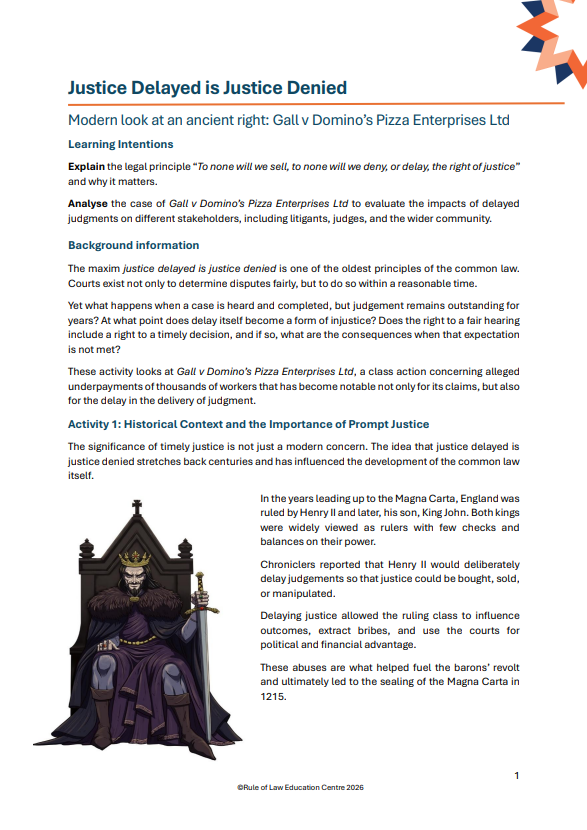
In the years leading up to the Magna Carta, England was ruled by Henry II and later, his son, King John. Both kings were widely viewed as rulers with few checks and balances on their power.
Chroniclers reported that Henry II would deliberately delay judgements so that justice could be bought, sold, or manipulated.
Delaying justice allowed the ruling class to influence outcomes, extract bribes, and use the courts for political and financial advantage.
These abuses are what helped fuel the barons’ revolt and ultimately led to the sealing of the Magna Carta in 1215.
One of the most famous guarantees in the Magna Carta, Clause 40, declared:
“To none will we sell, to none will we deny, or delay, the right of justice.”
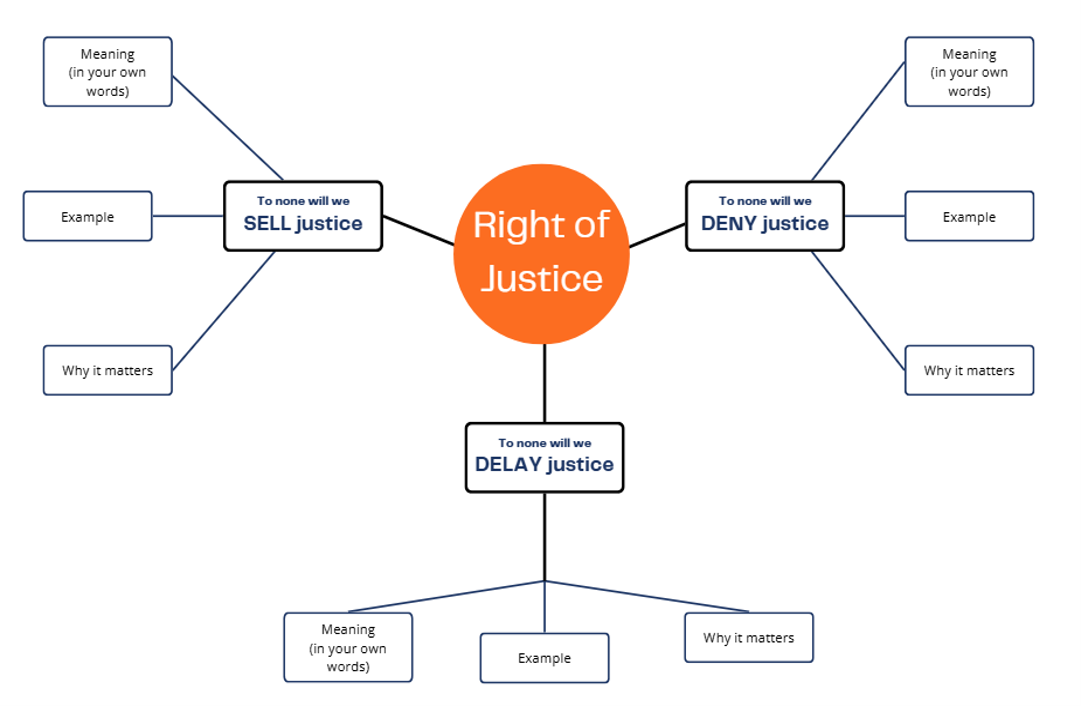
Create a Mind Map to understand clause 40
Using Clause 40 of the Magna Carta, create a mind map to understand and reflect on ways in which justice can be impacted.
Activity 2: Why Prompt Trials Matter Today: Gall v Dominos
Consider the case of Gall v Domino’s Pizza Enterprises Ltd, a class action concerning alleged underpayments of thousands of pizza delivery drivers and staff.
A one-page Case Brief can be found at: www.ruleoflaw.org.au/case-note-gall-v-dominos-pizza
Case Summary
Domino’s Pizza is a familiar presence in Australian communities. It is known for its fast service, cheap meals, and even a 20-minute delivery guarantee. However, behind the marketing, Domino’s workers allege the company has failed to meet a far more important guarantee, namely, the legal right to fair and proper pay.
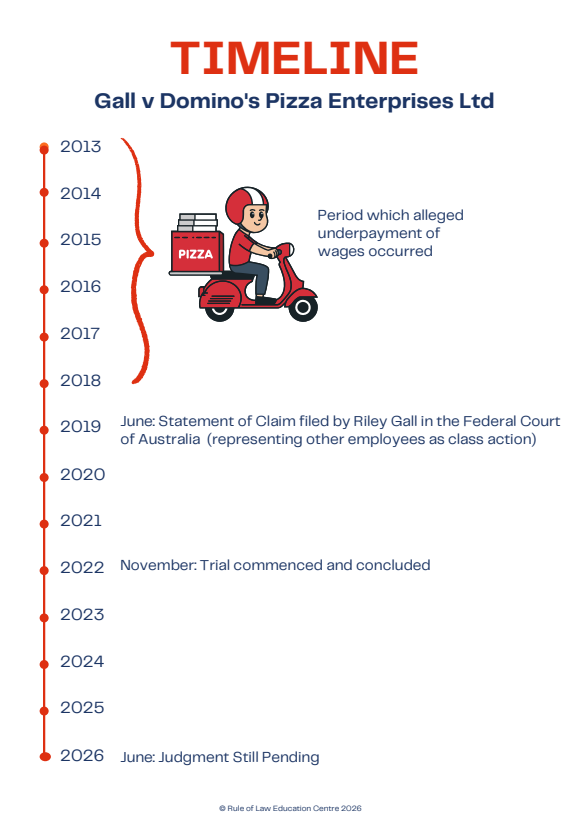
Riley Gall worked as a Domino’s delivery driver between 2015 and 2018. In June 2019, he commenced a class action in the Federal Court of Australia on behalf of a number of other Domino’s workers.
A class action is a civil proceeding. It allows one or more persons to represent a larger group (class) who have suffered the same or similar harm caused by the respondent.
In this case, the claim alleges that Domino’s (the Franchisor) underpaid staff between 2013 and 2018 by directing its franchisees (the individual stores) to use outdated enterprise agreements instead of the Fast Food Industry Award 2010, which provided higher minimum wage rates. In other words, the workers allege the Franchisor had engaged in misleading and deceptive conduct about the pay rates applicable to their employees, who were consequently underpaid.
Awards are legally binding instruments that set minimum pay and conditions for particular industries. They cannot fall below the standards in the Fair Work Act 2009 (Cth) and often provide additional protections tailored to specific occupations.
The Applicant’s claim initially sought remedies (i.e., compensation for lost wages) under the Fair Work Act only but later amended the claim to include remedies under the Australian Consumer Law (ACL).
Procedural history
In June 2019, the Statement of Claim (the document that commences proceedings) was filed in the Federal Court registry in Melbourne.
In November 2019, the Federal Court rejected Domino’s attempt to impose broad confidentiality (Legal professional privilege) over key evidence documents. The court found that the restrictions were overstated and inconsistent with open justice (Gall v Domino’s Pizza Enterprises Ltd [2019] FCA 1799)).
In April 2021, Domino’s failed in its bid to strike out the workers’ ACL claim; the Court held the Fair Work Act is not a “complete code” and does not exclude concurrent ACL claims (Gall v Domino's Pizza Enterprises Limited (No 2) [2021] FCA 345 (13 April 2021)).
In November 2022, the Court ruled Domino’s had improperly redacted key evidence documents and ordered fuller disclosure, with costs awarded against Domino’s (Gall v Domino's Pizza Enterprises Limited (No 3) [2022] FCA 1330 (7 November 2022)).
In November 2022, the trial commenced and concluded.
Since the trial concluded in November 2022, the matter has been reserved for judgment. At the time of writing (June 2026), this was 3.5 years ago (more than 1,300 days).
Activity: Perspectives on Justice – Gall v Domino’s Pizza
Goal
To explore how different groups experience justice differently, especially when court decisions are delayed.
Step 1: Assign Perspectives
Divide the class into 4 groups. Each group represents one perspective:
Gall (the employee on behalf of other employees)
Domino’s (the company)
Judges
The community
Step 2: Group Discussion
Each group discusses and prepares answers to:
What is your role in this example?
What would justice look like to you in this case?
From your perspective, what are some reasons why there might be a delay in justice? What is the impact of that delay?
There is a famous phrase, Justice delayed is justice denied, what does that mean to you?
Comments:
The timeliness of trials and other court proceedings is important for several reasons:
It protects the presumption of innocence. Prolonged delays in criminal matters can mean months or years of remanded custody. Those accused may lose jobs, housing, relationships, and reputation long before a court determines guilt. Delay can, therefore, punish the innocent before a finding has been made by the court.
It protects evidence. Witness memories fade, physical evidence deteriorates, and documents are lost. The longer a case drags on, the greater the risk of injustice. The Chris Dawson case is a good example of the difficulties in providing evidence that is usable when there is an extended delay.
It maintains public confidence in the judiciary. Excessive delay undermines the community's trust that the justice system is accessible, effective, and impartial.
Ultimately, lengthy delays increase costs, prolong uncertainty, and risk unfairness to both sides. They also burden the courts because no judge can be expected to recall the detail of a complex trial years later without re reading the entire record, an enormous waste of public resources. The alternative is worse, whereby a judgment is based on fading memory rather than a fresh and accurate assessment of the evidence.
Individuals are entitled not only to a fair trial, but also to a timely one.
Related Resources
-
This case note highlights the 3.5‑year judgment delay in Gall v Domino’s and its implications for fair, prompt, and accessible civil justice.
-
This explainer outlines the key elements of a fair trial, including impartial courts, open justice, timely hearings, legal representation and the presumption of innocence. It shows how these safeguards protect individual rights, ensure accountability and maintain public confidence in the justice system.
Explore Related Topics
-
Equality Before the Law
Explore resources on equality before the law, including the Lost Parcel story, showing how legal rules apply fairly to all people, strengthening fairness in everyday situations.
-
Presumption of Innocence
Explore resources on the presumption of innocence, showing how the burden of proof protects the accused and safeguards fairness in criminal justice.
-
Independent and Impartial Judiciary
Explore resources on an independent and impartial judiciary, including the history of the Supreme Court & its role in delivering justice & strengthening trust in the judiciary.