
The Division of Powers
-
This classroom activity uses a flood‑crisis scenario to help students apply the Division of Powers by analysing how local, state and federal governments respond during emergencies. Working in groups, students examine town‑specific crisis cards, identify each level of government’s responsibilities, develop a coordinated emergency plan, and present how cooperation across jurisdictions supports effective disaster management under Australia’s federal system
-
Reflection Activity designed as part of the Informed Civics Competition where students draw on the blank card what they have learned about the concept of Levels of Government and their responsibilities including the division of powers
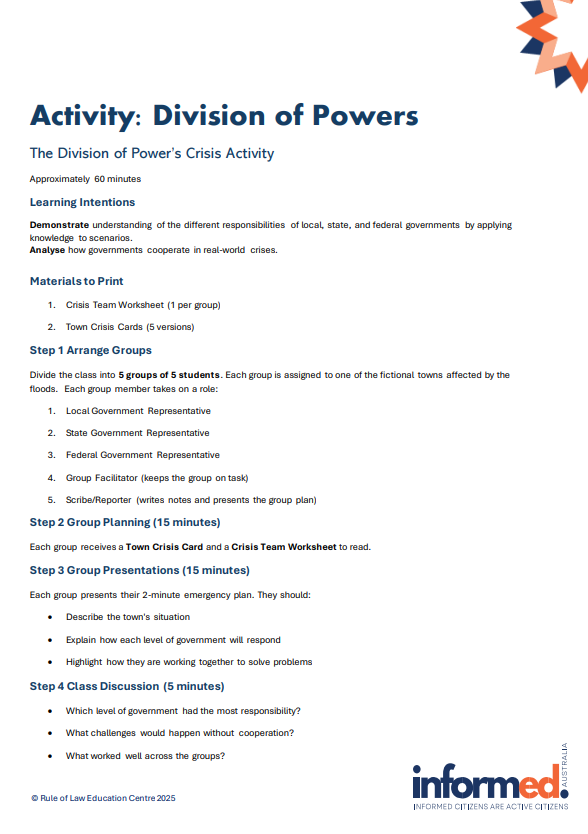
The Division of Powers Crisis Activity
Approximately 60 minutes
Learning Intentions
Demonstrate understanding of the different responsibilities of local, state, and federal governments by applying knowledge to scenarios.
Analyse how governments cooperate in real‑world crises.
Materials to Print
Crisis Team Worksheet (1 per group)
Town Crisis Cards (5 versions)
Step 1 – Arrange Groups
Divide the class into 5 groups of 5 students. Each group is assigned to one of the fictional towns affected by the floods. Each group member takes on a role:
Local Government Representative
State Government Representative
Federal Government Representative
Group Facilitator
Scribe/Reporter
Step 2 – Group Planning (15 minutes)
Each group receives a Town Crisis Card and a Crisis Team Worksheet to read.
Step 3 – Group Presentations (15 minutes)
Each group presents a 2‑minute emergency plan. They should:
Describe the town’s situation
Explain how each level of government will respond
Highlight how they are working together to solve problems
Step 4 – Class Discussion (5 minutes)
Which level of government had the most responsibility?
What challenges would happen without cooperation?
What worked well across the groups?
Team Crisis Worksheet
Government Powers Quick Guide
Federal Government:
National funding and grants
Defence Force deployment
Centrelink and emergency payments
State Government:
Police, ambulance, fire, SES
Hospitals and schools
Declaring states of emergency
Local Government:
Local roads and waste
Emergency accommodation (community centres)
Local volunteers and communication
The Main Scenario
In July 2025, an unprecedented weather system brings a week of continuous torrential rain to regional Australia. Rivers burst their banks, and flash floods sweep through several towns. Entire communities are isolated, roads are destroyed, power and phone services are down, and essential infrastructure like hospitals and evacuation centres are overwhelmed.
Five towns have been impacted: Kooravale, Marrinbar, Eagle's Crossing, Wirruna, and Dalmore Creek. Governments at all levels must urgently respond to save lives, protect infrastructure, encourage cooperation and assist with recovery.
Team Discussion Questions
Describe the situation in their town
Decide what each level of government can do
Choose 3 key actions (one from each level)
Identify one action requiring cooperation
Prepare a 2‑minute presentation explaining responsibilities and reasoning
Town Crisis Scenario
Cut up and hand out.
Group 1: Kooravale
Main hospital at capacity
Power out in 60% of town
Major bridges flooded
200 residents stuck at community sports centre
Group 2: Marrinbar
Entire town cut off
Food and fuel running out
School used as evacuation centre
Water treatment plant damaged
Group 3: Eagle’s Crossing
Aged care home underwater
Ambulance access blocked by landslides
Power station damaged
Emergency services stretched thin
Group 4: Kiruna
Rising floodwaters
No mobile coverage
Indigenous community needs evacuation support
Local council HQ inaccessible
Group 5: Dalmore Creek
Local government depot flooded
Public transport suspended
Road to nearest hospital blocked
SES overwhelmed by emergency calls
Related Resources
-
This fact sheet explains how power is shared across Australia’s three levels of government—Commonwealth, State/Territory and Local—under the federal system created by the Constitution. It outlines the Division of Powers in section 51, the responsibilities retained by the states, the role of local councils, and how High Court interpretation and Commonwealth funding have expanded federal influence. It highlights why dividing power matters for accountability, community responsiveness and protecting people from concentrated authority.
-
This explainer outlines Australia’s governance structures and how authority is organised across different institutions and levels of government. It explains how these structures distribute power, support accountability and help ensure decisions are made lawfully and in the public interest.
Explore Related Topics
-
The Separation of Powers
Explore resources on the separation of powers, explaining how separating power maintains checks on government through independent institutions, defined functions and accountability.
-
Federation of Australia
Explore resources on Federation, outlining how Australia became a nation, divided powers, and established the constitutional structures & democratic principles that govern today.
-
Checks and Balances on Power
Explore resources on checks and balances, explaining how oversight limits power and ensures decisions remain lawful and accountable through independent scrutiny, and transparent review processes.