
Charif Kazal
-
Mr Kazal has been found by NSW ICAC as guilty of corrupt conduct but was not criminally charged nor able to challenge the findings of ICAC.
It would be a mistake, to view this absence of prosecution as beneficial for Mr Kazal. Because there is no merits review of ICAC’s determinations, a criminal trial would have given him the opportunity to have the facts that led to the commission’s finding subjected to scrutiny. Instead, he has been labelled as corrupt and denied access to the one forum that could have determined conclusively whether he was in fact guilty of wrongdoing: a criminal trial. He has had his reputation damaged which impacts his family and his ability to conduct his family business.
The case of Mr Kazal shows that there needs to be some mechanism for those labelled as ‘corrupt’ by ICAC to test the findings in a court of law and some form of exoneration protocol introduced. -
In the 2015 case of Murray Kear, the Courts held that the corruption findings against Mr Kear were wrong. This finding however, did not remove the corruption findings made by NSW ICAC.
Charif Kazal and Human Rights breaches
Overview
This case is an example of where an Anti-Corruption Commission makes a Corrupt finding, but there are no criminal proceedings. It considers the impact on those who have these findings made against them.
Procedural History of Charif Kazal
a. ICAC makes finding of Corrupt Conduct
On Friday 16 December 2011, NSW ICAC published the following findings:
ICAC FINDINGS
The ICAC has found that Andrew Kelly and Charif Kazal engaged in corrupt conduct.
ICAC RECOMMENDATIONS
The ICAC is of the opinion that the advice of the DPP should be sought with respect to the prosecution of Mr Kazal for an offence under the Independent Commission Against Corruption Act 1988 of giving false evidence to the Commission that he never intended to settle Mr Kelly’s accommodation account for the May 2007 trip.
ICAC’s basis of its finding of corrupt conduct was that Mr Kazal conduct was intended to influence or could constitute a criminal offence (‘the could test‘). As a result, Mr Kazal was declared ‘corrupt’ by ICAC not because a court found he had broken a law, but because ICAC decided he ‘could‘ have broken a law.
b. DPP decides to not commence proceedings for Criminal Offence
ICAC sought the advice of the DPP as to whether Mr Kazal should be criminally prosecuted. On 28 August 2012 the Solicitor for Public Prosecutions advised ICAC:
“that the DPP considers there was insufficient evidence against Andrew Kelly and Charif Kazal to commence proceedings for any criminal offence.”
c. Mr Kazal challenges the Jurisdictional Validity of ICAC findings at NSW Supreme Court
In 2013, Mr Kazal challenged the jurisdictional validity at the NSW Supreme Court and the Supreme Court found that the ICAC finding fell within its jurisdiction.
d. Inspector of ICAC views Mr Kazal’s case and calls for Exoneration Process
One check on the exercise of the power of NSW ICAC is the Inspector of ICAC.
As outlined on the NSW Government’s website:
The Inspector of the Independent Commission Against Corruption (the ICAC) is an independent statutory officer whose role and functions is to hold the ICAC accountable in the way it carries out its function.
In the extensive report by John Nicholson SC, Acting Inspector ICAC: Report by the Office of the Inspector of the Independent Commission Against Corruption on complaints by Andrew Kelly, Charif Kazal and Jamie Brown, tabled in the NSW parliament, June 29, 2017 Nicholson stated:
The consequence of that course, is that Charif Kazal will never have the opportunity to clear his name.
That finding [of corruption] having been made, however, leaves Charif Kazal with a stain upon his honour, reputation and his right to be considered as a person of good character with no means at law of being able to retrieve or recapture those qualities through recourse to the law or to have the findings of the Commission expunged from the records of ICAC and its publishings on the internet. It has impacted upon his presumption of innocence.
Nicholson’s report stated:
It offends the populous sense of the “fair-go” if a label of corrupt conduct can be place incorrectly upon a person without any real chance of him or her having the label reviewed. Even those convicted of corrupt dealings, and indeed those who have had their appeals finalised, still have mechanisms for having their innocence restored to them should it be the case that they are able to mount a compelling case that they are in fact innocent of a crime.
Nicholson shows he believes it is futile to complain to the office of ICAC’s independent inspector under provisions of the ICAC Act in an attempt to rectify an incorrect finding by ICAC.
Exhaustion of domestic remedies for justice
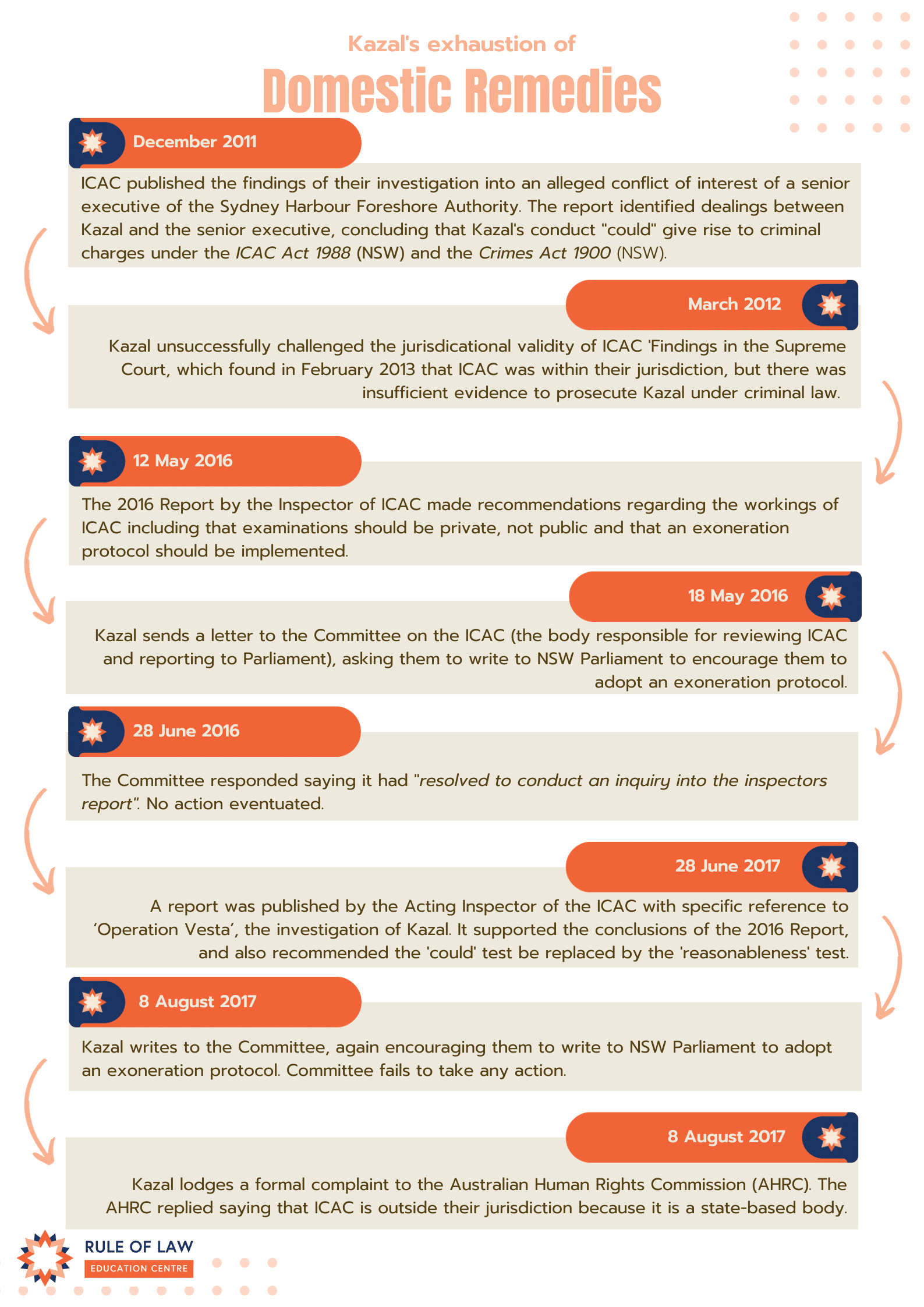
As seen above and in the attached infographic, Mr Kazal tried every avenue within the Australian justice system to test the ‘corrupt’ finding made by ICAC.
No exoneration or ability to review the finding of ICAC was available.
Complaint made to the ICCPR for breaches in human rights
The final check on the power that ICAC is the United Nation Human Rights Committee.
On February 2022, Mr Kazal brought his complaint to the ICCPR UN Human Rights Committee.
138 Session (26 June 2023 – 26 July 2023) in late November 2023 released its findings regarding Mr Kazals complaint. It found that certain procedures at ICAC violated international human rights and the committee ruled that the federal government should compensate Mr Kazal and prevent similar violations. The report stated:
“ . . . the inquiry conducted by ICAC, and its adverse public findings made against [Kazal] which he could not challenge, amounted to a violation of [Kazal’s] rights under Article 17 of the Covenant”
The absence of reasons for ICAC’s decisions to hold a public hearing and make its findings public amounted to an arbitrary interference in Mr Kazal’s right to privacy.
It should be noted that the views of the UN Human Rights Committee are not legally binding and the federal government cannot be forced to live up to its treaty obligations. Stay tuned to see if our government is serious about resolving human right breaches when they are raised and whether they take steps to protect Australians.
Final Comments regarding Mr Kazal’s Case
Mr Kazal has been found by NSW ICAC as guilty of corrupt conduct but was not criminally charged nor able to challenge the findings of ICAC.
It would be a mistake, to view this absence of prosecution as beneficial for Mr Kazal. Because there is no merits review of ICAC’s determinations, a criminal trial would have given him the opportunity to have the facts that led to the commission’s finding subjected to scrutiny. Instead, he has been labelled as corrupt and denied access to the one forum that could have determined conclusively whether he was in fact guilty of wrongdoing: a criminal trial. He has had his reputation damaged which impacts his family and his ability to conduct his family business.
The case of Mr Kazal shows that there needs to be some mechanism for those labelled as ‘corrupt’ by ICAC to test the findings in a court of law and some form of exoneration protocol introduced.
Related Resources
-
This explainer outlines what Royal Commissions are, how they operate and why governments use them to investigate major issues. It explains their powers, independence, terms of reference, how they differ from courts, and why they are considered inquiries of last resort. It also explores recent calls for a Federal Royal Commission and how these inquiries strengthen public confidence and the rule of law.
-
Explains how checks and balances operate within Australia’s system of government to limit the concentration of power and ensure accountability. Highlights the roles of Parliament, the Executive, and the Judiciary in scrutinising each other’s actions, preventing abuses of authority, and upholding the rule of law.
-
Statutory anti‑corruption bodies operate independently of the three branches of government to strengthen accountability. Their broad investigative powers help address corruption but can risk breaching rights such as procedural fairness and the presumption of innocence, creating tension between effective oversight and individual human rights protections.
Explore Related Topics
-
Royal Commissions
Explore resources on Royal Commissions, outlining how these inquiries investigate major issues, and drive transparency, accountability and reform through independent processes, public hearings and detailed final reports.
-
Checks and Balances on Power
Explore resources on checks and balances, explaining how oversight limits power and ensures decisions remain lawful and accountable through independent scrutiny and transparent review processes.
-
Democracy
Explore resources on democracy, highlighting how accountability and representative institutions ensure power is exercised fairly and transparently through open processes, civic engagement and responsible governance.