
Civics and Citizenship
-
This explainer examines the claims made by ‘sovereign citizens’—individuals who argue they are not bound by Australian law—and shows how courts across Australia have consistently rejected these arguments. It outlines common claims about personal sovereignty, consent to laws and the Magna Carta, explains why these arguments conflict with the rule of law, and uses real cases to demonstrate how courts uphold parliamentary authority, legal certainty and equality before the law.
-
A structured overview of the 2017–18 dual citizenship controversy and the High Court’s interpretation of Section 44(i). It explains why dual citizens cannot sit in federal parliament, how the Court has defined “foreign power,” and the implications of landmark cases such as Sykes v Cleary, Sue v Hill, and Re Canavan. The summary highlights the tension between modern mobility and constitutional safeguards designed to protect parliamentary integrity and undivided allegiance.
-
A practical guide to the formal and informal roles citizens play in sustaining Australia’s democratic system. It explains how participation—through voting, jury service, civic engagement, and everyday respectful behaviour—protects democratic stability and prevents authoritarianism. The resource traces the development of voting rights, emphasises the role of juries as community decision‑makers, and connects rights with responsibilities essential to a healthy civic culture.
-
A comprehensive introduction to the knowledge, skills and values students need to participate confidently in Australia’s democracy. It explains the difference between civics and citizenship, the role of the Constitution, democratic beliefs, and the institutions that uphold the rule of law. The resource highlights how rights, responsibilities, historical perspectives and active engagement work together to maintain a fair, safe and accountable society.
-
A clear explanation of what rights are, how they are protected, and why every right carries a corresponding responsibility. It distinguishes between positive and negative rights, individual and collective rights, and shows how responsibilities ensure fairness and prevent harm. Through practical examples—such as education and freedom of speech—the resource demonstrates how balancing rights with responsibilities supports equality, safety and respectful communities.
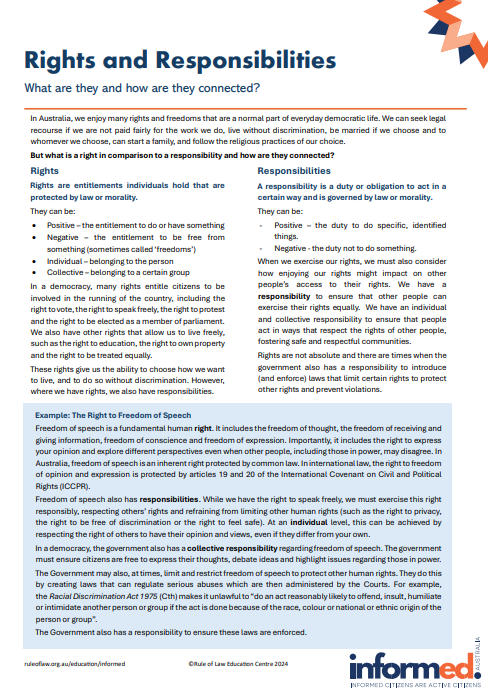
Rights and Responsibilities
What are they and how are they connected?
In Australia, we enjoy many rights and freedoms.
We can go to school, travel to other states for holidays, have access to clean water to drink and play with friends. We can seek legal recourse if we are not paid fairly for the work we do, live without discrimination, be married if we choose and to whomever we choose, can start a family, and follow the religious practices of our choice.
But what is a right in comparison to a responsibility and how are they connected?
Rights
Rights are entitlements individuals hold that are protected by law or morality and society’s expectations.
They can be:
Positive – the entitlement to do or have something
Negative – the entitlement to be free from something (sometimes called ‘freedoms’)
Individual – belonging to the person
Collective – belonging to a certain group
In a democracy, many rights entitle citizens to be involved in the running of the country, including the right to vote, the right to speak freely, the right to protest and the right to be elected as a member of parliament. We also have other rights that allow us to live freely, such as the right to education, the right to own property and the right to be treated equally.
These rights give us the ability to choose how we want to live, and to do so without discrimination. However, where we have rights, we also have responsibilities.
Responsibilities
A responsibility is a duty or obligation to act in a certain way and is governed by law or morality.
They can be:
Positive – the duty to do specific, identified things.
Negative – the duty not to do something.
When we exercise our rights, we must also consider how enjoying our rights might impact on other people’s access to their rights. We have a responsibility to ensure that other people can exercise their rights equally. We have an individual and collective responsibility to ensure that people act in ways that respect the rights of other people, fostering safe and respectful communities.
Rights are not absolute and there are times when the government also has a responsibility to introduce (and enforce) laws that limit certain rights to protect other rights and prevent violations.
Example: The Right to Freedom of Speech
Freedom of speech is a fundamental human right. It includes the freedom of thought, the freedom of receiving and giving information, freedom of conscience and freedom of expression. Importantly, it includes the right to express your opinion and explore different perspectives even when other people, including those in power, may disagree. In Australia, freedom of speech is an inherent right protected by common law. In international law, the right to freedom of opinion and expression is protected by articles 19 and 20 of the International Covenant on Civil and Political Rights (ICCPR).
Freedom of speech also has responsibilities. While we have the right to speak freely, we must exercise this right responsibly, respecting others’ rights and refraining from limiting other human rights (such as the right to privacy, the right to be free of discrimination or the right to feel safe). At an individual level, this can be achieved by respecting the right of others to have their opinion and views, even if they differ from your own.
In a democracy, the government also has a collective responsibility regarding freedom of speech. The government must ensure citizens are free to express their thoughts, debate ideas and highlight issues regarding those in power.
The Government may also, at times, limit and restrict freedom of speech to protect other human rights. They do this by creating laws that can regulate serious abuses which are then administered by the Courts. For example, the Racial Discrimination Act 1975 (Cth) makes it unlawful to “do an act reasonably likely to offend, insult, humiliate or intimidate another person or group if the act is done because of the race, colour or national or ethnic origin of the person or group”.
The Government also has a responsibility to ensure these laws are enforced.
Related Resources
-
This activity explores how misinformation, disinformation and fake news affect democratic decision‑making. Students compare historical and modern examples of false information, examine its impact on citizen judgement and government accountability, and analyse how emerging technologies make it harder to distinguish credible news.
-
This PowerPoint introduces students to the difference between rights and responsibilities and explains how they work together in a democratic society. It outlines what rights are, how they are protected in Australia, and why every right has a corresponding responsibility. Through clear examples and discussion prompts, students explore how exercising their rights affects others, how responsibilities support fairness and respect, and how Australia’s legal system protects key freedoms.
-
This fact sheet explains how rights and responsibilities work together, using freedom of speech as a case example. It outlines different types of rights, why rights are not absolute, and how responsibilities ensure everyone can exercise their freedoms safely and equally. The resource shows how Australian law protects freedom of expression while allowing limits—such as anti‑discrimination laws—to prevent harm and uphold the rights of others.
Explore Related Topics
-
Human Rights
Explore resources on human rights, outlining key protections, legal frameworks, and how rights are balanced against government power in through constitutional principles, legislative safeguards and rule‑of‑law accountability.
-
Aboriginal & Torres Strait Islanders
Explore our resources on Aboriginal and Torres Strait Islander peoples, outlining legal history, cultural traditions, land rights, and contemporary justice issues in Australia.
-
Democracy
Explore resources on democracy, highlighting how accountability and representative institutions ensure power is exercised fairly and transparently through open processes, civic engagement and responsible governance.