
Aboriginal and Torres Strait Islander People
-
This activity helps students explore pluralism and why democratic societies protect a diversity of beliefs, values and identities. It guides learners to identify examples of pluralism, examine how laws support peaceful coexistence and understand how respecting difference strengthens equality, participation and the rule of law.
-
Reflection Activity designed as part of the Informed Civics Competition where students draw on the blank card what they have learned about the concept of plurality.
-
Investigate how the Supreme Court of NSW applied English law to Aboriginal peoples and how legal approaches have changed over time. Through source analysis, historical case studies, and modern High Court decisions, students examine continuity and change in governance structures, the rule of law, judicial independence, and the recognition of Aboriginal rights and customs.
Continuity and Change in NSW
The Supreme Court and the Application of English Law to Aboriginal Peoples
Cultural Warning: Members of Aboriginal and Torres Strait Islander communities are advised that this resource contains the names of people who have passed away.
Curriculum Link:
History 7-10, Depth Study (core) – Australia: making a nation – from Federation to WWI (1889- c. 1919)
Continuity and change of NSW governance structure
Supreme Court of NSW including the legacy of Sir Francis Forbes
Learning Objectives
By completing these activities, you will:
Distinguish between continuity in NSW governance structures, particularly the Supreme Court of NSW, and change in the laws applied by the Court.
Explain how principles such as the rule of law and judicial independence have continued throughout the Supreme Court's history.
Investigate the role of Sir Francis Forbes in establishing and protecting the rule of law in New South Wales.
Analyse how court decisions and legal developments changed the recognition and treatment of Aboriginal people over time.
Use primary and secondary sources to identify and explain continuity and change in NSW's governance and legal systems.
Inquiry Question
How has the Supreme Court of NSW continued its common law legal heritage and structures over time, while the law has changed to recognise and protect Aboriginal people?
Continuity and Change in the Supreme Court of NSW
Continuity: The Institution
The Supreme Court of NSW was established on 17 May 1824 and has operated continuously ever since.
Throughout its history, the Court has continued to draw on the English common law tradition, including the rule of law, an independent judiciary, procedural fairness, and the use of precedent.
At Federation in 1901, the Supreme Court of NSW continued to operate, but the newly established High Court of Australia became Australia's final court of appeal.
Change: The Law
While the institution and principles have remained largely unchanged, the law it applies has evolved.
One example of legal change can be seen in court decisions involving Aboriginal people. In R v Ballard (1829), the Supreme Court recognised that Aboriginal people were governed by their own laws and customs and chose not to apply English law to a dispute between Aboriginal people. In R v Murrell (1836), the Court also acknowledged the existence of Aboriginal laws and customs but reached a different conclusion, holding that English law applied to everyone within the colony.
Another example of legal change occurred in Mabo (No 2) (1992), in which the High Court formally recognised the land rights of Aboriginal people.
Introduction
When the Supreme Court of NSW was established, its role seemed straightforward: to apply British law in the colony where applicable. In practice, however, this was much more complicated.
Aboriginal people had lived on this land for thousands of years and were governed by their own laws, customs and systems of authority. The establishment of New South Wales introduced a new legal system based on English law.
This raised important questions for the new Supreme Court. When people from different legal traditions came into conflict, whose law applied?
The Court needed to decide:
Did English law apply when a colonist was accused of harming an Aboriginal person?
Did English law apply when an Aboriginal person was accused of harming a colonist?
Did English law apply when an Aboriginal person was accused of harming another Aboriginal person?
The answers to these questions reveal both continuity and change: continuity in the Supreme Court's role as an independent guardian of the rule of law, and change in the way the law recognised and responded to Aboriginal people.
“It [The New South Wales Supreme Court] has been a constant guardian in changing times.” - Chief Justice Bell
Source Documents
This worksheet contains three activities, each based on a different source document and designed to help students investigate continuity and change in the Supreme Court of NSW.
Activity 1 uses the Supreme Court of NSW History Wall:
www.supremecourt.gallery/history-wall/
To mark its bicentenary in 2024, the Supreme Court of NSW launched the History Wall, a permanent exhibition exploring the Court's 200-year history. Available both at the Court and online, it highlights significant events, people and decisions that have shaped the Court over time.
Activity 2 uses Governor Arthur's Proclamation to the Aboriginal People:
www.sl.nsw.gov.au/stories/governor-arthurs-proclamation-aborigines
This historical proclamation provides insight into British attempts to establish the rule of law in colonial Australia and the relationship between Aboriginal peoples and the colonial legal system.
Activity 3 uses judgments from early court decisions.
These judgments allow students to examine how judges applied the law in the early colony and how legal approaches to Aboriginal people developed over time.
Activity 1: The Foundations of NSW Governance
Introducing the Supreme Court History Wall
In this activity, you will use the online History Wall to investigate the history of the Supreme Court of NSW. You will explore how the Court's role has changed over time and identify important principles, such as the rule of law and judicial independence (freedom from government influence), that were established early in the Court's history and continue today.
Fill-in-the-blanks
Instructions: Use the Colonisation and Conflict (Pre‑1850) page of the Supreme Court History Wall to complete the fill‑in‑the‑blanks activity below: https://www.supremecourt.gallery/history-wall/colonisation-and-conflict
Word Bank: emancipated · Macquarie · First Fleet · share · Jeffery Bent · appointed · legal · Charter of Justice · John Macarthur · two · growth · Bent · Charter of Justice · Reverend Samuel Marsden · military officers · aristocracy · soft · convict labour · Exclusives · offspring · overturned
1820's The Early Courts
English law arrived with the ___________ in 1788. The First _______________ (1787) established a civil court and a court of criminal jurisdiction, headed by a deputy judge-advocate and six _____________, many of whom had no _________ training. The Second ______________ (1814) created three new civil courts, including the Supreme Court of Civil Judicature. The colony’s first judge was Judge _____________, whom one historian described as ‘vain, pretentious, insolent and un-conciliatory’. ___________ refused to allow former convicts to appear as solicitors and heard no cases at all for ___________ years. He clashed frequently with Governor ____________, who wrote that ‘the highest law officer in the colony is the root of every faction and cabal that takes place in the colony’.
1800's Convicts, Emancipists, and Exclusives
Governor Lachlan Macquarie _____________ many convicts and ___________ them to positions in all spheres of life, including the law and medicine. Some of Macquarie’s pardons were ___________, but that did not halt the ___________ of an increasingly assertive class of freed convicts and their native-born ___________. Opposing Macquarie were the ___________; retired officers, free settlers like the _______________________________, and wealthy pastoralists like ______________. The Exclusives had the pretensions of a landed ___________, based on a reliable supply of assigned ____________. The British Government came to ___________ the Exclusives’ dismay that Macquarie was ___________ on convicts.
Research Questions
The first criminal and civil cases heard in the colony provide insights into the early development of the Supreme Court and the justice system. As you investigate these cases, look for evidence of principles such as the rule of law, access to justice, and judicial independence (freedom from government influence). Using the linked case brief and your own research, complete the table below:
R v Barsby (1788) (criminal case)
Cable v Sinclair (1788) (civil case) https://www.ruleoflaw.org.au/case-note-cable-v-sinclair-kable#resource
| Criminal Case | Civil Case | |
|---|---|---|
| Parties – Who was involved in the case? | ||
| Offence – What was the person accused of doing? | ||
| When was the case heard by the court? | ||
| Finding – What did the court decide? |
Why did the British Government believe courts needed to be established in the new colony?
What were the advantages and disadvantages of having military officers, who had experience in discipline and leadership but no formal legal training, responsible for running courts?
Why did Governor Macquarie emancipate convicts and appoint them to positions within the colony?
Why was it important for convicts and emancipated convicts to be able to participate in the court system?
What do the first criminal and civil cases reveal about the development of the rule of law, access to justice, or judicial independence in early New South Wales?
Fill-in-the-blanks
Instructions: Use the Colonisation and Conflict (Pre‑1850) page of the Supreme Court History Wall to complete the fill‑in‑the‑blanks activity below: https://www.supremecourt.gallery/history-wall/colonisation-and-conflict
Word Bank: 17 May 1824 · authority · antipodean · Newfoundland · prosper · Legislative Council · 8 November 1841 · Francis Forbes · inaugural Chief Justice · Van Diemen’s Land · New South Wales Act 1823 · conflict · knighted · health · New South Wales Act 1823 · veto · Chief Justice · Legislative Council · renowned · member · repugnant · renowned · Darling · British Government · John Bigge · incompatible · review · Supreme Court · Charter of Justice · Imperial Parliament
The Third Charter of Justice
By the 1820s New South Wales had begun to ________, but to the ________________ this was ___________ with the colony’s function as an __________ prison; ‘an object of real terror.’ On 5 January 1819 Commissioner ___________ was appointed to ________ the colony’s affairs. His third report, Inquiry on the Judicial Establishments of New South Wales and _____________________, recommended forming a ______________ and a ______________. The ______________ passed the _________________. The Third ______________ reached Sydney and was proclaimed with the opening of the Supreme Court on ______________.
Sir Francis Forbes (1823-1837)
______________ was called to the English Bar in 1812 and served as ______________ of ______________ from 1816 to 1822. While on leave in London in 1822, he helped the Colonial Office to draft the ____________________________ and accepted an appointment as the ____________________________ of the new Supreme Court. Under the Act, Forbes was also a ______________ of the ______________, and had ______________ to declare draft legislation to be ______________ to the laws of England – effectively a ______________. This was destined to mire him in political controversy. Nowhere was this more pronounced than in his ______________ with Governor ______________ over revocable licensing provisions of the Newspaper Regulating Act. Forbes was ______________ for his pragmatism and even temperament, but his heavy workload and incessant conflicts with Darling and others caused his ______________ to suffer. Forbes was ______________ in April 1837 and retired on 1 July 1837. He died on ______________ at Leitrim Lodge in Newtown, Sydney.
Research Questions
Who was the first Chief Justice of the NSW Supreme Court? Who did he have conflict with during his time as Chief Justice?
Watch the video Checks and Balances: The Story of Francis Forbes and Governor Darling. Explain how an independent judge, free from the influence of the Governor or government, can help protect the rights and freedoms of people in the community. https://www.ruleoflaw.org.au/digital-media-video-story-telling-of-checks-and-balances-and-establishement-of-nsw-supreme-court#resource.
Analyse how the First, Second and Third Charters of Justice changed the governance and legal structures of New South Wales. In your answer, explain how the principles of equality before the law (including for convicts), the rule of law (that no one is above the law), and an independent judiciary continued throughout these changes.
Fill-in-the-blanks
Instructions: Use the Colonisation and Conflict (Pre‑1850) page of the Supreme Court History Wall to complete the fill‑in‑the‑blanks activity below: https://www.supremecourt.gallery/history-wall/colonisation-and-conflict
Word Bank: wool · guerrilla warfare · Bathurst · repealed · Great Dividing Range · wealth · martial law · white pastoralists · Wiradjuri · reprisal raids
1824 Frontier War & Martial Law
By the early 1820s, exports of ___________ to Britain began to generate immense ___________. Land west of the ________________ was granted to _______________ with no recognition or regard for the traditional rights of Aboriginal people. Between 1820 and 1824, the white population increased tenfold in the ___________ region, from 114 to 1,267. There, conflict between settlers and the ___________ people escalated and on 14 August 1824 Governor Brisbane declared _____________. Aboriginal leader Windradyne led his warriors in a ______________ campaign, attacking isolated farms. Settlers responded with mounted ______________ and mass poisonings until martial law was ___________ on 11 December 1824.
“[P]rotection from arbitrariness requires a government with a monopoly over the imposition of force, and in the early years of settlement in New South Wales there was no such government much beyond the limits of Sydney. Thus on the relentlessly expanding frontier, restrictions on the use of force by settlers (and natives) were not enforced, and given the nature of white settlement could not have been. Settlers were often isolated, frightened and, in the nature of things, on the make. And what they were intent on making, pastoral success, involved them in taking Aborigines’ land, water holes, killing their game as pests, killing them, too, for a variety of reasons.” - Martin Krygier, ‘False Dichotomies, True Perplexities, and the Rule of Law’, pg 20.
Research Questions
What challenges arise when settlement expands faster than governments can enforce the law?
Complete the SWOT analysis by considering the advantages and disadvantages of applying British law across the colony, including in remote areas and Aboriginal and Torres Strait Islander communities.

Activity 2: Equality before the law
In this activity, you will analyse Governor Arthur's Proclamation to the Aboriginal People. The proclamation presented Aboriginal people and colonists as equally protected by British law and equally responsible for obeying it. As you examine the source, consider why colonial governments promoted this message and whether the principle of equality before the law was always achieved in practice.
Source Questions
Looking at Governor George Arthur’s Proclamation, fill in the table below.
*Note that this proclamation was issued in Van Diemen's Land (Tasmania), not NSW.
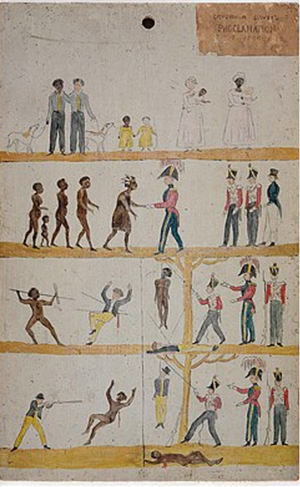
| Observation | What does this show about equality before the law? |
|---|---|
| The top panel shows... | |
| The second panel shows... | |
| The lower two panels show... |
Source: https://www.sl.nsw.gov.au/stories/governor-arthurs-proclamation-aborigines
Research Questions
Why might this message have been important in the colony?
If Aboriginal people were considered equal before the law and entitled to its protection, should English law also have applied to disputes between themselves and within their own communities? Explain your reasoning.
The Proclamation shows the law treating colonists and Aboriginal people equally. Do you think this always happened in practice? Use evidence to explain your answer.
Activity 3: Equality Before the Law and Aboriginal Laws and Customs
Activities 1 and 2 explored the development of the Supreme Court and the idea that all people were entitled to the protection of the law. In this activity, you will investigate how the courts applied these principles in practice.
The early Supreme Court judges faced a difficult challenge. Aboriginal people had their own laws, customs and systems of authority. At the same time, colonial governments claimed that British law applied throughout the colony and should protect all people within it. Before deciding whether a person was guilty or not guilty, the Court first had to decide whether it had the legal authority to hear the case. This legal authority is called jurisdiction.
The cases in this activity show how courts attempted to balance these competing ideas. As you examine each case, identify what remained the same about the Court and its role (continuity) and what changed in the way judges interpreted and applied the law (change).
| Case | R v Lowe (1827) https://trove.nla.gov.au/newspaper/article/37071756/4249201 | ||||||||||||||||||||||||||||||||||||||||||||||||||||||||||||||||||||||
| Facts | Lieutenant Nathaniel Lowe was accused of ordering the killing of an Aboriginal man in his custody known as Jackey Jackey. He was charged with murder. | ||||||||||||||||||||||||||||||||||||||||||||||||||||||||||||||||||||||
| Legal Question | Did the Supreme Court have the authority (jurisdiction) to apply English criminal law to a dispute between an Aboriginal person and a colonist? | ||||||||||||||||||||||||||||||||||||||||||||||||||||||||||||||||||||||
| Court’s Decision |
The Court decided that Aboriginal people were entitled to the protection of English law when interacting with British colonists. As a result, English law applied to disputes and crimes involving both groups. Chief Justice Forbes stated: “[T]he individual charged is a person bearing his Majesty's Commission, and is an officer in the 40th regiment. He then is personally within the jurisdiction of this Court. The offence charged against him is that of having taken away the life of a native; now, this native must be considered, whatever be his denomination, a British subject. If not to be an alien friend...in any case he is entitled to lex loci” The Australian, 23 May 1827, pg3 Justice Stephen stated: “natives of this colony...[are]within the protection of the laws” The Australian, 23 May 1827, pg4 | ||||||||||||||||||||||||||||||||||||||||||||||||||||||||||||||||||||||
| Continuity/ Change |
Continuity (governance structures): The Supreme Court continued to apply the rule of law through an independent judiciary. The judges held that a British army officer was not above the law and independently decided that the Court could hear the case. Change (the law): The Court rejected the argument that English law did not apply and therefore recognised that Aboriginal people were entitled to the protection of English law when interacting with British colonists. | ||||||||||||||||||||||||||||||||||||||||||||||||||||||||||||||||||||||
| Outcome | After the trial,
Check your understanding about Ballard and Lowe cases
Check your understanding about Murrell’s case
Check Your Understanding on Change and Continuity
Further Reading
Assessment: Aboriginal Laws and Customs in Modern Australian Law
Using the cases above, complete the table below.
Related Resources
Explore Related Topics
|