
Human Rights
-
This activity helps students recognise key human rights concepts by locating important terms linked to the Universal Declaration of Human Rights. It reinforces foundational ideas such as equality, dignity, freedom and fairness, supporting classroom discussions about how rights are protected in Australia and why they matter under the rule of law.
-
This activity helps students explore how democratic principles and human rights work together in Australia’s system of government. Through guided questions and examples, students identify key rights, examine how they are protected, and consider why limits on power, accountability and equality before the law are essential in a democratic society.
-
This activity helps students identify key democratic freedoms—such as speech, association, religion and movement—and consider how they operate in everyday situations. Students analyse short scenarios, decide which freedoms are involved, and discuss why limits on rights must be reasonable, justified and consistent with the rule of law. The task builds understanding of how freedoms are protected in Australia and why responsible citizenship matters.
-
Reflection Activity designed as part of the Informed Civics Competition where students draw on the blank card what they have learned about the concept of freedoms.
Freedoms Reflection
Blank playing card visual reflection activity
Students use this blank playing card as a reflection tool to explore the concept of freedoms. Before drawing, students read the rule of law factsheet here. Designing the card helps students distil these ideas into a clear visual summary.
Students can submit this completed playing‑card drawing to the Informed Civics Competition for a chance to win!
See suggested drawing prompts below:
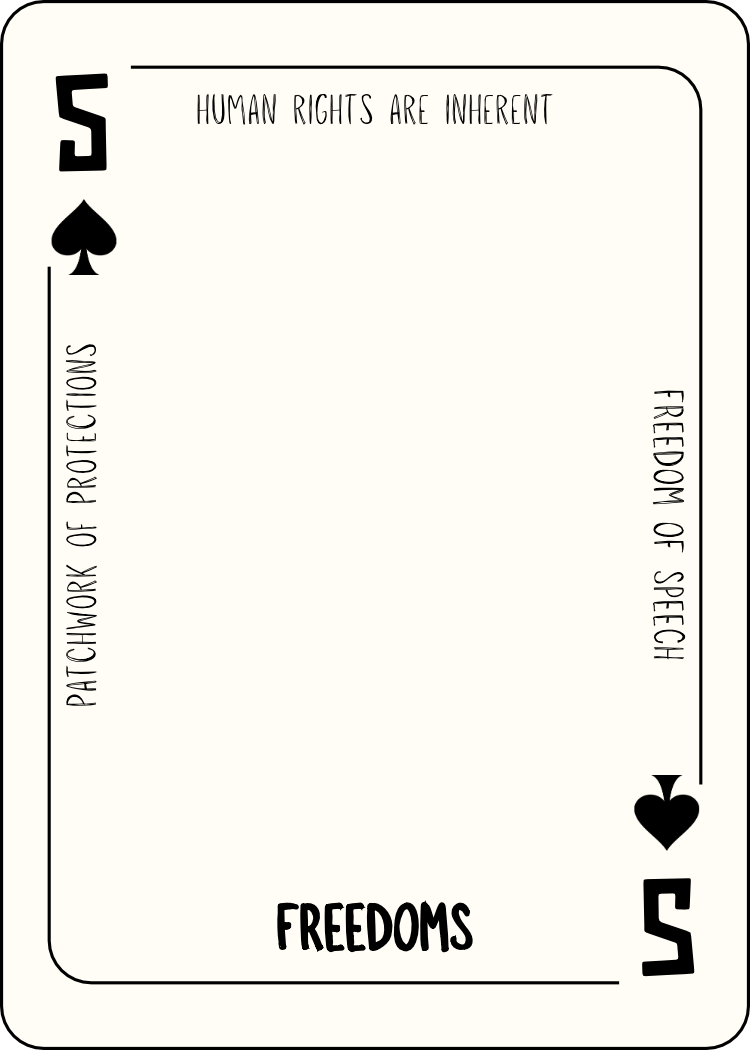
Suggested drawing prompt: Draw two people using their freedom at the same time. How do they make sure one person's freedom doesn't take away the other's?
Related Resources
-
This factsheet explains that human rights are inherent and inalienable, not granted by governments, and outlines how Australia protects these freedoms through a patchwork of constitutional, common law, statutory and international sources. It highlights key democratic freedoms—such as speech, religion and movement—alongside the need for fair, clearly justified limits that balance individual rights with community safety. The resource reinforces that enjoying rights also involves responsibilities, and that protecting freedoms depends on active citizenship and the rule of law.
-
This explainer outlines the main arguments for and against adopting a Charter of Rights in Australia. It summarises claims that a charter could strengthen rights protection, improve accountability and modernise the legal framework, alongside concerns that it may shift power to judges, create uncertainty, or weaken parliamentary responsibility. The page helps students compare both sides of the debate and understand how rights are currently protected under Australia’s legal system.
Explore Related Topics
-
Equality Before the Law
Explore resources on equality before the law, including the Lost Parcel story, showing how legal rules apply fairly to all people, strengthening fairness in everyday situations.
-
Presumption of Innocence
Explore resources on the presumption of innocence, showing how the burden of proof protects the accused and safeguards fairness in criminal justice.
-
Independent and Impartial Judiciary
Explore resources on an independent and impartial judiciary, including the history of the Supreme Court & its role in delivering justice & strengthening trust in the judiciary.