
Human Rights
-
This explainer examines whether Australia should adopt a National Charter of Rights, outlining how human rights are currently protected through the Constitution, legislation, common law, democratic institutions and the rule of law. It presents clear arguments for a Charter—such as improved accessibility, stronger accountability, enforceable remedies, minority protections and alignment with international obligations—and arguments against, including concerns about shifting power to courts, judicial value‑judgments, inconsistent interpretations, and the strength of Australia’s existing democratic safeguards. The resource also explores the historical reasons Australia does not have a Bill of Rights and explains why balancing rights is a core parliamentary function. Designed for civics and legal education, it provides a balanced, accessible overview of one of Australia’s most significant public debates.
-
This explainer outlines where human rights in Australia come from, showing how protections arise from the Constitution, legislation, common law and international obligations rather than a single bill of rights. It highlights key constitutional and common law rights, the role of courts in limiting government power, and how the rule of law underpins Australia’s system of rights protection.
-
This factsheet explains that human rights are inherent and inalienable, not granted by governments, and outlines how Australia protects these freedoms through a patchwork of constitutional, common law, statutory and international sources. It highlights key democratic freedoms—such as speech, religion and movement—alongside the need for fair, clearly justified limits that balance individual rights with community safety. The resource reinforces that enjoying rights also involves responsibilities, and that protecting freedoms depends on active citizenship and the rule of law.
-
This explainer brings together key Australian case studies showing how courts balance individual rights with community safety, legal limits and government power. It highlights how rights are protected through the Constitution, legislation and common law, and how judges apply rule‑of‑law principles when resolving conflicts between freedoms and lawful authority. The resource gives students clear, real‑world examples of how human rights operate in practice.
Should Australia have a National Charter of Rights?
Arguments for and against a Human Rights Act
Pre-Learning Questions
What do you think human rights are, and why do societies need rules or limits around them?
Who do you believe should make decisions about what rights and responsibilities exist in Australia?
Do you think Australia needs an overarching Charter of Rights, or are our current protections enough?
Introduction
Human rights are the rights, freedoms and protections that belong to every person simply because they are human. They include civil and political rights (such as freedom of speech, religion, movement and assembly) as well as other rights outlined in international instruments like the Universal Declaration of Human Rights, the International Covenant on Civil and Political Rights (ICCPR) and the International Covenant on Economic, Social and Cultural Rights (ICESCR).
Countries protect human rights in different ways, and one approach is to adopt a Charter or Bill of Rights. This model works well in some nations and less effectively in others, depending on their history, institutions, constitutional traditions, and social values.
So what is the best way for Australia to protect human rights?
Australia is unusual among comparable democracies because it does not have a national Charter or Bill of Rights. Instead, rights are protected through a patchwork of sources, including the Constitution, legislation, the common law, Parliament, the courts, and key democratic principles. Despite not having an overarching ‘human rights’ document, Australia has a strong track record of protecting and promoting human rights. According to Freedom House’s Global Freedom Index, Australia has a freedom rating of 94%, which is 13 higher than the United States and 2 higher than the United Kingdom.
To understand whether Australia should adopt a Charter of Rights, we need to examine how our current system works and explore the arguments for and against changing it.
How Are Human Rights Protected in Australia?
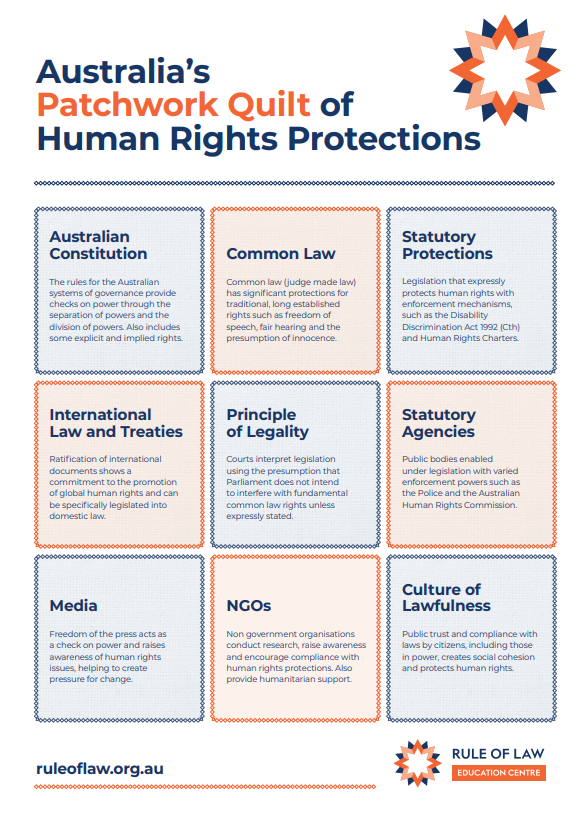
Human rights in Australia are protected through a combination of:
the Australian Constitution
federal and state legislation
the common law
courts and tribunals
statutory agencies like the police and the Australian Human Rights Commission
parliamentary debate & scrutiny processes
legal principles such as responsible government, separation of powers, the rule of law, and the principle of legality
the media/free press
a culture of lawfulness & respect for rights
The following section outlines the main arguments in support of introducing a Charter of Rights in Australia.
Arguments in Favour of an Australian Charter of Rights
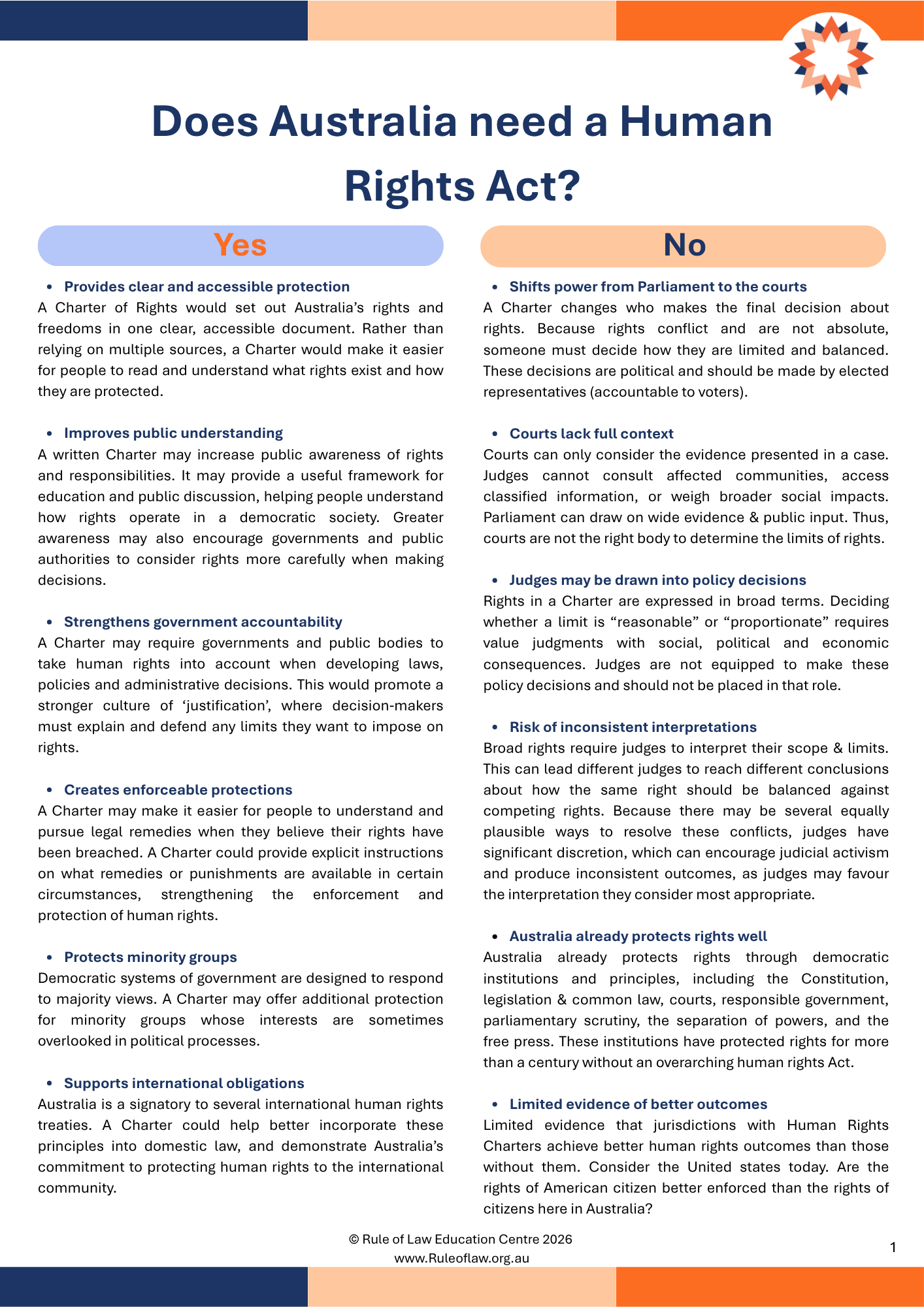
Provides clear and accessible protection
Supporters argue that a Charter of Rights would set out Australia’s rights and freedoms in one clear, accessible document. Instead of relying on multiple sources, a Charter would make it easier for people to read and understand what rights exist and how they are protected.
Improves public understanding
A written Charter can increase public awareness of rights and responsibilities. Supporters say it provides a useful framework for education and public discussion, helping people understand how rights operate in a democratic society. Greater awareness may also encourage governments and public authorities to consider rights more carefully when making decisions. The law being known and accessible is an important principle of the rule of law.
Strengthens government accountability
A Charter would require governments and public bodies to take human rights into account when developing laws, policies, and making administrative decisions. Supporters argue this would promote a stronger culture of justification and checks and balances, because decision‑makers would need to explain and defend any limits placed on rights.
Creates enforceable protections
A Charter may make it easier for people to understand and pursue legal remedies when they believe their rights have been breached. A Charter could provide explicit instructions on what remedies or punishments are available in certain circumstances. Supporters argue this strengthens the enforcement and protection of human rights.
Protects minority groups
Supporters note that democratic systems often respond to majority views. A Charter may offer additional protection for minority groups whose interests are sometimes overlooked in political processes.
Supports international obligations
Australia is a signatory to several international human rights treaties. Supporters argue that a Charter would help better incorporate these principles into domestic law, and demonstrate Australia’s commitment to protecting human rights to the international community.
The Human Rights Law Centre is a well known supporter. It summarises its argument as follows:
A Human Rights Act is:
Popular. Regular opinion polling between 2021 and 2023 shows three in four Australians support an Act.
Broad. It benefits everyone but is especially important for people whose rights are most at risk, such as Aboriginal & Torres Strait Islander peoples, children, people with disability, older people, and people in remote and regional areas.
Simple. It outlines what rights everyone in our community have and helps ensure governments and public servants factor them in when making decisions.
Effective. National Acts have been operating successfully in similar nations like the United Kingdom, New Zealand and Canada. At the state and territory level, Acts are operating successfully in Victoria, the ACT and Queensland. Evidence shows that Acts help governments to deliver better, more human-focused laws, policies & services.
Democratic. Australia is the only western liberal democracy in the world without a legislated Human Rights Act. Following a year-long inquiry, the Federal Parliamentary Joint Committee on Human Rights has recommended the Federal Government introduce an Act.
“Be careful what you wish for sometimes. Yes, it can be a great thing…I wouldn’t want a country that did not have a Bill of Rights. At the same time, that is not what protects the American people...Justice Scalia always said this, ‘North Korea and Russia have a longer, and many would argue a better Bill of Rights than most, but they are not governed by the Rule of Law. They are governed by dictatorial men, and what we have is the separation of powers, and that is what makes America unique. It is what makes Australia unique. It is these countries that really value the separation of powers. Because the checks and balances protect the ordinary citizen’”
Why Doesn't Australia Have a National Charter of Rights?
When drafting the Constitution in the 1890s, the framers considered whether to include a Charter or Bill of Rights. They looked to two models: the United States, where rights were constitutionally entrenched, and Britain, where rights were protected through Parliament, the common law and documents such as the 1215 Magna Carta and the 1689 Bill of Rights.
Ultimately, they decided an entrenched charter (i.e., writing rights into the Constitution) did not suit Australia’s democratic system. Instead, the Constitution focused on federal structures and limits on government power, leaving the protection of rights to Parliament, the courts and democratic processes. This blend of American federalism and British parliamentary traditions is known as the “Washminster” system.
The decision reflected the framers’ confidence in representative and responsible government. Unlike the United States, Australia did not emerge from a revolution, and the framers believed parliamentary accountability provided an effective safeguard against abuse of power. Ministers were accountable to Parliament and Parliament was accountable to voters (i.e., the people), who could remove governments at elections.
This approach underpins parliamentary sovereignty, the idea that elected representatives, rather than judges or monarchs, should determine how rights are defined, protected and balanced in Australia.
Why Rights Need to Be Balanced
Human rights are not absolute. Sometimes, one right can come into conflict with another right or with an important public interest. For example, freedom of speech may conflict with other rights, such as the right to safety, privacy, or reputation. While all these rights are important, reasonable limits must be placed on them to prevent one right from unfairly harming others.
Under Australia’s current system, Parliament is responsible for setting these limits through legislation. When making laws, Parliament can consider public consultation, expert advice, and national-security information to determine where a right should reasonably be limited. For example, Australian laws place limits on freedom of speech in areas such as defamation, vilification, threats, and incitement.
Courts then apply these laws when deciding individual cases. This creates a separation of powers where parliament sets the legal limits, and courts interpret and apply those laws to specific situations. This separation of responsibilities is a core feature of Australia’s democratic system.
Why a Charter Could Create Problems for the Courts
If Australia introduced a Charter of Rights it would change this structure. Charters typically express rights in broad, general terms, such as “every person has the right to freedom of expression. ” However, broad rights do not specify where the right ends or how competing interests should be balanced.
If Parliament does not define those limits in advance, judges must do so when disputes arise. Although courts often decide what is “reasonable” in the circumstances when applying legal standards such as beyond reasonable doubt or on the balance of probabilities, those tests are evidence‑based and confined to the facts of a single case. Determining the limits of broad human rights is different. It would require judges to make value judgements that involve social, political and economic considerations. These value judgments have traditionally been made by elected representatives not courts.
Courts also operate with important constraints:
they can only consider the evidence presented in a case
they cannot consult affected communities or access classified information
they are not accountable to voters
These limitations mean that judges may reach different conclusions about the same right, resulting in inconsistent interpretations of the law and making it difficult to know which interpretation of the law applies. This is contrary to the rule of law principle that the law is known, accessible, and not retrospective.
It also has the effect of shifting important policy decisions away from elected representatives and into the hands of unelected judges.
Why Parliament, Not the Courts?
A central argument against introducing a Charter of Rights is that parliament (not the courts) should get to decide how rights are limited and balanced in Australia.
Parliament’s role
Parliament is designed to make decisions with full context. When rights need to be limited or balanced, Parliament can draw on:
public consultation
input from affected communities
expert advice from agencies such as ASIO, police and health authorities
parliamentary scrutiny committees
open debate between elected representatives
As Parliament can access broad evidence and community views, it is able to weigh national security, social impacts, economic consequences and the interests of different groups. If Parliament gets the balance wrong, voters can hold it accountable at the next election. This democratic accountability is a core feature of Australia’s system under the rule of law.
Courts’ role
Courts play an essential role in interpreting and applying the law, but they are not designed to make broad policy judgments about how rights should be limited. Judges work within the confines of individual cases and:
can only consider the evidence presented in court
cannot consult affected communities or access classified information
cannot assess wider social or economic consequences
are not accountable to voters
As a result, their decisions are narrower in scope. Judges must decide cases based on the material before them, not the broader context Parliament considers. This is why determining the limits of rights (a task involving political, social and economic value judgments) has traditionally been the responsibility of elected representatives.
The following section summarises the arguments against introducing a Charter of Rights in Australia.
Arguments Against a Charter of Rights
Shifts power from Parliament to the courts
Opponents argue that a Charter changes who makes the final decisions about rights. Given that rights conflict and are not absolute, someone must decide how they are limited and balanced. Opponents believe these decisions are fundamentally political and should be made by elected representatives who are accountable to voters, not by judges.
Judges may be drawn into policy decisions
Rights in a Charter are expressed in broad terms. Deciding whether a limit is “reasonable” or “proportionate” often requires value judgments with social, political and economic consequences. Critics argue that judges are not equipped to make these broader policy decisions and should not be placed in that role.
Courts lack full context
Opponents emphasise that courts can only consider the evidence presented in a case. Judges cannot consult affected communities, access classified information, or weigh broader social impacts. Parliament, by contrast, can draw on wide evidence and public input. Critics argue that courts are therefore not the right body to determine the limits of rights.
Risk of inconsistent interpretations
As broad rights require judicial interpretation, different judges may reach opposing conclusions about the scope of the same right. This is because there may be multiple equally plausible interpretations of how competing rights should be balanced. Critics argue that this discretion can encourage judicial activism and produce inconsistent outcomes, allowing judges to favour the interpretation they consider preferable in a given case. In this sense, broad rights may shift significant policy decisions away from elected representatives and towards unelected judges.
Australia already protects rights well
Critics argue that Australia already protects rights through democratic institutions and principles, including the Constitution, legislation, the common law, courts, responsible government, parliamentary scrutiny, the separation of powers, and the free press. They note that these institutions have safeguarded rights for more than a century without a national Charter.
May alter Australia’s constitutional balance
Opponents argue that the framers deliberately chose not to include a Bill of Rights, relying instead on democratic institutions and legal principles. A Charter could shift the separation of powers by increasing the role of courts in resolving rights disputes.
Limited evidence of better outcomes
Some critics question whether jurisdictions with Human Rights Charters consistently achieve better human rights outcomes than those without them. They argue that strong democratic institutions, political accountability and respect for the rule of law may be just as effective (if not more) in protecting individual rights. Consider the United states today. Are the rights of American citizen necessarily better protected than the rights of citizens here in Australia?
Watch video of Circuit Judge, Amul Thapar, of the United States Court of Appeals for the Sixth Circuit discussing the effectiveness of a Bill of Rights here.
The experience of COVID-19 also raises questions about whether having a human rights charter necessarily leads to better outcomes. Victoria, for example, has its own Human Rights Act, yet during the pandemic, Victorians experienced some of the longest and most restrictive lockdowns in Australia. Opponents argue that such examples suggest the existence of a human rights charter does not, by itself, guarantee stronger protection of individual rights.
Conclusion
The debate about a Charter of Rights is ultimately about how human rights should be protected in Australia. Supporters believe a Charter would strengthen rights protection through clear rules, improved accountability and accessible, easy-to-understand remedies. Opponents argue that rights are best protected through democratic institutions and principles, and that elected representatives (not judges) should make the final decisions when rights come into conflict.
However, the strongest safeguard for human rights is often not the legal framework itself, but the way people choose to treat one another. When both government and the community value dignity, fairness and respect in practice, and are held accountable by the rule of law, then rights are genuinely protected.
Related Resources
-
This activity helps students identify key democratic freedoms—such as speech, association, religion and movement—and consider how they operate in everyday situations. Students analyse short scenarios, decide which freedoms are involved, and discuss why limits on rights must be reasonable, justified and consistent with the rule of law. The task builds understanding of how freedoms are protected in Australia and why responsible citizenship matters.
-
This poster illustrates how human rights in Australia are protected through a patchwork of sources rather than a single bill of rights. It highlights the role of the Constitution, legislation, common law and international obligations, showing how each contributes to safeguarding freedoms, limiting government power and upholding the rule of law. The visual layout reinforces that rights protection in Australia relies on multiple overlapping legal frameworks working together.
Curriculum Alignments
Commerce 7-10 (2027) NSW
Law in Action (option)
Human rights and law in Australia
The importance of human rights
The characteristics of human rights
How human rights are incorporated into Australian law
History 7-10 (2027) NSW
Depth study (core): human rights and freedoms
Background and origins of human rights and freedoms
The US civil rights movement and its influence on Australia
Legal studies 11-12 (2027) NSW
International relations and human rights (core)
The nature of human rights
The characteristics of human rights
The changing nature and developing recognition of human rights
Categories of human rights, including civil and political rights, economic, social and cultural rights, the right to self-determination, environmental rights and peace rights
Fundamental instruments for establishing human rights contained in the international Bill of human rights
The role of international human rights law in upholding the obligations of nation-states in emerging areas of human rights protection
Australian protection of human rights
Australia’s obligation to protect human rights through the Australian Constitution, and statute and common law
The function and importance of the Australian human rights commission
Debates over the need for a human rights framework in Australia
Explore Related Topics
-
Freedom of Speech
Explore resources on freedom of speech, outlining how it supports democratic debate, accountability, the protection of individual rights and a rule‑of‑law culture through open discussion, transparent limits and responsible civic participation.
-
Law is Known and Accessible
Explore resources on accessible law, highlighting why clear, public and open legal rules are essential for fairness and participation by enabling informed decision‑making and transparency.
-
Laws
Explore resources on laws, explaining how rules are created, interpreted and enforced to maintain order, protect rights and support a functioning society through clear processes, accountability and fair application.