
The Magna Carta
-
This classroom activity looks at legacies and how they shape society. It includes short questions on a video about the Magna Carta in Australia and then extends students to consider where the rights from Magna Carta can be seen in modern Human Rights documents today.
-
Simple starter activity to get students comfortable with terminology and concepts in the Magna Carta.
-
Looking for an easy lesson, try this colouring in story book that tells the story of the Magna Carta
-
Celebrate the sealing of the Magna Carta on 15th June by enjoying a lesson and activities about the Magna Carta.
-
What is equality before the law and what does the Magna Carta have to say about it. This resources gets students to consider how a King might act that reveals that the laws do not apply to him. It then considers equality before the law in the early colony of Australia with the first civil case of Susannah and Henry Kable.
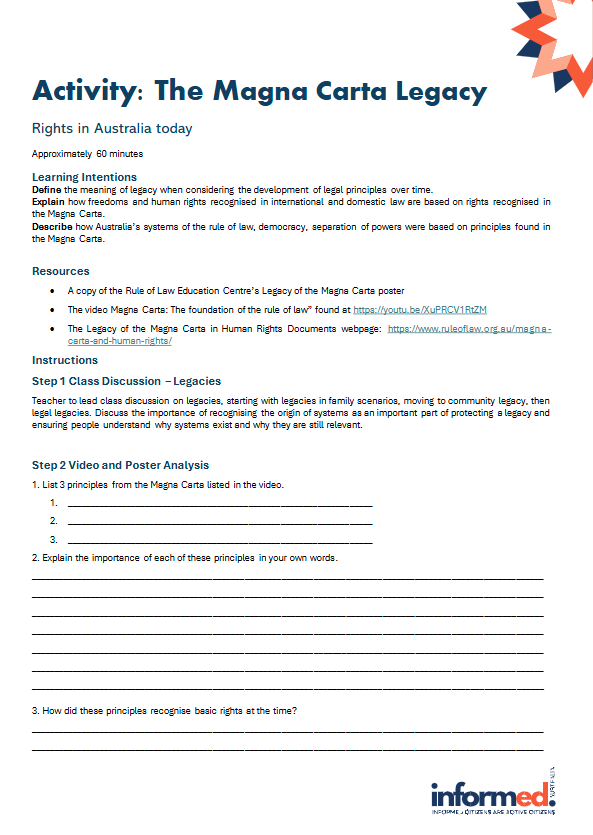
Activity: The Magna Carta Legacy
Rights in Australia today
Approximately 60 minutes
Learning Intentions
Define the meaning of legacy when considering the development of legal principles over time. Explain how freedoms and human rights recognised in international and domestic law are based on rights recognised in the Magna Carta. Describe how Australia’s systems of the rule of law, democracy, separation of powers were based on principles found in the Magna Carta.
Resources
A copy of the Rule of Law Education Centre’s Legacy of the Magna Carta poster
The video Magna Carta: The foundation of the rule of law
The Legacy of the Magna Carta in Human Rights Explainer
Instructions
Step 1 Class Discussion – Legacies
Teacher to lead class discussion on legacies, starting with legacies in family scenarios, moving to community legacy, then legal legacies. Discuss the importance of recognising the origin of systems as an important part of protecting a legacy and ensuring people understand why systems exist and why they are still relevant.
Step 2 Video and Poster Analysis
List 3 principles from the Magna Carta listed in the video.
Explain the importance of each of these principles in your own words.
How did these principles recognise basic rights at the time?
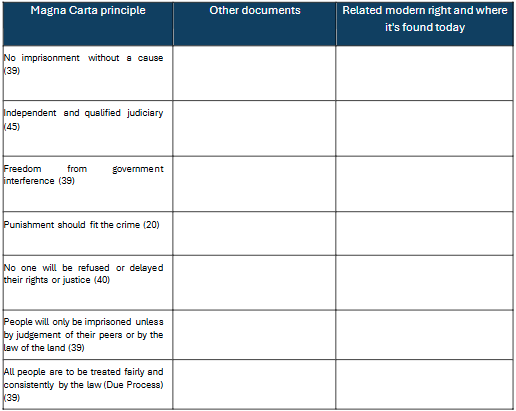
Step 3 Legacy Matching
For the principles listed in the table, use the Poster, the Magna Carta and Human Rights page and video to find:
Where that principle has appeared in other documents that have acted to protect rights over time (hint: they might appear in multiple documents); and
the modern right that recognises this principle and the human rights document it is found in.
Step 4 Scenario Task
State Governments have come together to make the decision to ban open courts from Monday to Thursday, meaning that no members of the public or press can attend to watch any trials on any of those days each week. If people arrive to watch, they will be arrested immediately and detained in prison until the court has time to hear their case. Bail is not available for this offence and court delays are currently anywhere between 6 and 12 months for a trial in the Local and Magistrates Courts across the states.
Identify 5 rights that are impacted by this decision.
Write your own Magna Carta clause to prevent this issue from escalating or happening again in the future.
Optional Extension:
Class debate
“The story of Magna Carta is a chapter in the continuing history of the struggle between power and freedom.” - Lord Irvine of Lairg
Related Resources
-
One page Fact Sheet summarising key concepts about the Magna Carta. Can be used as part of Informed Civics Competition. The Magna Carta introduced the concept of equality before the law, independent judiciary, checks and balances on power and judgement before your peers.
-
Celebrate the sealing of the Magna Carta on 15th June by enjoying a lesson and activities about the Magna Carta.
Explore Related Topics
-
What is the Rule of Law?
Explore resources explaining the rule of law, showing how a collection of principles works to limit government power and protect rights through clear rules, accountability and fairness.
-
Checks and Balances on Power
Explore resources on checks and balances, explaining how oversight limits power and ensures decisions remain lawful and accountable through independent scrutiny and transparent review processes.
-
Democracy
Explore resources on democracy, highlighting how accountability and representative institutions ensure power is exercised fairly and transparently through open processes, civic engagement and responsible governance.