
Law and Technology
-
This activity asks students to examine the COVIDSafe app as a case study in balancing public health tracking with individual rights, highlighting how increased surveillance must remain controlled, transparent and limited to prevent misuse while managing the spread of COVID‑19.
-
This activity guides students to analyse how media and social media influence the justice process, the Rule of Law and legal compliance. It uses juror‑misconduct scenarios to highlight risks to fairness, impartiality and just outcomes, then extends learning through review questions and a writing task. The document notes issues such as “the impacts on individuals when a jury is dismissed, and a retrial is needed” and how media commentary can affect “public perception of justice.”
-
This activity guides students to analyse how media and social media commentary can influence public perception, juror impartiality and the achievement of legal effectiveness criteria. Using real headlines and online comments, students evaluate impacts on fairness, the presumption of innocence, access to justice and public confidence, before applying these insights through written responses and a law‑reform research task.
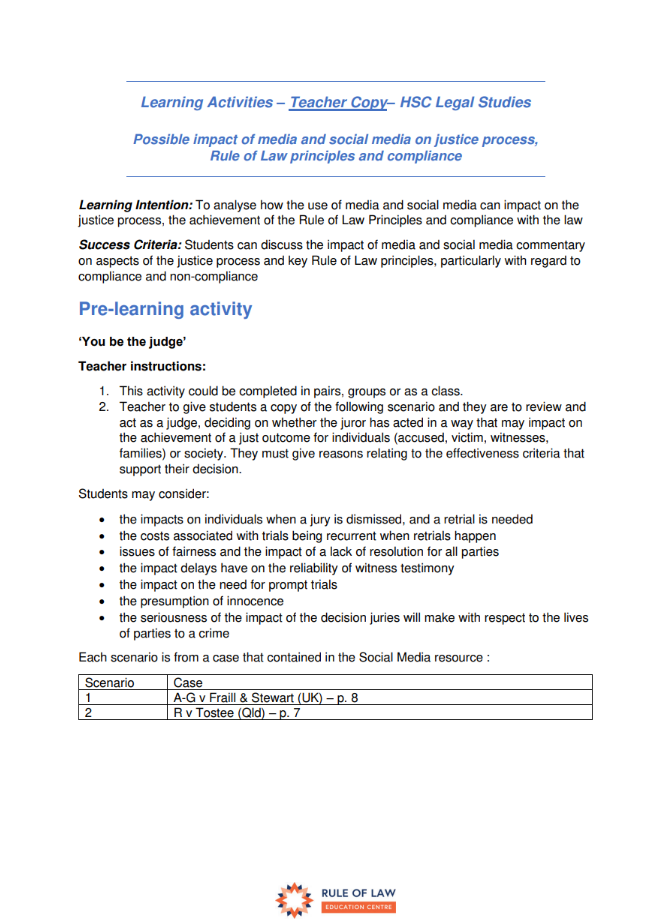
Media and Social Media: Impacts on Justice and the Rule of Law - HSC Activity
Learning Intention: To analyse how the use of media and social media can impact on the justice process, the achievement of the Rule of Law Principles and compliance with the law
Success Criteria: Students can discuss the impact of media and social media commentary on aspects of the justice process and key Rule of Law principles, particularly with regard to compliance and non-compliance
Pre-learning Activities:
‘You be the judge’
This activity could be completed in pairs, groups or as a class.
Teacher to give students a copy of the following scenario and they are to review and act as a judge, deciding on whether the juror has acted in a way that may impact on the achievement of a just outcome for individuals (accused, victim, witnesses, families) or society. They must give reasons relating to the effectiveness criteria that support their decision.
Students may consider:
the impacts on individuals when a jury is dismissed, and a retrial is needed
the costs associated with trials being recurrent when retrials happen
issues of fairness and the impact of a lack of resolution for all parties
the impact delays have on the reliability of witness testimony
the impact on the need for prompt trials
the presumption of innocence
the seriousness of the impact of the decision juries will make with respect to the lives of parties to a crime
Scenario 1
You are appointed as a judge on a case about drug trafficking and sale with multiple defendants, meaning it will be a long trial with a lot of evidence to hear. It comes to your attention that one of the jurors may know one of the defendants but failed to report it. You are also told that they may have been communicating during the case using an app and that the juror has been looking up other defendants on social media.
Scenario 2
You are the judge sitting on a manslaughter trial that has received vast amounts of media attention since the death of the young person. The jury has retired to deliberate on their judgement of guilty or not guilty. It has come to your attention via another juror that one of the jury members has been posting a picture each morning of their walk to jury duty, with a comment about being on jury duty and alluding to their involvement in a high-profile case, attracting much commentary from her followers.
Post-learning Activity – Written response development
After students have reviewed the Media and Social Media resources, they could complete the following activities.
Activity 1 - Review questions:
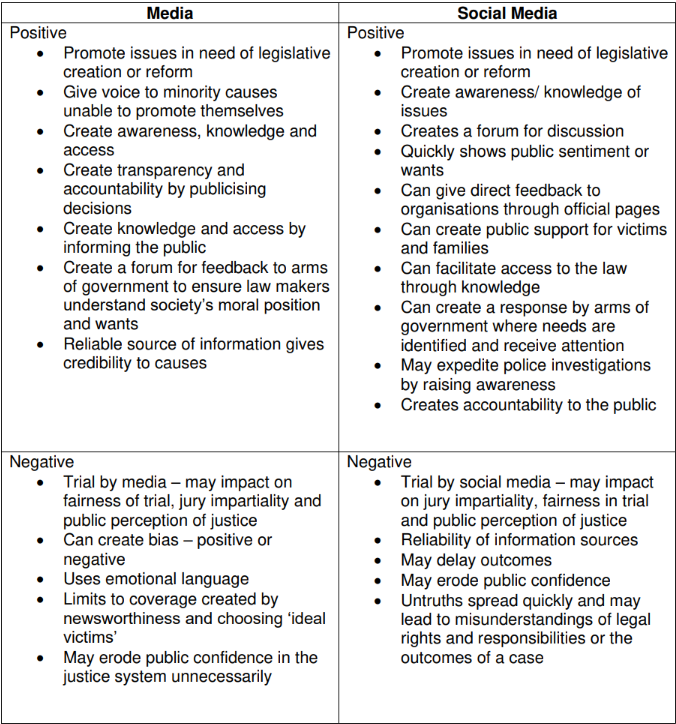
1. Create a table that shows the negative and positive impacts that media and social media can have upon the justice process.
2. How do media and social media create compliance and non-compliance simultaneously?
3. How do both create accountability in the different arms of government?
4. What is transparency and why is it important in upholding the Rule of Law?
5. Why is it important for the people to be able to be critical of the decisions being made in the justice system?
Activity 2 – Writing practice
Students should use their answers to the review questions to write a paragraphed response to the following question:
“Analyse the effectiveness of non-legal responses in achieving just outcomes for victims, offenders and society.”
Responses could refer to:
Student Copy
Learning Intention: To analyse how the use of media and social media can impact on the justice process, the achievement of the Rule of Law Principles and compliance with the law
Success Criteria: Students can discuss the impact of media and social media commentary on aspects of the justice process and key Rule of Law principles, particularly regarding compliance and non-compliance
Pre-learning Activities:
‘You be the judge’
Instructions:
Review each of the following scenarios and, acting as a judge, decide on whether the juror has acted in a way that may impact on the achievement of a just outcome for individuals (accused, victim, witnesses, families) or society. You must give reasons relating to the effectiveness criteria (MR J PEARR) to support your decision.
Scenario 1
You are appointed as a judge on a case about drug trafficking and sale with multiple defendants, meaning it will be a long trial with a lot of evidence to hear. It comes to your attention that one of the jurors may know one of the defendants but failed to report it. You are also told that they may have been communicating during the case using an app and that the juror has been looking up other defendants on social media.
Scenario 2
You are the judge sitting on a manslaughter trial that has received vast amounts of media attention since the death of the young person. The jury has retired to deliberate on their judgement of guilty or not guilty. It has come to your attention via another juror that one of the jury members has been posting a picture each morning of their walk to jury duty, with a comment about being on jury duty and alluding to their involvement in a high-profile case, attracting much commentary from her followers.
Post-learning Activity – Written response development
After you have reviewed the Media and Social Media resources, complete the following activities.
Activity 1 - Review questions:
1. Create a table that shows the negative and positive impacts that media and social media can have upon the justice process.
2. How do media and social media create compliance and non-compliance simultaneously?
3. How do both create accountability in the different arms of government?
4. What is transparency and why is it important in upholding the Rule of Law?
5. Why is it important for the people to be able to be critical of the decisions being made in the justice system?
Activity 2 – Writing practice
Use your answers to the review questions to write a paragraphed response to the following question:
“Analyse the effectiveness of non-legal responses in achieving just outcomes for victims, offenders and society.”
Related Resources
-
This poster explains how social media affects the justice system, noting that it can improve public access and transparency but also spread misinformation, fuel “trial by social media,” and disrupt fair trials by influencing jurors.
-
This case noteoutlines how media can support or undermine justice, showing that reporting can enhance scrutiny and public awareness while also creating risks to fairness, impartiality and the presumption of innocence. Through case studies such as Witness J, Trace, The Teacher’s Pet, Singh, Dawson and Lehrmann, it illustrates how media coverage can inform, influence or distort legal processes and outcomes.
Explore Related Topics
-
Checks and Balances on Power
Explore resources on checks and balances, explaining how oversight limits power and ensures decisions remain lawful and accountable, supporting transparency, restraint, & responsible government action.
-
Open and Free Criticism
Explore resources on open and free criticism of law & government, showing how scrutiny of institutions strengthens accountability and supports a rule‑of‑law culture.
-
Human Rights
Explore resources on human rights, outlining key protections, and how rights are balanced against government power in Australia through constitutional principles, legislative safeguards and rule‑of‑law accountability.