
Human Rights
-
This poster illustrates how human rights in Australia are protected through a patchwork of sources rather than a single bill of rights. It highlights the role of the Constitution, legislation, common law and international obligations, showing how each contributes to safeguarding freedoms, limiting government power and upholding the rule of law. The visual layout reinforces that rights protection in Australia relies on multiple overlapping legal frameworks working together.
-
This poster shows how key human rights principles connect to core elements of the rule of law. It highlights concepts such as equality before the law, limits on power, fair processes and independent courts, illustrating how each supports the protection of rights in Australia. The wheel format helps students see the relationships between rights, accountability and lawful government action.
-
This video series features interviews with the Australian Human Rights Commissioner, who explains key articles of the Universal Declaration of Human Rights and their relevance in Australia today. Each interview breaks down a specific right in clear, accessible language, helping students understand how human rights operate in practice and how they connect to Australia’s legal system and the rule of law.
-
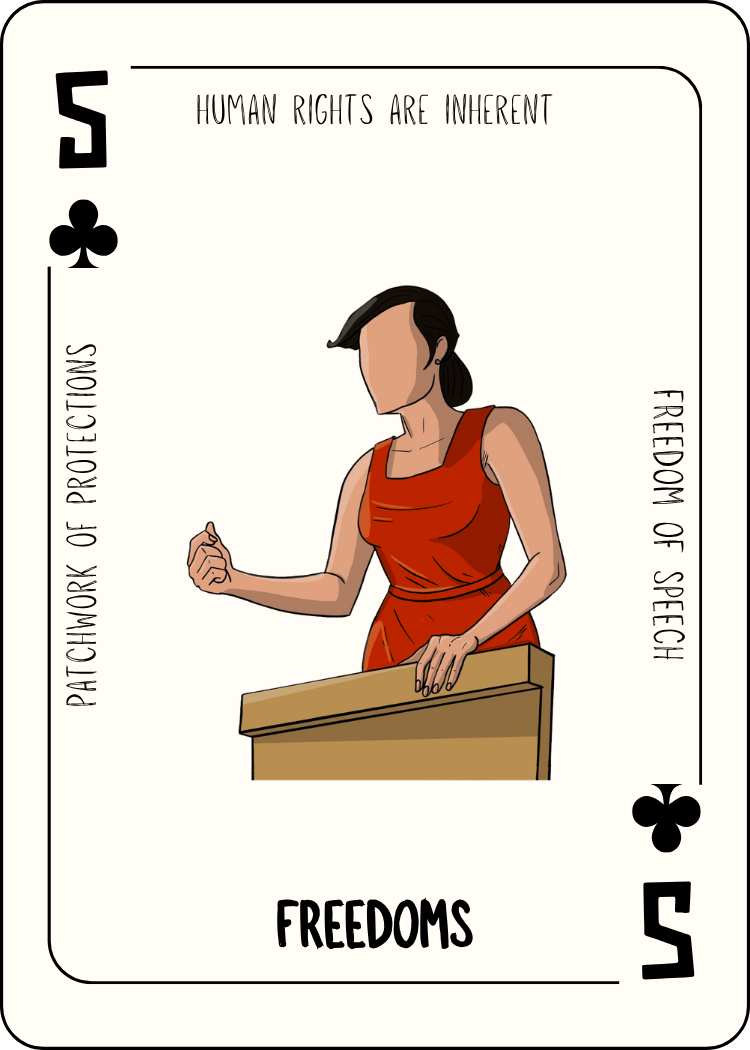
This poster forms part of the Informed Playing Card Project, showing that human rights are inherent and protected through Australia’s patchwork of laws.
Informed Freedoms Playing Card
Related Resources
-
This explainer outlines where human rights in Australia come from, showing how protections arise from the Constitution, legislation, common law and international obligations rather than a single bill of rights. It highlights key constitutional and common law rights, the role of courts in limiting government power, and how the rule of law underpins Australia’s system of rights protection.
-
This activity helps students identify key democratic freedoms—such as speech, association, religion and movement—and consider how they operate in everyday situations. Students analyse short scenarios, decide which freedoms are involved, and discuss why limits on rights must be reasonable, justified and consistent with the rule of law. The task builds understanding of how freedoms are protected in Australia and why responsible citizenship matters.
-
This factsheet explains that human rights are inherent and inalienable, not granted by governments, and outlines how Australia protects these freedoms through a patchwork of constitutional, common law, statutory and international sources. It highlights key democratic freedoms—such as speech, religion and movement—alongside the need for fair, clearly justified limits that balance individual rights with community safety. The resource reinforces that enjoying rights also involves responsibilities, and that protecting freedoms depends on active citizenship and the rule of law.
Explore Related Topics
-
Freedom of Speech
Explore resources on freedom of speech, outlining how it supports democratic debate, accountability, the protection of individual rights and a rule‑of‑law culture through open discussion, transparent limits and responsible civic participation.
-
Law is Known and Accessible
Explore resources on accessible law, highlighting why clear, public and open legal rules are essential for fairness and participation by enabling informed decision‑making and transparency.
-
Laws
Explore resources on laws, explaining how rules are created, interpreted and enforced to maintain order, protect rights and support a functioning society through clear processes, accountability and fair application.