
Law and Technology
-
This case note shows how social media affects the justice system, highlighting that it can spread information quickly and support investigations, but also create misinformation, fuel “trial by social media,” influence jurors, and threaten fair trials and the presumption of innocence.
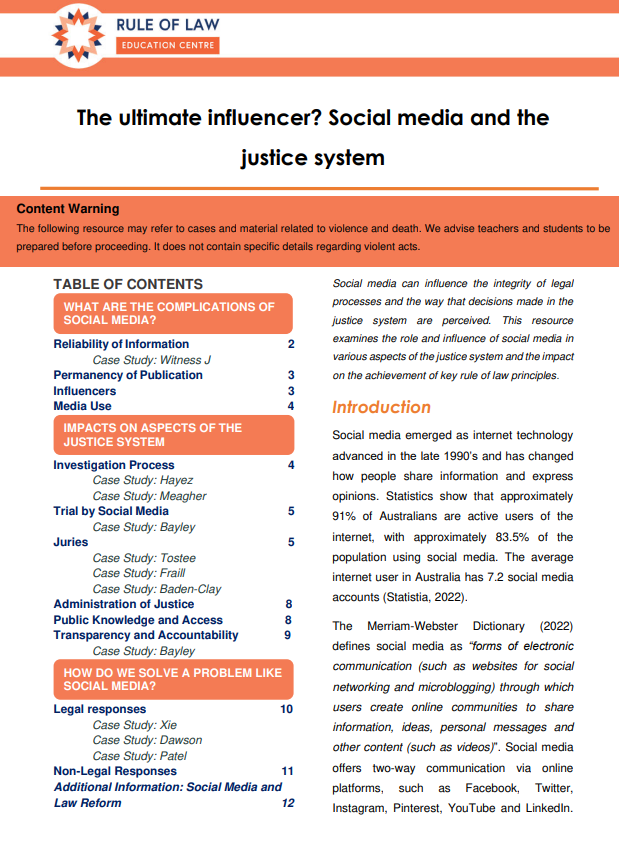
The ultimate influencer? Social media and the justice system
Social media can influence the integrity of legal processes and the way that decisions made in the justice system are perceived. This resource examines the role and influence of social media in various aspects of the justice system and the impact on the achievement of key rule of law principles.
Introduction
Social media emerged as internet technology advanced in the late 1990’s and has changed how people share information and express opinions. Statistics show that approximately 91% of Australians are active users of the internet, with approximately 83.5% of the population using social media. The average internet user in Australia has 7.2 social media accounts (Statistia, 2022).
The Merriam-Webster Dictionary (2022) defines social media as “forms of electronic communication (such as websites for social networking and microblogging) through which users create online communities to share information, ideas, personal messages and other content (such as videos)”. Social media offers two-way communication via online platforms, such as Facebook, Twitter, Instagram, Pinterest, YouTube and LinkedIn.
Virtual networks are created with a more targeted audience. As stated by His Honour Chief Justice Bathurst in his 2012 Warrane Lecture, content is “not merely consumed by users, [but] also created, organised and distributed by them.” Currently, anyone interacting on a platform can publish any subject matter they choose, with content being regulated and moderated by individual platforms.
Making it official
Social media can be used by official organisations, such as the courts, parliaments and branches of the executive to create transparency, knowledge and understanding of the law and access to administration. Courts can use social media to:
Publish judgements and information, supporting the principles of open justice and transparency;
Interact with younger citizens whose primary source of news may be social media platforms, creating knowledge and enabling compliance;
Facilitate direct, two-way engagement with the public, which may enhance public confidence and accessibility;
Educate the public, improving knowledge of legal procedure and confidence in the justice system; and
Provide direct, timely and accurate information to reduce media or social media inaccuracies and creating open justice.
However, there is a question as to what extent these are achieved given character limits on some platforms and the need for individuals to engage with (‘follow’) an account to receive information. Administratively, such interaction also requires that people are employed specifically to manage these communications, meaning court resources may be diverted to this service rather than their core functions.
Media outlets also use social media as another publication tool and act to assist the public to interpret what can be complicated legal information.
What are the complications of social media?
Reliability of Information
“The internet, social media and social networking websites all give access to a huge amount of information and enable their users to themselves create and disseminate information. Needless to say, all such information varies greatly in accuracy and reliability…” The Honourable Justice Peek. Strauss v Police [2013] SASC 3; 115 SASR 90, [12].
Unlike the media industry, there is no vetting process for the publication of information in posts on social media prior to their publication. Where media outlets have layers of approval and editing to ensure accuracy and compliance with legal requirements, on social media, these roles are generally fulfilled by the publisher themselves. There is also very little, if any, legal accountability for the publication of information or opinions generated by individuals that may be grounded in inaccurate information sources.
Very few personal details are required to sign up for social media accounts. In the majority of cases, no verification or proof of accuracy of personal information supplied is necessary, meaning accounts can be created by any person using whatever details they choose. A lack of transparency means that information given by individuals or organisations can be fabricated, with little or no legal repercussion. This can lead to the spread of misinformation or disinformation regarding individuals, investigations, trials and post-trial considerations.
Case Study - Witness J
In 2019, a prisoner identified only as Witness J was tried in the ACT Supreme Court in a secret trial for national security offences. He had been working as a military intelligence officer throughout the defence network. At the conclusion of the trial, a custodial sentence of two years and seven months was imposed, with all details of the matter supressed from public availability.
In November of 2019, a Twitter account was opened in the name of Witness J. Biographical information and tweets made from this account allude to persecution and unfair outcomes from his prosecution. Commentary regarding the secret trial have been published. However, there is no genuine way of people knowing whether these are being published by Witness J himself or by another interested party, leading to questions of the reliability and truth of the information.
Permanency of Publication
Prior to the emergence of internet, publications previously released were difficult to access. It would require contacting the publication for a back copy or attending a library to see the previous edition desired. Publishing on the internet makes previously published information more widely accessible and allows access for a longer period of time, if not permanently.
Influencers
Influencers have experienced exponential growth in interest from 2012 - 2022, particularly with younger age groups. In many cases, they receive free goods, services or payments by various organisations in exchange for marketing particular products, experiences and/ or opinions. Research has found that the power of the influencer rests with their ability to create a perception of friendship with their followers, creating a trust in reliance on the opinions and information they provide, particularly in teens and young adults. This creates a difficulty in users being able to filter information for honesty and accuracy, as it could be paid content, and could create undue influence over public opinion over a wide range of issues.
Media Use
Media outlets can also use social media to disseminate news and attract readers to their publications. According to the 2022 Australian Digital News Report, approximately 31% of Australians use Facebook for news, with 19% identifying it as their main source of news.
News outlets choose stories based on ‘newsworthiness’ to attract readers. However, given that social media applications use algorithms to filter the information that users view, this could mean that users are only being exposed to content based on articles or information they have viewed in the past, acting as an additional filter of information and distorting user knowledge.
As profit motivated organisations, media outlets can pay additional advertising fees on most platforms to have coverage of stories streamed to certain user groups or to appear in across feeds. In some instances, multiple platforms can be owned by one organisation, meaning that there can be cross platform dissemination of reports as well, maximising coverage and profit opportunities. This may create bias around legal issues, dependent on the ability and willingness of organisations to pay to have their story appear more often.
In addition, within the media industry itself, there is a large disparity in the reliability of reporting created by outlets. This largely depends upon the ownership, purpose and readership of the publication in question.
Impacts on aspects of the justice system
Investigation Process
Given the speed of publication and the ability for users to reshare information, social media can be a useful tool for police during the investigation process. Police across jurisdictions in Australia use Facebook pages and Twitter to make public appeals for information, including looking for missing persons or persons of interest and asking for witnesses to events of interest. Information can be shared across jurisdictions and state boundaries quickly in a very publicly accessible manner, potentially reducing the investigation time and creating prompt outcomes for individuals and the community.
Loved ones or interested parties can also appeal for information, potentially assisting police with the investigation process. This is referred to as ‘user-led crowd-sourced policing’, with research indicating that it may be most useful when identifying possible offenders.
Case Study - Theo Hayez
In May 2019, Mr Hayez disappeared after a night out in Byron Bay. Police at the time released a public appeal with his picture and details of his clothing and last whereabouts on the regional and NSW Police Facebook pages.
Case Study - Find Jill Meagher Facebook Page
Within 12 hours of her disappearance in 2012, a Facebook page was created by Jill Meagher’s husband and colleagues at the ABC titled “Find Jill Meagher”. It was shared and attracted 90,000 followers, creating assistance for the police investigation.
Trial by Social Media
Private users of social media may impede the investigation process through comments made or posted information or commentary. Such activities could assist in generating a public perception of guilt, resulting in a ‘trial by social media’ and may impact on the presumption of innocence and fairness.
To create conditions for a fair trial and support just outcomes, the justice system may need to employ measures such as trial delays, judge only trials or closed courtrooms. These measures create other difficulties, such as limiting the rights of the offender when a judge only trial is considered necessary, impacts on the promptness of trials, with delays having flow on effects to other cases and limits on open justice if a closed court is deemed necessary.
Case Study - R v Bayley
Identified as one of the first Australian cases to receive substantial interest via social media, the disappearance of Jill Meagher in Melbourne in 2012 created large amounts of interest among social media users while she was missing and following the arrest of Adrian Bayley.
Several Facebook pages were created throughout the case duration, including “Help us find Jill Meagher” attracting 90,000 followers and “RIP Jill Meagher”. After Police arrested Adrian Bayley for her murder, a number of hate related pages calling for justice and the reinstatement of the death penalty were created, attracting large amounts of interaction. The Age newspaper reported that in the 24 hours after Bayley’s arrest, mention of Jill Meagher had appeared in over 35 million Twitter feeds globally and her name was mentioned every 11 seconds across Twitter and Facebook, citing fears regarding the offender’s chance of a fair trial.
The large number of pages and comments prompted police to use their official Facebook page to request comments were supportive of and compliant with the justice process.
In addition, police released CCTV footage of Meagher being followed by and talking to an unknown man that was widely shared by users and led to a number of women identifying themselves on Facebook and through traditional media as having been followed by or victims of the same man, potentially enhancing just outcomes for previous victims.
Juries
The jury system creates fairness in trials by:
Ensuring that judges are not able to exercise arbitrary power over all decisions made in the court system;
Ensuring decisions are consistent with society’s standards at that time by having a cross section of people representing the community; and
Ensuring public accountability for decisions that have serious consequences for accused and victims.
Prior to the development of the internet, the amount of information that potential and empanelled jurors was exposed to was limited to print and television media. The smaller number of outlets, the time limited news cycle and the public nature of reporting created transparency in the information that jurors were exposed to. However, the emergence of internet has increased the type, availability and accessibility of information exponentially.
Specifically, social media has become a source of instant and easily digestible news for users. According to the Digital News Report Australia (2022), 27% of Australians use their smartphone to access news, with 31% of Australians using Facebook for news.
However, unlike print and television media of the past, the transparency of information users are exposed to is limited by privacy settings, making it difficult to ascertain what potential jurors may have seen. This is further complicated by the reliability of the information published and its source. Often, the source of information can be difficult to identify, with a variance in the quality and reliability of the information. The type of information users receive is also heavily dependent on algorithms used by platforms, which are created using data about the topics, groups and influencers users interact with and demographic information.
Jurors can interact with social media by either broadcasting or receiving information pre-trial, in trial or post-trial. The rule of law principles most impacted by a juror interacting in any of these ways is the presumption of innocence and fair trial.
There are several ways juror engagement with social media impacts upon these two principles:
Jurors disseminating information or commenting on a case during a trial via social media platforms may inhibit a fair trial or prejudice other jurors;
Jurors reading commentary of others or media outlets could prejudice their perspective regardless of evidence before the court;
Communication with friends, family, acquaintances, accused or other jurors could serve to prejudice their thoughts. In the case of other jurors, these could be deliberations outside of the jury room where other jurors are not party to the discussion, undermining the integrity of the jury decision; and
Research into persons of interest to the trial, details of the case, or other jurors potentially prejudicing their perceptions and giving them insights not presented as evidence tested before the court.
Judges give explicit instructions to juries prior to the trial commencing and prior to retiring to decide a verdict. These instructions are designed to protect the rights of the parties to the trial and the integrity of the verdict reached. Instructions include not actively searching for or engaging with any information regarding the case and not to discuss the case with outside parties, including revealing yourself as a juror on a specified case. This system relies upon the trust of jurors to act in good faith and comply with the guidelines given, with penalties for breaching these contained in the Jury Act 1977 (NSW).
Bias of jurors, either positive or negative, can alter the outcome of a case and may increase the occurrence of hung juries. Jurors’ impartiality may be impacted if exposed to social media examination of a case prior to trial, making deliberations and consensus difficult, including in majority verdict situations. Significantly, the exact impact on jurors is impossible to measure and will vary between individuals based on a range of factors. This can impact on resource efficiency and timely outcomes across the court system as retrials add to the case load already present.
Publication on social media by jurors during the case or deliberations can cause a mistrial to occur or can create grounds for a retrial or appeal. Even seemingly harmless comments not directly giving information or outcomes can be considered to impact on impartiality. This also creates increased costs to the justice system and delays in resolution of legal issues.
Fact: In the 2020-21 financial year, the average cost of finalising (coming to a decision) a criminal Supreme Court trial in NSW was $48,860 (Productivity Commission, 2022)
Case Study: R v Tostee Qld (2016)
During jury deliberations in the trial of Gabriel Tostee for the murder of Ms Warienna Wright, a juror was found to have posted daily pictures of a coffee cup with comments on her experiences on Instagram, prompting comments by her followers. Her interactions with others confirmed the trial she was sitting on and contained comments such as:
“I’m so glad I’m finding these pretty cups every day… because the trial has certainly been less than pretty”
“…feeling highly caffeinated… and ready to face yet another day of deliberations... I think.”
“It’s a high profile case… interesting to see the process though.”
The prosecution applied for a mistrial based on the belief that they could be seen as discussion of the case with outside parties and responding comments could be seen as prejudicial in some cases. The appeal was not granted, but the judge expressed disappointment, not finding that these comments and responses would have prejudiced the finding of the jury.
Case Study – A-G v Fraill & Stewart (UK)
In 2011, whilst acting as a juror on a drugs conspiracy trial with multiple defendants, Ms Fraill was found to be communicating with defendant Jamie Stewart using Facebook messenger. It was also discovered that she had searched online for information about another defendant online whilst deliberating the defendant’s outcome. It was the third trial for the case as the two previous trials had failed, the jury being discharged each time.
The jury was discharged by the judge and the trial was ended after 10 weeks. Both were found in contempt of court by the High Court, Fraill being jailed for 8 months for violating judicial instructions to not use internet during the trial, and Stewart for 2 months’, suspended for 2 years.
Case Study – R v Baden-Clay
The trial of R v Baden-Clay attracted substantial amounts commentary on social media. A 2017 study by Hews and Suzor conducted an analysis of 33,067 tweets that were published over the duration of the trial of Gerard Baden-Clay for the murder of his wife Alison, from 9 June 2014 – 15 July 2014. The study found that approximately 14.7% of tweets published by ordinary users contained prejudicial information. This could have impacted on the trial outcome if jurors were exposed and alter public perception of justice served or post-trial outcomes.
The Administration of Justice
It should be considered that the staff of the justice system are also users of social media. Codes of conduct exist to assist in regulating staff use of platforms, with a flexibility in educational and disciplinary measures created in response to individual breaches. However, justice staff are also individuals with personal lives, pressures and networks. They could feel compelled to comment on inaccuracies they see published or could be exposed to information that may create bias, influencing the way they conduct their daily activities while at work. These factors may impact the presumption of innocence afforded to accused, and ultimately the fairness of the criminal justice process.
Increases in judge only trials could be a result of excessive commentary on social media in high profile cases. This has implications for fairness in trials and just outcomes as the decision rests with a judge rather than peers, changing the way outcomes are reached and delaying outcomes as well.
Parties to criminal and civil trials may also be users of social media. Representatives for both parties can access publicly available information on social media platforms and can gather evidence from such that could create particular perceptions of the either party to the case and provide information that could alter, even enhance, the outcomes of proceedings.
Public Knowledge and Access
Users of social media can publish and distribute material quickly to a wide network, particularly if account holders have large numbers of followers. This can help to inform the public of legal rights and obligations, enhancing public knowledge and potentially increasing compliance. Police, courts and justice departments across states can increase use social media to inform the public of persons of interest or legal obligations.
However, the immediate nature of social media publication can mean that commentary is entered into quickly, without due thought or adequate consideration of the impact. This may also lead to rapid and widespread misinformation, or the publication of details that can impact on trial outcomes for either prosecution or defence, and the achievement of just outcomes.
Transparency and Accountability
Social media provides a platform for users to voice their concerns with the justice system and its processes, enabling them to present views that can generate policy change.
Case Study - R v Bayley
This case, previously mentioned, led to changes to the Corrections Act 1987 (Vic) (‘the Act’). The offender was on parole at the time of Mrs Meagher’s murder, a fact that received a large degree of attention on social media given a number of other deaths at the hands of parolees in Victoria preceding her death. Law makers responded to the outcry by amending the Act. Amongst other changes, section 78 introduced penalties for offenders breaching parole conditions, not previously contained in the existing legislation.
How do we solve a problem like social media?
Legal responses
In NSW, the currently preferred instrument for regulating juror interaction on social media during proceedings are pre- and post-trial judicial directions, as written in the NSW Criminal Bench Book (2022).
Post empanelment, pre-trial instructions at [1- 480] remind jurors that their role is to come to “a true verdict in accordance with the evidence.”, with an express instruction to not conduct any research, including using internet. Stated restrictions and associated penalties are imposed by sections 68B and 68C of the Jury Act 1977 (NSW).
However, these instructions rely heavily on juror integrity and may be difficult to monitor and regulate. Opinion is divided about whether this approach is effective in upholding the right to a fair trial.
What else could we do?
Sequestration – jury members are temporarily housed in a hotel and removed from their lives for the duration of the trial and/or deliberations. This method may be used in higher profile cases to maximise the opportunity for a fair trial but may not be effective given previous exposure already in the minds of the jury. This method would also be very costly for the state.
Case Study - R v Xie
In the third trial of Robert Xie for the murder of the Lin family, Justice Fullerton sequestered the jury on November 12, 2015 in order enable the jury to focus on deciding a verdict. She discharged the jury on December 1, 2015 after they advised over several days that they had been unable to come to a unanimous or majority verdict.
Relocation – the trial is moved to another jurisdictional location to access a jury pool that may not have been exposed to influence. However, the internet has removed the existence of jurisdictional boundaries for information, reducing the effectiveness of this option.
Judge only trials –where there has been high levels of coverage and commentary, in the interests of supporting the presumption of innocence and fair trial, a judge only trial may be applied for. However, this removes the right of the individual to be tried by peers according to society’s values
Case Study - R v Dawson
Mr Christopher Dawson was to stand trial for the murder of his wife, Lynette in 1982. The case had received large amounts of commentary on social media preceding and following his arrest following the publication of the popular podcast, The Teacher’s Pet. Mr Dawson was granted a judge only trial as Justice Fullerton determined that it would be extremely difficult to empanel a jury that had not been exposed to the podcast or associated commentary.
Trial delays to allow for bias reduction – a time lapse could create a buffer in jury bias caused by adverse publicity; however, the permanent nature of most internet-based information would impact on the effectiveness of this measure.
Justice Fullerton allowed for a stay in proceedings in order to allow bias potentially created by the podcast and associated commentary to reduce.
Internet screening of jurors – monitoring of internet usage of jury members for breeches to act as a disincentive and to enforce rules. This has implications for privacy rights and would require specialist software and staff, impacting on resource efficiency.
Prohibiting use of social media for the duration of the trial – not allowing members of the jury to interact on social media for the duration of the trial would reduce the instance of breaches occurring. However, issues such as social media addiction and reliance on social media for communication with 11 support networks creates issues of wellbeing for the jury. It is also extremely difficult to monitor and enforce.
Pre-trial questioning of jurors – jurors fill in a questionnaire designed to ascertain bias, particularly in highly publicised cases to ascertain whether they are suitable candidates.
Case Study - R v Patel
Dr Patel was to stand trial for the manslaughter of a patient who died after surgery. Justice George Fryberg granted an application made by the defence lawyers under the Jury Act 1995 (Qld) to question the jurors after selection to test for bias. The application identified pretrial publicity as a reason for testing jury bias.
Expanded juror training – when jurors report for duty, explicit teaching of the requirements, obligations and penalties may increase juror compliance. Justice systems in other jurisdictions, such as some parts of the USA, have opted to trust the integrity of jurors. Systems have been adapted around social media regulation, focusing on other methods to address the issue such as refining jury instructions to enhance juror understanding. “Long experience of the jury system shows that juries, when given proper and full instructions by judges, are well able to put aside extrinsic material and to act solely on evidence led in court.” The Honourable Phillip Cummins, The “Open and Shut” Workshop, Rule of Law Institute, 2014
Non-legal Responses
Media outlets raise awareness of the issues associated with the use of social media by people within the justice system, either through employment or participation. Stories about inappropriate use of social media impacting on just outcomes are often reported, assisting to educate the public in the impacts of inappropriate social media use in justice matters and create knowledge for future jurors of what their obligations are.
Conclusion
Social media is a multifunctional landscape. It can be used for social, entertainment, marketing, information and communication purposes. Content is created and accessed by users in a 24-7 cycle on a global scale. Users include private individuals, not for profit groups, interest groups and public and private entities, including the courts and federal, state and local parliaments and government departments.
It poses many new and unique challenges for the justice system, particularly regarding the presumption of innocence, fair trials and the secrecy and integrity of jury deliberations. It is difficult to monitor and doing so would be very costly for the justice system. The ability to comment publicly supports the principle of open justice, creating transparency and accountability in the system, and can assist in achieving just outcomes by assisting with investigations and providing feedback to the executive.
The question facing Australian jurisdictions is whether they should evolve to accept social media as a part of the everyday life of its participants. Rather than battle against use of social media, acceptance and adaptation of regulation that minimises the impact of use may be more effective in the long term.
Further information: Social Media and Law Reform
In some areas, such as business use, bodies like the Australian Consumer and Competition Commission can act on complaints made by consumers regarding false and misleading information. However, the regulation of social media is incredibly complicated for the following reasons:
most social media companies have their origins in other jurisdictions; • the nature of internet being ‘jurisdictionless’ (to some degree);
the wide-ranging purpose, type and use of social media by private individuals, business owners and government organisations;
the rapid development of technologies and applications;
the ability for user anonymity; and
the volume of users and content interacting across the globe on a 24- hour basis.
Despite these challenges, Australian law makers have attempted to respond to the need for regulation in some key areas of social media use.
In response to increased harm experienced by Australian adults and children because of adverse online interactions, such as bullying and sharing of personal content, the Online Safety Act 2021 (Cth) was created by Federal Parliament. The Act forces service providers to respond quickly when complaints are received regarding commentary or content that has been shared, giving online service providers defined expectations regarding user safety. It also makes providers accountable for the safety of individuals in Australia using their services.
In addition, the Social Media (Anti-Trolling) Bill 2022 (Cth) was before Federal Parliament prior to the 2022 election. Designed to overturn the impact of the Voller case (see below) and limit the defamation liability of individuals and organisations that administer social media accounts, the bill was to make social media service providers the publisher and therefore responsible for all comments. However, the bill lapsed at dissolution created by the calling of the Federal election and is currently not proceeding as at August 2022.
Defamation is a pressing issue in social media. In the case of Fairfax Media Publications; Nationwide New Pty Ltd; Australian News Channel Pty Ltd v Voller [2020] NSWCA 102, the New South Wales Court of Appeal ruled that individuals and organisations, such as media companies, can be held responsible for defamatory comments made on their social media pages, not only by their journalists, but by readers of their social media accounts (third parties). This decision was upheld in Fairfax Media Publications v Voller [2021] HCA 27. This has led to many platform administrators needing to have moderators monitoring comments on posts.
Related Resources
-
This case note outlines the High Court’s decision in Comcare v Banerji, where a public servant challenged her dismissal after anonymously posting critical political comments on Twitter. The Court confirmed that the implied freedom of political communication is not a personal right but a limit on legislative power, and held that the APS Code of Conduct did not impose an unjustified burden on that freedom. The decision highlights how the rule of law balances public sector duties, political communication and constitutional limits on government power.
-
This poster forms part of the Informed Playing Card Project, showing how Australian values such as the fair go, freedom and respect for others guide civic behaviour and support a cohesive, democratic society.
-
This activity helps students identify Australia’s core civic values—such as equality, respect, freedom and responsibility—and apply them to everyday scenarios. Students discuss how these values guide behaviour, support democratic participation and connect to the rule of law.
Explore Related Topics
-
Checks and Balances on Power
Explore resources on checks and balances, explaining how oversight limits power and ensures decisions remain lawful and accountable, supporting transparency, restraint, & responsible government action.
-
Open and Free Criticism
Explore resources on open and free criticism of law & government, showing how scrutiny of institutions strengthens accountability and supports a rule‑of‑law culture.
-
Human Rights
Explore resources on human rights, outlining key protections, and how rights are balanced against government power in Australia through constitutional principles, legislative safeguards and rule‑of‑law accountability.