
Equality Before the Law
-
Explains the rule‑of‑law principle that all people are equal before the law and entitled to the same legal protections, rights, and responsibilities. Highlights how impartial courts, fair procedures, and the consistent application of legal rules prevent discrimination, uphold accountability, and ensure justice is administered without favour or prejudice.
-
This explainer outlines the principle that all people are treated equally by the legal system, regardless of status, background or identity. It highlights how impartial courts, consistent rules and fair procedures protect individuals from discrimination and ensure everyone has the same rights, responsibilities and access to justice.
Equality Before the Law
What does it mean for all people to be equal before the law?
In Australia, equality is a core value of our democracy. It is often described as giving everyone a “fair go.” This means Australians have the same rights to vote, take part in society, and be treated equally under the law
Equality before the law means that every person is treated the same by the legal system, regardless of their wealth, age, gender, race, religion, occupation or social status. It ensures that no one is above the law, including government officials, and that all similar cases are treated alike to create consistency in the treatment of parties to a matter before the courts.
To help protect this key aspect of our justice system, when Australian judges take their oath (the promises judges make to the people of the community when they agree to be a judge of the court), they make an undertaking to “do right to all manner of people according to law without fear or favour, affection or ill will”. This promise means that they will try to treat all people equally and make decisions based only on the law, not on their personal beliefs or feelings, or pressure form external groups or the government.
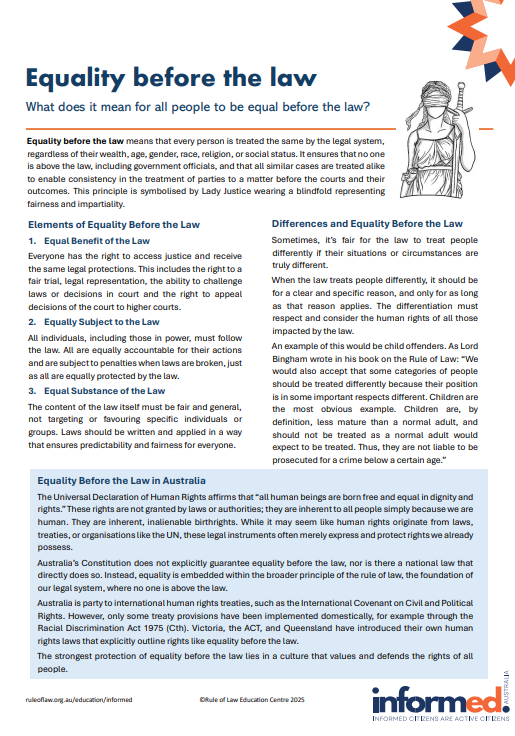
This important principle is symbolised by Lady Justice wearing a blindfold to represent the fairness, impartiality and lack of bias given to all people before the law in our community.
Elements of Equality Before the Law
Equal Benefit of the Law Everyone has the right to access justice and receive the same legal protections. This includes the right to a fair trial, legal representation, the ability to challenge laws or decisions in court and the right to appeal decisions of the court to higher courts.
Equally Subject to the Law All individuals, including those in power, must follow the law. All are equally accountable for their actions and are subject to penalties when laws are broken, just as all are equally protected by the law.
Equal Substance of the Law The content of the law itself must be fair and general, not targeting or favouring specific individuals or groups. Laws should be written and applied in a way that ensures predictability and fairness for everyone.
Differences and Equality Before the Law
Sometimes, it’s fair for the law to treat people differently if their situations or circumstances are truly different.
When the law treats people differently, it should be for a clear and specific reason, and only for as long as that reason applies. The differentiation must respect and consider the human rights of all those impacted by the law.
An example of this would be child offenders. As Lord Bingham wrote in his book on the Rule of Law: “We would also accept that some categories of people should be treated differently because their position is in some important respects different. Children are the most obvious example. Children are, by definition, less mature than a normal adult, and should not be treated as a normal adult would expect to be treated. Thus, they are not liable to be prosecuted for a crime below a certain age.”
Equality Before the Law in Australia
The Universal Declaration of Human Rights affirms that “all human beings are born free and equal in dignity and rights.” These rights are not granted by laws or authorities; they are inherent to all people simply because we are human. They are inherent, inalienable birthrights. While it may seem like human rights originate from laws, treaties, or organisations like the UN, these legal instruments often merely express and protect rights we already possess.
Australia’s Constitution does not explicitly guarantee equality before the law, nor is there a national law that directly does so. Instead, equality is embedded within the broader principle of the rule of law, the foundation of our legal system, where no one is above the law.
Australia is party to international human rights treaties, such as the International Covenant on Civil and Political Rights. However, only some treaty provisions have been implemented domestically, for example through the Racial Discrimination Act 1975 (Cth). Victoria, the ACT, and Queensland have introduced their own human rights laws that explicitly outline rights like equality before the law. The strongest protection of equality before the law lies in a culture that values and defends the rights of all people.
Related Resources
-
This activity helps students explore how the principle of equality before the law operates in real situations. It guides learners to identify unequal treatment, analyse how fair procedures protect rights and understand why impartial laws and courts are essential for justice in a democratic society.
-
Explains the rule‑of‑law principle that all people are equal before the law and entitled to the same legal protections, rights, and responsibilities. Highlights how impartial courts, fair procedures, and the consistent application of legal rules prevent discrimination, uphold accountability, and ensure justice is administered without favour or prejudice.
Explore Related Topics
-
The Magna Carta
Explore resources on the Magna Carta, outlining how this landmark document became a foundational pillar of the rule of law by limiting royal power, affirming legal rights and shaping enduring principles of justice and accountability.
-
Independent and Impartial Judiciary
Explore resources on an open, independent & impartial judiciary, including the history of the Supreme Court and its role in delivering fair justice through transparency, and accountability.
-
What is the Rule of Law?
Explore resources explaining the rule of law, showing how a collection of principles works to limit government power and protect rights through clear rules, accountability & fairness.