
Law and Technology
-
This explainer outlines how technology creates new rule‑of‑law challenges, showing that expanding surveillance, data retention and social‑media‑driven harms place pressure on privacy, accountability and fair legal processes. It highlights concerns about broad metadata powers, unlawful access, cybercrime, and the difficulty of keeping legislation up to date, while also noting that technology can improve efficiency and access to justice when used transparently and responsibly.
-
This explainer outlines how media can support or undermine the justice system, showing that it can promote scrutiny, transparency and law reform, but can also create bias, fuel “trial by media,” and jeopardise fair trials through prejudicial coverage and profit‑driven reporting.
-
This article from Robin Speed considers a proposal to make it illegal to talk or write the truth about another person where it “invades” that person’s privacy. It looks at the historical freedom of speech in Australia and how this proposal could restrict our freedoms today.
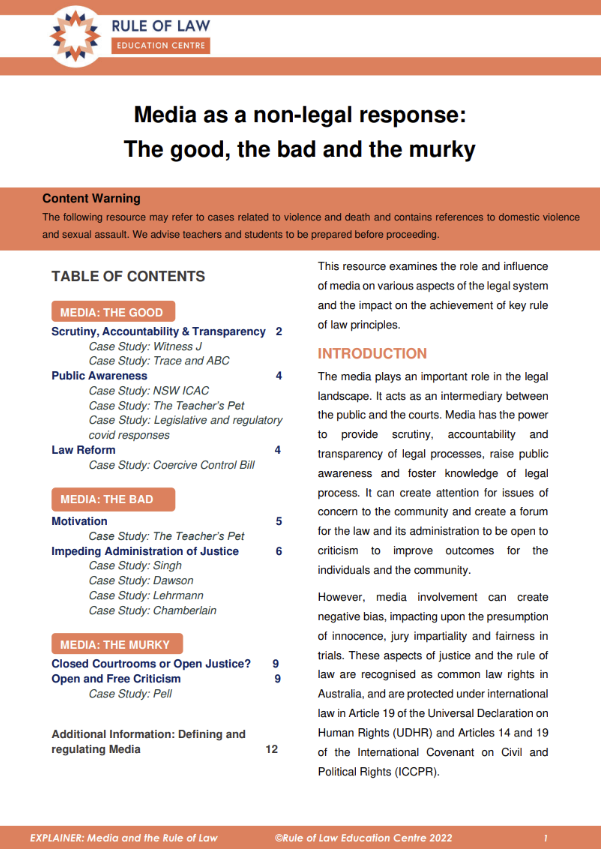
Media as a non-legal response: The good, the bad and the murky
This resource examines the role and influence of media on various aspects of the legal system and the impact on the achievement of key rule of law principles.
Introduction
The media plays an important role in the legal landscape. It acts as an intermediary between the public and the courts. Media has the power to provide scrutiny, accountability and transparency of legal processes, raise public awareness and foster knowledge of legal process. It can create attention for issues of concern to the community and create a forum for the law and its administration to be open to criticism to improve outcomes for the individuals and the community. However, media involvement can create negative bias, impacting upon the presumption of innocence, jury impartiality and fairness in trials. These aspects of justice and the rule of law are recognised as common law rights in Australia, and are protected under international law in Article 19 of the Universal Declaration on Human Rights (UDHR) and Articles 14 and 19 of the International Covenant on Civil and Political Rights (ICCPR).
Media: the good
Scrutiny, Accountability and Transparency
“Publicity is the very soul of justice... the surest of all guards against improbity. It keeps the judge himself, while trying, under trial… Without publicity, all other checks are fruitless.” Jeremy Bentham, 1790
Open justice
One of the key roles of journalists and the media is to provide a forum for discussion, analysis and criticism of the arms of government on behalf of the people of a democracy, enabling transparency and accountability. In the courts, this role is supported by the principle of open justice. Evidence of open justice can be found in the UK dating back to Saxon and Norman times, with news media identified as emerging in the 1600’s.
The key functions of open justice are:
to inform the public of what is happening in the courts and how justice is being administered
to expose participants to public scrutiny enhancing truthfulness and ensure accountability of the courts for the decisions made
to provide public vindication for relevant parties and the community (the ‘therapeutic function’)
Open courtrooms, publicly available judgments, public access and media reporting on cases ensure that those responsible for pre trial, in-trial and post-trial legal processes are accountable to the people for accuracy, fairness and appropriateness in decision making. This upholds the principle of fair trial and creates the ability for either party to appeal if they feel the decision did not comply with legal principles.
Courts also have the jurisdiction to adapt the rules of open justice and can exercise discretion to close court rooms, supress reporting or impose a non-publication order to avoid interference in justice being served.
These measures are usually taken to protect the identity of people in sensitive matters, such as sexual offences, matters of national security, and children under the age of 16 involved in proceedings in some capacity. Courts can also allow media access to a closed courtroom or to view, hear or have access to a transcript of the testimony given at a later time. These provisions enable the courts to balance the need for open justice with the need for individuals involved in sensitive matters to be protected.
Case Study - Witness J - ACT Supreme Court
In 2019, a prisoner identified as Witness J was tried in the ACT Supreme Court in a secret trial for national security offences. He had been working as a military intelligence officer throughout the defence network. At the conclusion of the trial, he was sentenced and imprisoned, with all details of the matter supressed from public availability. Two members of the media noticed the secretive nature of the proceedings and, after enquiring, were told by the presiding judge, Justice John Burns, that although undesirable, the closure of the court and suppression of all documents was considered to be in the interests of protecting national security and outweighed the need for proceedings to be open to the public.
Free press and the freedom of speech
“Freedom of expression is a fundamental human right… But around the world, there are governments and those wielding power who find many ways to obstruct it…People have a right to information that affects their lives, and states have a duty to provide this information. Such transparency is essential to good government.” Ban Ki-Moon
“A free press is the most legitimate, and, at the same time, the most powerful weapon that can be employed to annihilate such [individual] influence, frustrate the designs of tyranny, and restrain the arms of oppression.” Robert Wardell, 1824, first editor and proprietor of The Australian newspaper.
The rule of law requires that freedom of speech allows for the people to provide feedback and be critical of all arms of government. A free press is a vehicle for public opinion to provide scrutiny and accountability. The media has the unique position of being able to educate and inform the public, the Parliament, the Executive and the Judiciary regarding need for change in legal processes or regulations. They can advocate for change and give voice to issues that may otherwise be unnoticed or give weight to causes that may affect smaller groups in the community who are struggling to gain support or raise awareness. Media coverage can also influence government policy change to occur in response to publicity on a given issue, particularly where it generates strong public sentiment.
Informal Justice
Media generated podcasts can act as an informal (non-legal) avenue for justice and can work with formal legal processes to further or resolve unsolved cases. Coverage of such matters can lead to the discovery or examination of evidence not previously analysed or witnesses coming forward, enhancing just outcomes for victims and society. They can also raise public awareness of system failures and lead to improvements in criminal investigation or trial processes by increasing accountability for actions and the integrity of justice system processes.
Case Study - Trace, ABC (2017-2018)
This seven-episode investigation into the murder of Maria James in 1980 in Melbourne, narrated by investigative journalist Rachael Brown, led to a witness coming forward who had not done so during the initial investigation. It was also revealed that a key piece of physical evidence had in fact come from another crime scene and been mixed in with the evidence for the James case.
Considering this new information discovered by the podcast investigation, the Victorian Coroner ruled to open a new inquest in 2018. The inquest concluded with an open finding in March 2022 but identified two key persons of interest and found that many aspects of evidence mismanagement by Victoria Police contributed to a lack of prosecution.
Public Awareness
Media plays an important role in keeping the public informed about legislative shortfall, review, creation, and reform.
Although many documents regarding these processes are publicly available through parliament and relevant government departments (the Executive), the media provides a more condensed version that will generally summarise relevant aspects for the public, creating more easily digestible information and potentially increasing engagement in sections of the community. This may also act to increase knowledge and accessibility, potentially reducing community non-compliance when new legislation is introduced, or existing legislation is reformed.
Media reporting on matters of legal importance acts to raise community awareness and creates transparency in the processes of legislative design, administration and reform. Enhanced awareness may encourage and enable citizens to become more actively involved in other democratic processes.
Case Study - NSW ICAC
Journalists, such as Chris Merritt (Vice President of the Rule of Law Education Centre), regularly write about the need for reforms in social and legal policy to address issues of government bodies over-extending their powers beyond their jurisdiction. His regular commentary on NSW ICAC has created public awareness of a statutory authority operating outside of its jurisdiction with regularity, identifying a need for the NSW government to review and amend policies and procedures to improve the compliance and efficiency of ICAC.
Case Study - Podcast: The Teacher’s Pet - The Australian Newspaper (2018-2019)
Available for approximately 11 months between May 2018 and April 2019, the serial podcast attracted enormous amounts of attention across the globe. It reignited public interest in the case in Australia, particularly given the timing of release 5 months after the findings and recommendations of the Royal Commission into Institutional Responses to Child Sexual Abuse were handed down.
The podcast investigated the case of the disappearance of Lynette Dawson, whose husband, Mr Christopher Dawson, was, at the time, having an affair with a 16-year-old. Great public interest, commentary and pressure resulting from the publication of the podcast forced the NSW DPP to bring action and reopen the case, resulting in a charge of murder being laid against Mr Dawson, instilling trust in the justice system to respond to matters of concern to the community.
Case Study - Legislative and Regulatory Covid Responses
Throughout 2020 and 2021, several rapid emergency changes were made to legislation across the Commonwealth, States and Territories in response to the Covid-19 pandemic. These and associated public health orders were widely reported in media, raising public awareness and enabling compliance.
Law Reform
The quantity of media attention and collective weight of public opinion generated through reporting can create policy and legislative changes due to public outcry about the role of the justice system in the victim’s experiences. This may enhance prompt resolution of legal issues before they escalate, improving outcomes for individuals and society. An example of this is the introduction of ADVO’s in response to increasing levels of domestic violence rates and related deaths amongst NSW women and children.
Case Study – Crimes Legislation Amendment (Coercive Control) Bill 2022 (NSW)
The media has played an important advocacy role for victims of domestic violence. Released on July 20, 2022, the Crimes Legislation Amendment (Coercive Control) Bill 2022 (NSW) has been widely publicised through the media to encourage public feedback to the proposed legislation. By creating transparency, the media is generating opportunities for the public to participate in the democratic process and ensure that the proposed law is accessible, can be complied with and is meeting society’s needs.
Importantly, the media has also supported the questioning of flaws in the public consultation process, with only a six-week consultation period for key bodies to provide comment and ensure the interests of their clients are met.
Media: the bad
Motivation
The media has a responsibility to report on matters of public concern and interest, including legal matters. However, as profit making entities, media outlets also have a responsibility to their shareholders in creating interest in their content and therefore sales. This creates a conflict between fair and accurate reporting and the need for them to generate readership and profit.
The emergence of the ‘True Crime’ genre of podcasts has created an avenue for investigative journalists to produce more in depth, serialised investigations that provide detailed examination of cases over several episodes. Podcasts can provide a lucrative income stream for media outlets, with the incentive for listeners to continue to listen to discover answers.
Investigative ‘True-Crime’ podcasts tend to focus on cases that create emotional responses to maximise consumer engagement particularly those where there is no resolution. This will increase paid subscriptions and advertising revenue for the outlet. However, such limits on case selection are not reflective of overall outcomes of the justice system and can erode public confidence in the justice system, failing to acknowledge the thousands of cases finalised (investigated and tried) with an outcome on a yearly basis. This creates a perception of widespread problems in the justice system that do not exist on a large scale.
Specific to NSW, in the period from 2017 2020, 126,500 cases were finalised in the court system, with 90.5% of accused found guilty and 4.6% of cases withdrawn by the prosecution. (BOSCAR, 2021)
In addition, podcasts invite listeners to play the role of ‘citizen jurors’, making their own decision based on the evidence presented in the series. The dissection and discussion of details pertaining to the case may serve to erode the presumption of innocence for previous suspects or accused that may be charged in the future. There are concerns that subjects of these podcasts are instead starting with a ‘presumption of guilt’ in the name of profit for media outlets.
Case Study – Podcast: The Teacher’s Pet – The Australian Newspaper (2018-2019)
The 16-episode podcast, “The Teacher’s Pet”, and associated “bonus episode”, produced by the Australian Newspaper and narrated by investigative journalist Hedley Thomas, was available from 18 May 2018 – 5 April 2019. During its availability, the podcast had received 28 million downloads worldwide, with approximately 1 million of those occurring in the jury catchment area of greater Sydney. Identified by Justice Fullerton as a key reason for granting a stay of proceedings until June 1, 2021, the accused was identified as guilty during the podcast, impacting on his presumption of innocence and removing the ability for him to receive a fair trial at the time of charging:
“… there is a real risk that the podcast has influenced prospective Crown witnesses, whether consciously or unconsciously, to reconsider their memories of events long past and to do so through Mr Thomas’ mindset… that the applicant was guilty of murder and that the applicant has told a succession of lies over many years to conceal his guilt.” R v Dawson [2020] NSWSC 1221 at [22]
Impeding Administration of Justice
A tension exists between the courts, who are protecting the rights of vulnerable community members, presumption of innocence and the right to a fair trial, and the media who are engaging in the protection of free speech, transparency, and accountability.
Newsworthiness, language, and perspective
“A stigma is attached to people accused of crimes from the moment news or social media identifies them as a suspect. If… the accused has been identified and charged, the public will expect them to be convicted irrespective of whether the Crown prosecutor has provided evidence of the person’s guilt beyond a reasonable doubt. The public can reject the legal process… shirking the presumption of innocence, through their moral indignation at the crime that has been committed and a demand for someone to be held accountable.” Lauren Chancellor
In criminal matters, the presumption of innocence requires that all accused before the court are innocent until proven guilty beyond reasonable doubt, upholding the principles of fairness and equality. This ensures that all accused persons, regardless of the crime, receive a fair trial based on evidence and facts tested in court by thorough examination and cross-examination to ensure accuracy and relevance.
However, the presumption of innocence can be impacted by the degree and type of pre-trial publicity that a case receives in the media, as well as coverage of the trial during proceedings. As media outlets are profit driven and have coverage limitations because of limited news space, there is a tendency to:
Select cases based on ‘newsworthiness and ‘ideal victims’, focusing on particular crime types that cause more shock, fear and outrage in order to attract more consumer attention;
Use of emotional language (brutal, shocking, horrific, loss, criminal, killer) that may create a perception of guilt, create empathy for the victim(s) and give the reader a more personal involvement with the case;
Report more from the prosecution perspective than the defence, possibly creating a pre-trial ‘presumption of guilt’ and make it difficult to empanel jurors in higher profile cases; and
Be presented as though an eye-witness account of events and facts, creating a perception of credibility and reliability of information to audiences.
Case Study - R v Singh
Mr Singh, a Sikh man, was accused of murdering his wife, Parwinder Kaur by dousing her with petrol and setting her alight. Even though he was not known to police for any matter and no reports of domestic violence between the two had been made previously by any parties, he was portrayed widely in the media as being an abusive husband, with an emphasis being placed on his cultural background and financial disagreements of the couple. She was portrayed as a gentle, kind and devoted wife, well-liked by neighbours and colleagues.
However, the extensive media coverage and Mr Singh’s portrayal throughout failed to focus on the strong scientific evidence gathered from the scene that indicated Ms Kaur had self poured and ignited the fuel, leading the public to perceive Mr Singh as guilty before his trial had commenced.
The ideal victim
The nature of a crime can attract readership, particularly where the media select stories based on ‘the ideal victim’; someone the public will generate empathy for, follow the story and be keen to see justice served for. Ideal victims are usually the vulnerable, defenceless and innocent, such as children or the elderly. Female victims are more highly represented in crime reporting.
An example of ideal victim reporting could be in cases of domestic violence, widely reported on in Australian media. The framing of news stories regarding domestic violence is subject to ‘newsworthiness’ and the portrayal of ‘ideal victims’, with an emphasis on female and child victims and homicides, often in middle class households, representing the largest social group in Australia.
Victims of other types of behaviours classified as domestic violence and minority victim groups, such as males, are less represented in media, with the potential to make it more difficult for them to seek justice due to not fitting mainstream norms of victimhood. Such media representations could also lead to policy being formulated that does not address the most urgent and ‘lesser’ offences, but rather focus on issues that allay public concern to generate public satisfaction, such as bail and sentencing.
Trial by media
The creation of an ideal victim often means the accused is presented in an opposing manner – hostile with questionable motives, suspicious activities leading up to the crime and possible identification of involvement in past criminal activities. When media reports in this manner, a ‘trial by media’ can be created, where the type of publicity a case has received gives the public a perception of guilt through the portrayals of the accused and generation of empathy for the victim.
Several implications for the criminal justice process arise in the instance of trial by media. An increase in applications for and approvals of judge only trials due to adverse publicity may arise, requiring more court time as applications are heard by judges. This will impact on resource efficiency and delays. However, this also may affect access to justice that accused persons may receive.
The right to a trial by jury, contained in Chapter 39 of the Magna Carta and existing as a common law right at state level in Australia, was intended to protect accused persons from the abuse of arbitrary power that could be exercised by judges and allowed judgement by peers. It also ensures public accountability for the findings of indictable offences and ensures outcomes reflect current social values. Excessive adverse publicity indirectly removes this option for accused persons due to jury contamination, limiting their opportunity for justice.
The volume and type of pre-trial publicity may also lead to the delay of trials to allow for an impartial jury to be empanelled once time has elapsed and publicity reduced. This would impact on the timely delivery of justice for both the victim and the accused by preventing a prompt trial from taking place. A delay in trials may also impact upon the accuracy of evidence and the credibility of witness testimony, impacting on fairness.
Case Study - R v Dawson
In the application for a permanent stay of proceedings to the matter of the murder of his wife, Lynette, in 1982, the defence cited that the alleged offender would not be able to receive a fair trial as his presumption of innocence had been eroded by extensive media coverage which presented the accused in a guilty light. In their application, the defence submitted a wide range of excerpts, including:
ABC Television 2003 episode of Australian Story episode “Looking for Lyn”;
9 Network October 2015 episode of A Current Affair dedicated to Lynette Dawson’s disappearance;
9 Network September 2018 episode of 60 Minutes; and
All episodes of the 2018/2019 podcast, “The Teacher’s Pet”.
Television interviews with the author of the podcast prior to charges being laid were also cited as having created adverse prejudicial sentiment in the community. In his application, the lawyer for Mr Dawson identified the podcast content as being of particular concern.
“Mr Boulton submitted that the nature and extent of public commentary concerning Lynette Dawson’s disappearance and the nomination of the applicant as the person who killed her has caused the applicant significant unfairness…. the format, journalistic style, tone and content of the podcast itself… exposes the applicant to the risk of his trial being irredeemably unfair.” R v Dawson [2020] NSWSC 1221, [17] (Fullerton, J)
The motion for a permanent stay of proceedings was dismissed in September 2020, however Justice Elizabeth Fullerton ordered that the trial not commence before a jury before 1 June 2021 as she considered there to be “no doubt that the adverse publicity in this case, or more accurately, the unrestrained and uncensored public commentary about the applicant’s guilt, is the most egregious example of media interference with a criminal trial process which this Court has had to consider...” R v Dawson [2020] NSWSC 1221, [443] (Fullerton, J)
Further, the accused was also granted a judge only trial by Chief Justice Beech-Jones on 09 May 2022. In his judgement, His Honour supported the commentary given by Her Honour Justice Fullerton in her judgement for the stay on proceedings, also citing that the large amount of pre-trial publicity, the podcast’s wide distribution and its persuasive nature would impede Mr Dawson from receiving a fair trial by jury.
“In this case, the nature of the Podcast and its extremely wide distribution raises real concerns about the fairness of a trial before a jury…In the end result, fairness to the accused and the necessity to ensure community confidence in the process of the criminal law compels the conclusion that the interests of justice require he face trial before a Judge sitting alone…” R v Dawson [2020] NSWSC 1221, [46] (Beech-Jones, CJ)
These measures to protect Mr Dawson’s rights to a fair trial and his presumption of innocence has delayed proceedings and is continuing to impacting on other rights of the accused and the victim’s family.
Case Study – R v Lehrmann (ACT Supreme Court) 2022
Journalist Ms Lisa Wilkinson interviewed alleged victim Ms Brittany Higgins for Channel 10 Network program, “The Project’. Ms Higgins has accused Mr Bruce Lehrmann of sexual assault in 2019. He has pleaded not guilty. Although warned by the judge to not refer to the matter as the trial had not yet commenced, Ms Wilkinson thanked Ms Higgins in an awards acceptance speech for her ‘trust’ and ‘for never giving up’ in telling her story.
Given that all sexual assault trials in the ACT must be heard by a jury, in the court’s view, the wording Ms Wilkinson had used implied that Ms Higgins story was the truth and had created prejudicial statements alluding to the guilt of Mr Lehrmann, rendering a fair trial impossible at that time. Justice Lucy McCallum stated that “the distinction between an allegation and a finding of guilt has been obliterated.”, leading her to order a stay of proceedings from June 2022 until October 2022, delaying resolution for both parties to the matter and impacting on the achievement of fair and prompt trials.
Case Study – The Chamberlain Case – Northern Territory Coroners and Supreme Courts, Federal Court, High Court of Australia (1982 – 2012)
The Chamberlain case attracted significant public interest and is arguably the most publicised case in Australian history. Media and news reports painted Lindy Chamberlain as being indifferent to her daughter’s death. Lindy would later reflect “If I smiled, I was belittling my daughter’s death. If I cried, I was acting” (Retro Report). The media’s extensive coverage of the Chamberlain case led to rumours being reported as fact in a number of publications, particularly with speculation about bloody handprints and Azaria’s name meaning ‘sacrifice in the wilderness’. Although these elements were proven to be false, this ‘trial by media’ created a court of public opinion in which the Chamberlains were undoubtedly guilty.
Negative bias against the Chamberlains, particularly Lindy, had been created via the media’s volumes of prejudicial and speculative commentary, impacting on the fairness of their trial. In a 1984 piece, the Sydney Morning Herald raised concerns about the “publicity factor” and empanelling a jury member “who has not heard about the Chamberlain case, and had not at least formed an impression, even in the sub-conscious, about the trial” because of the intense media scrutiny surrounding the case. Without an impartial jury to apply the evidence presented in court, fair and just outcomes are jeopardised.
Media: the murky
Closed Courtrooms or Open Justice?
The measures that the court takes to protect individuals in exceptional circumstances are recognised as protecting certain rights that uphold the integrity of the justice process. Closed courts, suppression of information and non-publication orders, although aiming to create fairness in legal process, may have the impact of creating opportunities for ‘closed justice’ and diminish transparency. If not carefully applied and regulated by the courts themselves, there is a potential impact on fairness and just outcomes where public scrutiny and transparency are removed.
Open and Free Criticism
In balancing the interests of the public and the need for profit, media outlets need to be cautious that they do not exploit opportunities to be highly critical of legal processes that have been properly conducted but oppose the public’s wishes.
Sentencing is an area where there is a tendency for negative press regarding leniency. However, the public has little knowledge of the aims of sentencing, or the statutory and legislative guidelines being applied to the individual case. They are reliant upon the media for information. Such instances may undermine public confidence in the justice process, creating doubt in the integrity of the system. Ultimately, this may lead to individual or collective non-compliance with the law.
Case Study - R v Pell
On May 16, 2018, the Victorian DPP applied for a suppression order “on the ground it was necessary to prevent a real and substantial risk of prejudice to the proper administration of justice…” (DPP v Pell (Suppression Order) [2018] VCC 905, [14]). The application was supported by the defence and was made on the 25 June 2018 by Chief Judge Kidd.
The suppression order specified that publication of any report on the trials being faced by the accused, or any information derived from the trial or court documents from the trial applied to all publications, websites and electronic broadcast formats accessible within all states and territories in Australia. There had also been a previous suppression order made in the Magistrates Court on July 10, 2017, regarding the committal proceedings and a further interim order made on 2 May, 2018.
Public outcry and media criticism of the decision ensued as there was a belief that the suppression order would protect the offender from public scrutiny for his alleged actions when others had not been afforded the same protections. However, the court believed that his right to a fair trial in any subsequent trials would be compromised by publicity. His sentencing and appeals were not subjected to the order and were open, showing the court was satisfied that fairness would not be impacted by media publicity at that stage of proceedings.
Conclusion
The media plays a key role in assisting to achieve the rule of law principles. However, they must ensure that their actions are compliant with those principles themselves and work with the justice system to ensure accountability, transparency and public awareness are the core focus of material produced.
Additional Information: Media in Australia and its regulation by Parliament and the Courts
Defining Media
The term ‘media’ is used to describe the traditional mass media communications industry. Media organisations within that industry comprise print media, news media, digital media, photography, broadcasting (radio and television) and other online reporting services. Traditional media offers one-way communication, focussed on delivering and publishing news for the general public. Qualified journalists are employed to research and report on stories considered to be in the public interest. They are accountable for the accuracy of their portrayals through criminal and civil law.
Legislative Regulation of Media in Australia
The Australian government seeks to regulate the media industry and has put in place clear laws, regulations, codes of practice and guidelines, with the Australian Communications and Media Authority (ACMA) being the independent statutory authority that is responsible for applying most of these measures and ensuring the media operates professionally and responsibly within these bounds. Regular oversight, review and reform of Australia’s regulatory framework helps it adapt to changing technologies, however, there is a disparity between the rate of change and the ability of regulations to keep up.
Regulation of Media in Australian Courts
The Courts can only address issues with media coverage if legal boundaries are crossed. This will generally occur where the media has breached a suppression order, scandalising contempt or committed a sub judice contempt.
Contempt of Court: The Sub Judice Rule
To protect the accused’s rights to the presumption of innocence and fair trial, the law has created the sub judice rule which prevents the publication of prejudicial material that may serve to influence the general public and potential or empanelled jurors prior to or during the course of the trial. The test applied in this rule does not prevent publicity of a case, rather assesses whether the information published will prejudice the fairness of the trial. Publishing prejudicial information is considered to be contempt of the court and the integrity of the trial process. Penalties apply to media outlets who are ruled to be in contempt through the publication of such information.
Related Resources
-
This case note outlines the High Court’s decision in Comcare v Banerji, where a public servant challenged her dismissal after anonymously posting critical political comments on Twitter. The Court confirmed that the implied freedom of political communication is not a personal right but a limit on legislative power, and held that the APS Code of Conduct did not impose an unjustified burden on that freedom. The decision highlights how the rule of law balances public sector duties, political communication and constitutional limits on government power.
-
This poster forms part of the Informed Playing Card Project, showing how Australian values such as the fair go, freedom and respect for others guide civic behaviour and support a cohesive, democratic society.
-
This activity helps students identify Australia’s core civic values—such as equality, respect, freedom and responsibility—and apply them to everyday scenarios. Students discuss how these values guide behaviour, support democratic participation and connect to the rule of law.
Explore Related Topics
-
Checks and Balances on Power
Explore resources on checks and balances, explaining how oversight limits power and ensures decisions remain lawful and accountable, supporting transparency, restraint, & responsible government action.
-
Open and Free Criticism
Explore resources on open and free criticism of law & government, showing how scrutiny of institutions strengthens accountability and supports a rule‑of‑law culture.
-
Human Rights
Explore resources on human rights, outlining key protections, and how rights are balanced against government power in Australia through constitutional principles, legislative safeguards and rule‑of‑law accountability.