
Separation of Powers
-
US Judge Amul Thapar discusses how structural constitutional protections — especially the separation of powers — can provide stronger and more enduring safeguards for freedoms than a bill of rights alone.
-
Former Solicitor-General Walter Sofronoff KC explains the importance of an independent judiciary, how courts maintain separation from political influence, and why this independence is essential to the rule of law.
-
A classroom poster illustrating the Legislature, Executive and Judiciary and how each branch limits the others. Designed for visual reinforcement of the separation of powers structure.
-
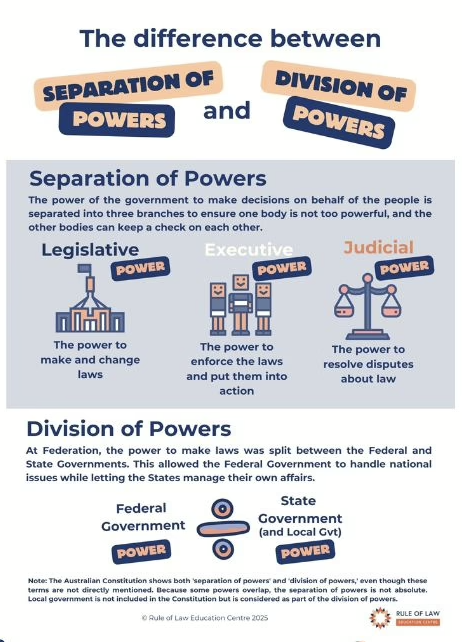
A side-by-side poster comparing the Separation of Powers (between branches) and the Division of Powers (between Federal and State governments). Helps students distinguish these two often-confused constitutional principles.
Difference between the Separation of Powers and the Division of Powers - Poster
Overview
The Separation of Powers and Division of Powers are key elements of our system of governance and are particularly important in limiting the power of each of the branches of government in Australia. The structure of Separation of Powers sees power sharing across the Judiciary, Executive and Legislature preventing overreach by any one branch, with the Constitution explicitly providing the framework and powers of each branch. Our new resource pack explores the difference between the Separation and Division of Powers, the relationship between and responsibilities of each of the branches government, and how they act as a check on the power of the other two.
Tags: separation of powers, division of powers, checks and balances, rule of law, constitutional law, Australian government, civics education
Related Resources
-
Extract and link
-
Description text goes here
Made possible through the support of donors and partners.
Explore Related Topics
-
Constitution
This pilot page uses the conceptual structure and themes from the existing website. Wording can be further refined later, but the framework is aligned with the current website and metadata model.
-
Principles of Legality
This pilot page uses the conceptual structure and themes from the existing website. Wording can be further refined later, but the framework is aligned with the current website and metadata model.
-
Checks and Balances
This pilot page uses the conceptual structure and themes from the existing website. Wording can be further refined later, but the framework is aligned with the current website and metadata model.