
Separation of Powers
-
Explains how the Australian Constitution separates the powers of government into the Legislature, Executive and Judiciary, and how this division maintains checks and balances to protect individual rights and uphold the rule of law.
-
Outlines why the judiciary must remain independent from the legislative and executive branches to ensure impartial decision-making and preserve the rule of law.
-
Compares how judicial independence is upheld across three constitutional systems, examining historical context, institutional safeguards and challenges in Afghanistan, Poland and Australia.
-
A one-page factsheet summarising the three branches of government established by the Australian Constitution and how each prevents excessive concentration of power. Includes complementary classroom activities.
-
Explains the difference between separating power between the Legislature, Executive and Judiciary, and dividing power between Federal and State governments. Designed as a clear classroom reference.
-
Explores the early colonial establishment of the NSW Supreme Court and its role in developing judicial independence and a free press, forming key foundations of Australia’s rule of law tradition.
Development of Democracy in Australia: Establishment of the NSW Supreme Court - History
Overview
From the earliest of days of the NSW Penal Colony, the values and institutions that underpin Australia’s democratic form of government were present. The concept of the separation of powers, with an independent judiciary and freedom of speech (through the free press), were important elements that protected the rights of citizens (both convicts and free) and contributed to a fair society.
These ideals have not been static nor perfectly realised. They have required re-evaluation and reform by brave Australians who have stood up when the protections were not available to all in society.
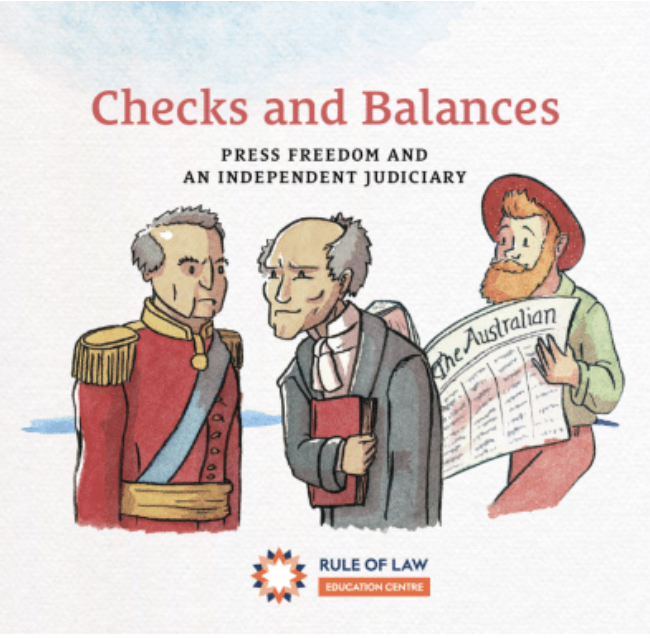
The story of Checks and Balances: Press Freedom and an Independent Judiciary is about one such person, Chief Justice Forbes.
Tags: separation of powers, judicial independence, freedom of the press, rule of law, constitutional law, Australian legal history, Australian government
Book: Checks and Balances: Press Freedom and an Independent Judiciary
Related Resources
-
R v Kirby; Ex parte Boilermakers’ Society of Australia (1956) 94 CLR 254.
Explains the High Court’s decision confirming that judicial power can only be exercised by courts established under Chapter III of the Constitution. The case established the strict separation between judicial and non-judicial functions within federal institutions.
-
A classroom poster illustrating the three branches of government — Legislature, Executive, and Judiciary — and how each provides checks and balances on the others to uphold the rule of law. Designed for use in history, civics, and legal studies classrooms.
Made possible through the support of donors and partners.
Explore Related Topics
-
Constitution
This pilot page uses the conceptual structure and themes from the existing website. Wording can be further refined later, but the framework is aligned with the current website and metadata model.
-
Principles of Legality
This pilot page uses the conceptual structure and themes from the existing website. Wording can be further refined later, but the framework is aligned with the current website and metadata model.
-
Checks and Balances
This pilot page uses the conceptual structure and themes from the existing website. Wording can be further refined later, but the framework is aligned with the current website and metadata model.