
The Federation of Australia
-
This classroom activity uses ten contemporary scenarios to help students apply key constitutional principles—including the Division of Powers, Separation of Powers, judicial independence, and the rule of law—to real‑world conflicts. Students analyse issues such as surveillance, protest bans, environmental regulation, AI judges, and federal–state disputes, identifying which constitutional powers are engaged, what rights or limits are at stake, and what should happen next.
-
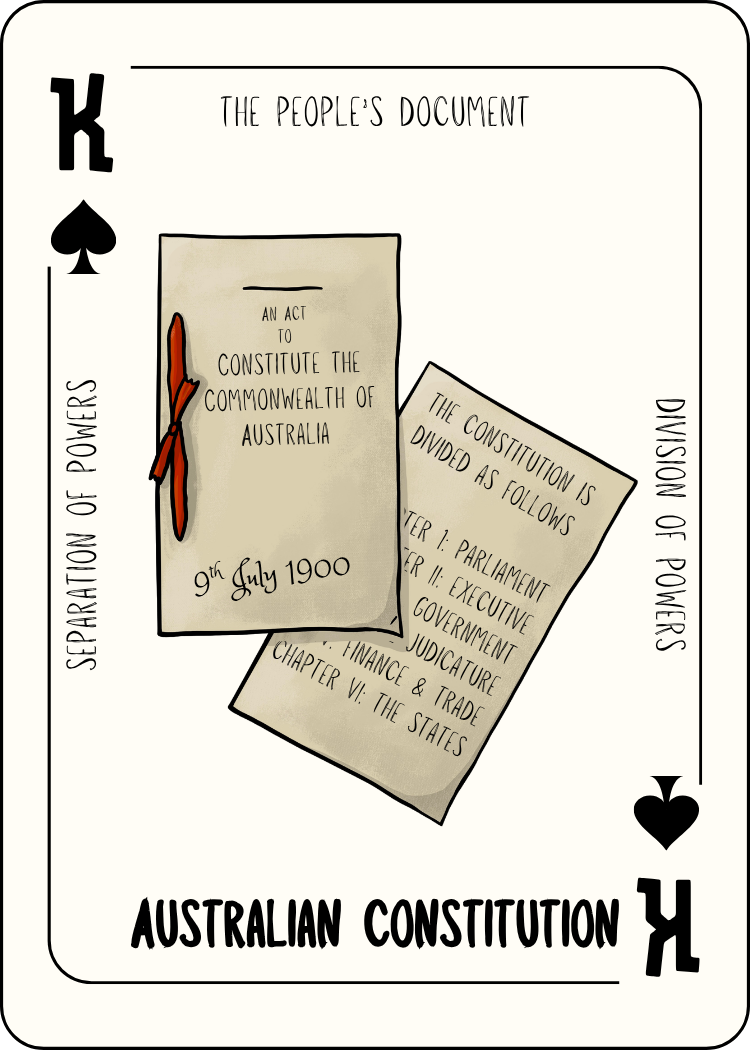
Reflection Activity designed as part of the Informed Civics Competition where students draw on the blank card what they have learned about the concept The Constitution.

Informed: The Role of the Constitution Activity
Scenario Analysis
Approximately 30 minutes
Learning Intentions
Applies knowledge of the Constitution and its role to create solutions to relevant scenarios.
Demonstrates understanding of the relevance of the Constitution to contemporary issues.
Teacher Instructions
Step 1 – Cut out and distribute the scenario cards (see below)
Teacher arranges class into up to 10 groups and gives each group one scenario card.
Step 2 – Group activity
Each group appoints a scribe and discusses:
What part(s) of the Constitution the scenario relates to
What principles are being tested (Division of Powers, Separation of Powers, Rule of Law)
Whether any rights, freedoms or limits on power are being challenged
What should happen next
Groups write key points to share with the class.
Step 3 – Class discussion
Each group presents:
What the issue is
How it connects to the Constitution
What should happen next and why
Teachers should open the scenarios up for discussion as to whether all students agree with the points raised by the group and their interpretation of the issue at hand and what should happen next. Teachers could then conduct a vote by a show of hands for the class as to the decision of the group regarding what should happen next.
Scenario 1: Federal Health Data Sharing vs State Privacy
The Federal Government passes the National Health Information Act requiring States to upload patient records to a national database. Victoria refuses, arguing it violates state privacy laws and raises concerns about data security and consent.
Discussion
How does this show tension between Federal and State powers?
Which parts of the Constitution help resolve conflicts like this?
Scenario 2: Prime Minister’s Secret Surveillance Orders
Parliament passes the Transparency in Surveillance Act, but the Prime Minister secretly orders agencies to continue unreported surveillance. Officials are unsure whether to obey Parliament or the PM.
Discussion
Why must the Executive follow laws passed by Parliament?
What happens if officials ignore laws they disagree with?
Scenario 3: Logging in the Great Forest
Tasmania allows expanded logging in a forest declared a Federal Conservation Zone. State courts uphold the logging law. Logging occurs in a World Heritage area, leaving residents unsure whether it is legal.
Discussion
What challenges arise when Federal and State laws conflict?
How does the Constitution manage these disagreements?
Scenario 4: Protest Ban Near Parliament House
The Federal Government bans protests within 500 metres of Parliament House due to security concerns. Peaceful protesters argue the law suppresses democratic freedoms. Several are arrested.
Discussion
What freedoms might be affected?
How does the Constitution protect rights without a Bill of Rights?
Scenario 5: High Court Meeting
Reports emerge that the Prime Minister privately met with High Court judges to discuss upcoming climate‑related cases, without public knowledge or oversight.
Discussion
Why are secret meetings between the PM and judges problematic?
How does the Constitution protect judicial independence?
Scenario 6: Money Madness
South Australia launches a state‑backed digital currency, the South Coin, to support local businesses and pay wages. It is intended to operate alongside the Australian dollar.
Discussion
Which level of government has exclusive power over currency?
How does this relate to the Division of Powers?
What role might the High Court play?
Scenario 7: Courts Barred from Reviewing Immigration Decisions
Parliament amends the Migration Act to prohibit courts from reviewing immigration detention appeals. Government argues it strengthens border security; advocates warn it undermines the rule of law. The High Court is expected to hear challenges.
Discussion
Why is judicial review vital to separation of powers?
What risks arise when courts cannot review government decisions?
Scenario 8: AI Judges in Minor Criminal Cases
The Federal Government introduces an AI system to issue rulings in minor criminal cases without human judges, aiming to reduce backlogs. WA is asked to trial it.
Discussion
How could AI impact the judiciary’s role under the Constitution?
How does this relate to separation of powers?
Scenario 9: Environmental Concerns
Parliament strengthens protections for the Great Barrier Reef, but the environment minister delays enforcement, citing economic concerns, and refuses to answer questions in Parliament. Environmental groups argue the delay ignores Parliament’s decisions.
Discussion
How does delaying enforcement affect the balance of power?
What role does the Executive have in implementing laws?
Scenario 10: Federal Funding for Schools with Policy Conditions
The Federal Government offers States extra school funding only if they adopt a new standardised curriculum. Queensland refuses, arguing its own curriculum is effective. The Federal Government threatens to withhold funding.
Discussion
How does funding influence the balance of power?
What does this show about Federation and shared responsibilities?
Related Resources
-
An overview of the key features of the Australian Constitution, including its role as the highest source of law, its democratic structure, and its deliberate division and separation of powers. It explains federalism, the responsibilities of the Parliament, Executive and Judiciary, the High Court’s constitutional role, and the Constitution’s reliance on the rule of law and responsible government rather than a full Bill of Rights.
-
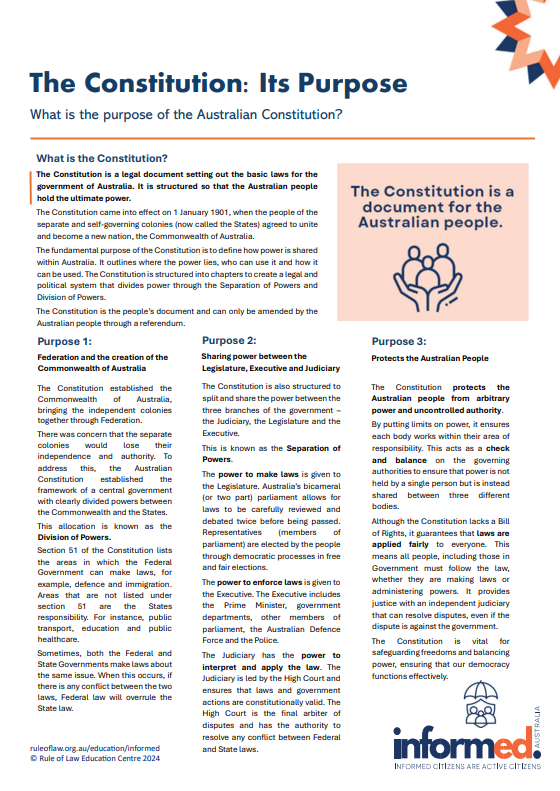
This fact sheet explains the purpose of the Australian Constitution, outlining how it creates the Commonwealth, divides law‑making powers between the Commonwealth and the States, and separates authority between the Legislature, Executive and Judiciary. It highlights how the Constitution limits government power, ensures democratic accountability, and protects Australians by requiring all branches to act within the law and under High Court supervision.
-
This poster forms part of the Informed Playing Card Project, using a playing‑card design to show the Australian Constitution as the people’s document that creates, divides, and limits government power.
-
This video outlines why the Australian Constitution exists, showing how it creates the Commonwealth, divides and limits government power, and ensures that all branches of government remain accountable to the people. It highlights the Constitution’s role as the nation’s foundational rulebook, explaining how it structures democratic government, prevents the misuse of power, and provides a stable framework for law‑making and rights protection.
Explore Related Topics
-
The Division of Powers
Explore resources on the division of powers, showing how power is shared between the Commonwealth and states under the Constitution through defined responsibilities.
-
Australia: Making a Nation
This collection of resources is aligned to the NSW History 7–10 Depth Study Australia: Making a Nation, supporting student learning from Federation through to World War I.
-
Democracy
Explore resources on democracy, highlighting how accountability and representative institutions ensure power is exercised fairly and transparently through open processes, civic engagement and responsible governance.