
The Federation of Australia
-
This classroom activity uses ten contemporary scenarios to help students apply key constitutional principles—including the Division of Powers, Separation of Powers, judicial independence, and the rule of law—to real‑world conflicts. Students analyse issues such as surveillance, protest bans, environmental regulation, AI judges, and federal–state disputes, identifying which constitutional powers are engaged, what rights or limits are at stake, and what should happen next.
-
Reflection Activity designed as part of the Informed Civics Competition where students draw on the blank card what they have learned about the concept The Constitution.
The Constitution Reflection
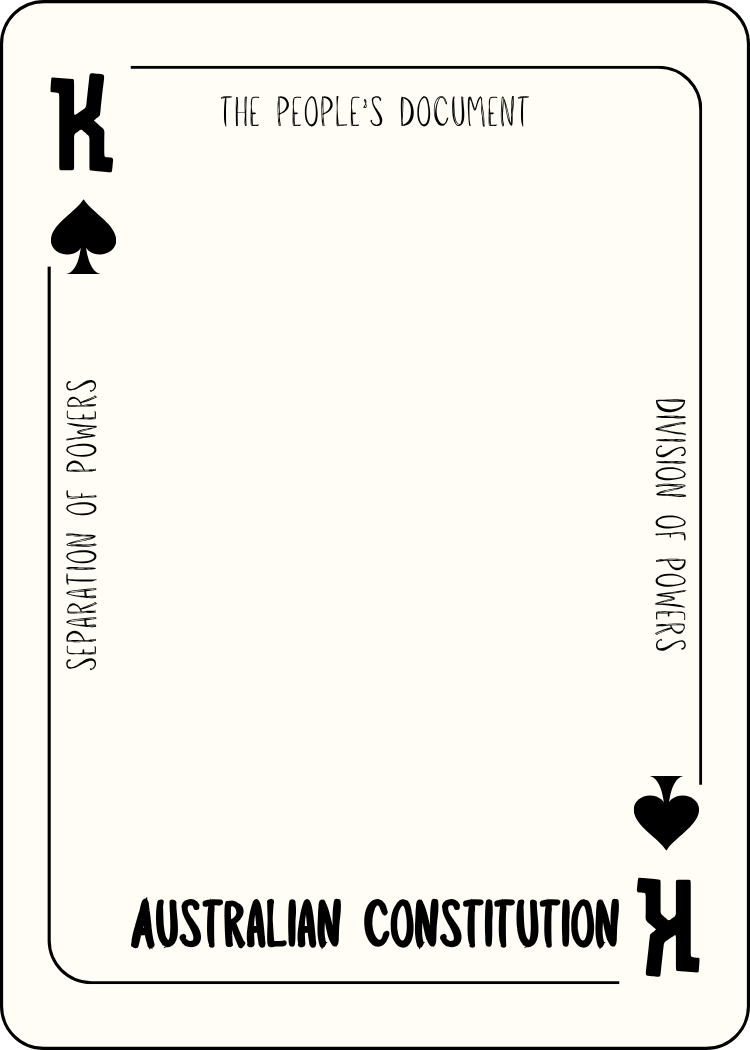
Blank playing card visual reflection activity
Students use this blank playing card as a reflection tool, turning their learning about the Australian Constitution into a single, memorable visual. Before drawing, students read the factsheet on the Australian Constitution here to build a clear understanding of how the Constitution structures power, connects people to government, and underpins Australia’s democratic system. Designing the card encourages students to distil these key ideas and concepts into a personal, visual summary of their understanding.
Students can submit this completed playing‑card drawing to the Informed Civics Competition for a chance to win!
See suggested drawing prompts below:
Suggested drawing prompt:
Students draw “democracy tree” where the roots represent people and shared democratic values, the trunk represents the Australian Constitution, and the branches represent Parliament, Executive, and Judiciary. They add leaves showing individuals participating in democracy (e.g., voting, following laws, engaging in debate).
Students create a six‑section visual diagram combining the two core constitutional structures:
Three branches (separation of powers - Parliament, Executive, Judiciary); and
three levels (division of powers -Federal, State, Local).
In each section, they draw a simple stick‑figure scene showing how power is exercised
Related Resources
-
This fact sheet explains the purpose of the Australian Constitution, outlining how it creates the Commonwealth, divides law‑making powers between the Commonwealth and the States, and separates authority between the Legislature, Executive and Judiciary. It highlights how the Constitution limits government power, ensures democratic accountability, and protects Australians by requiring all branches to act within the law and under High Court supervision.
-
This poster forms part of the Informed Playing Card Project, using a playing‑card design to show the Australian Constitution as the people’s document that creates, divides, and limits government power.
-
This video outlines why the Australian Constitution exists, showing how it creates the Commonwealth, divides and limits government power, and ensures that all branches of government remain accountable to the people. It highlights the Constitution’s role as the nation’s foundational rulebook, explaining how it structures democratic government, prevents the misuse of power, and provides a stable framework for law‑making and rights protection.
Explore Related Topics
-
The Division of Powers
Explore resources on the division of powers, showing how power is shared between the Commonwealth and states under the Constitution through defined responsibilities.
-
Aboriginal & Torres Strait Islanders
Explore our resources on Aboriginal and Torres Strait Islander peoples, outlining legal history, cultural traditions, land rights, and contemporary justice issues in Australia.
-
Democracy
Explore resources on democracy, highlighting how accountability and representative institutions ensure power is exercised fairly and transparently through open processes, civic engagement and responsible governance.