
The Federation of Australia
-
This case note traces major historical milestones—from early colonial councils and the secret ballot to women’s suffrage, Federation, and the creation of the High Court—showing how democratic rights and institutions developed to ensure accountability, equality before the law, and stable, rule‑of‑law‑based government.
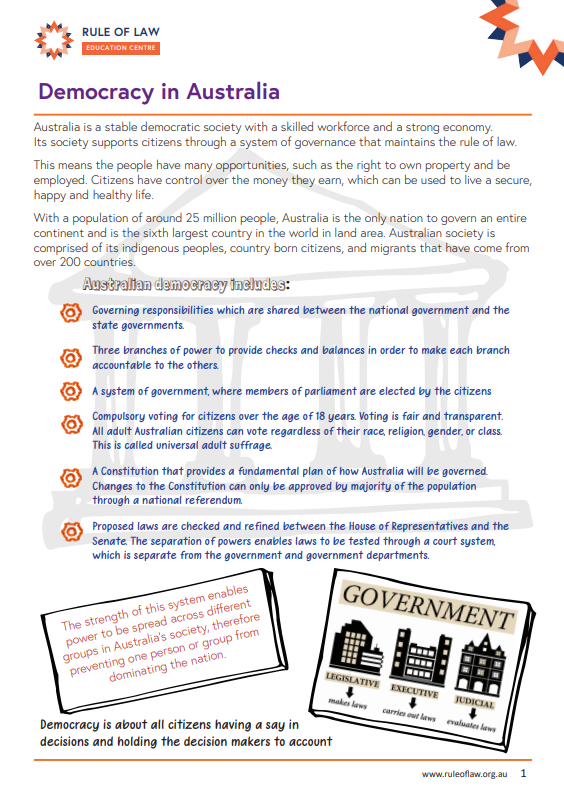
Democracy in Australia
Australia is a stable democratic society with a skilled workforce and a strong economy. Its society supports citizens through a system of governance that maintains the rule of law.
This means the people have many opportunities, such as the right to own property and be employed. Citizens have control over the money they earn, which can be used to live a secure, happy and healthy life.
With a population of around 25 million people, Australia is the only nation to govern an entire continent and is the sixth largest country in the world in land area. Australian society is comprised of its Indigenous peoples, country‑born citizens, and migrants from over 200 countries.
Australian democracy includes:
Governing responsibilities shared between national and state governments.
Three branches of power providing checks and balances.
A system where members of parliament are elected by citizens.
Compulsory, fair, and transparent voting for citizens over 18 (universal adult suffrage).
A Constitution outlining how Australia is governed, with changes requiring a national referendum.
Proposed laws being checked between the House of Representatives and the Senate, with courts independently testing laws.
Democracy is about all citizens having a say in decisions and holding decision‑makers to account.
The strength of this system enables power to be spread across different groups in Australia’s society, therefore preventing one person or group from dominating the nation.
The development of representative democracy in Australia
There have been many key events in history that reflect how representative society has developed in Australia. Colonies struggled to form systems of government based on rule‑of‑law principles. Wealthy landowners and emancipated convicts worked together to achieve liberties and rights for all.
Active and engaged citizens can effect change
1788 – A printing press arrives with the First Fleet, enabling public debate and political campaigns. By 1803, the first newspaper is published.
1819 – Emancipists petition the British Parliament about the lack of an effective and fair legal system.
1854 – Eureka Rebellion: miners clash with government troops over inequitable mining licences, protesting corruption and brutality.
1870 – First payment for Members of Parliament in Victoria, ending the practice of only wealthy men serving.
An inclusive and equitable society
1868 – Convict transportation ends.
1898–1900 – Federation referendums; Edmund Barton becomes Australia’s first Prime Minister.
1901 – The Commonwealth of Australia is proclaimed; the Constitution creates a federation of six colonies.
Free and transparent elections
1820s – A council is created in NSW to advise the governor; members appointed by the British Parliament.
1843 – First NSW parliamentary election; ex‑convicts eligible to vote and stand.
1856 – South Australia introduces “one man one vote.”
1855–1857 – Colonies become self‑governing with constitutions and bicameral parliaments.
1856 – Secret ballot introduced in SA and Victoria.
1894 – Female suffrage in South Australia.
1901 – First federal parliament opens.
1924 – Compulsory voting introduced.
1963 – Universal suffrage achieved for all citizens regardless of race, gender, income, or status.
The rule of law — everyone is equal before the law
1787 – First Charter of Justice for NSW courts.
1788 – First civil case: a convict couple successfully sue their ship captain.
1824 – First trial by jury.
1903 – High Court established to interpret the Constitution and resolve federal–state disputes; three judges including Sir Edmund Barton.
Related Resources
-
This poster forms part of the Informed Playing Card Project, using a playing‑card design to show the Australian Constitution as the people’s document that creates, divides, and limits government power.
-
This video outlines the purpose and key features of the Australian Constitution, including the Separation of Powers, Division of Powers, and the role of the High Court in interpreting and enforcing the nation’s foundational rules. It explains how constitutional change occurs through referendums, why Australia deliberately avoided a bill of rights, and how the Constitution limits government power while supporting a stable, democratic system.
-
This fact sheet outlines the major steps towards Federation, from the 1897–98 Constitutional Conventions and the 1899 referendums through to the passage of the Constitution by the British Parliament in 1900 and the inauguration of the Commonwealth in 1901. It highlights the political negotiations, public votes, and legal milestones that shaped Australia’s Constitution and established the framework for a unified federal nation.
Explore Related Topics
-
The Division of Powers
Explore resources on the division of powers, showing how power is shared between the Commonwealth and states under the Constitution through defined responsibilities.
-
Aboriginal & Torres Strait Islanders
Explore our resources on Aboriginal and Torres Strait Islander peoples, outlining legal history, cultural traditions, land rights, and contemporary justice issues in Australia.
-
Democracy
Explore resources on democracy, highlighting how accountability and representative institutions ensure power is exercised fairly and transparently through open processes, civic engagement and responsible governance.