
The Federation of Australia
-
This explainer outlines how the Australian Constitution structures government through the separation and division of powers, ensuring that law‑making, executive action, and judicial decision‑making remain distinct and accountable. It highlights how the Constitution limits arbitrary power, provides checks and balances, protects a small number of express rights, and relies on democratic processes and judicial review to uphold the rule of law.
-
This explainer outlines why Constitution Day on 9 July marks Australia’s legal ‘birth’, celebrating the passage of the Commonwealth of Australia Constitution Act 1900 and the unification of six British colonies into one federal nation. It traces the path to Federation—including trade barriers, immigration concerns, democratic reforms, and Henry Parkes’ push for national unity—and highlights how the Constitution created a federal system, limited government power, and embedded the rule of law as Australia’s highest legal authority.
-
This fact sheet explains the purpose of the Australian Constitution, outlining how it creates the Commonwealth, divides law‑making powers between the Commonwealth and the States, and separates authority between the Legislature, Executive and Judiciary. It highlights how the Constitution limits government power, ensures democratic accountability, and protects Australians by requiring all branches to act within the law and under High Court supervision.
-
This fact sheet outlines the major steps towards Federation, from the 1897–98 Constitutional Conventions and the 1899 referendums through to the passage of the Constitution by the British Parliament in 1900 and the inauguration of the Commonwealth in 1901. It highlights the political negotiations, public votes, and legal milestones that shaped Australia’s Constitution and established the framework for a unified federal nation.
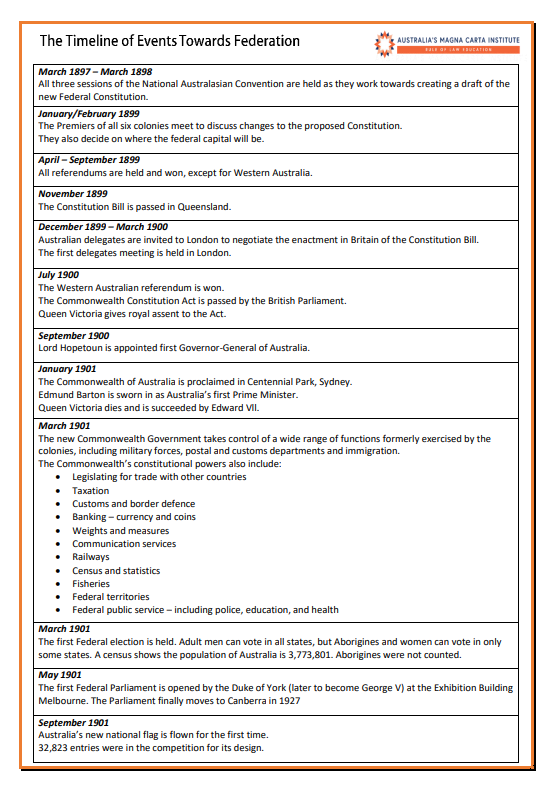
Timeline of Events Towards Federation
March 1897 – March 1898
All three sessions of the National Australasian Convention are held as they work towards creating a draft of the new Federal Constitution.
January/February 1899
The Premiers of all six colonies meet to discuss changes to the proposed Constitution. They also decide on where the federal capital will be.
April – September 1899
All referendums are held and won, except for Western Australia.
November 1899
The Constitution Bill is passed in Queensland.
December 1899 – March 1900
Australian delegates are invited to London to negotiate the enactment in Britain of the Constitution Bill. The first delegates meeting is held in London.
July 1900
The Western Australian referendum is won. The Commonwealth Constitution Act is passed by the British Parliament. Queen Victoria gives royal assent to the Act.
September 1900
Lord Hopetoun is appointed first Governor-General of Australia.
January 1901
The Commonwealth of Australia is proclaimed in Centennial Park, Sydney. Edmund Barton is sworn in as Australia’s first Prime Minister. Queen Victoria dies and is succeeded by Edward Vll.
March 1901
The new Commonwealth Government takes control of a wide range of functions formerly exercised by the colonies, including military forces, postal and customs departments and immigration. The Commonwealth’s constitutional powers also include:
Legislating for trade with other countries
Taxation • Customs and border defence
Banking – currency and coins
Weights and measures
Communication services
Railways • Census and statistics
Fisheries • Federal territories
Federal public service – including police, education, and health
March 1901
The first Federal election is held. Adult men can vote in all states, but Aborigines and women can vote in only some states. A census shows the population of Australia is 3,773,801. Aborigines were not counted.
May 1901
The first Federal Parliament is opened by the Duke of York (later to become George V) at the Exhibition Building Melbourne. The Parliament finally moves to Canberra in 1927
September 1901
Australia’s new national flag is flown for the first time. 32,823 entries were in the competition for its design.
Related Resources
-
This poster forms part of the Informed Playing Card Project, using a playing‑card design to show the Australian Constitution as the people’s document that creates, divides, and limits government power.
-
This video outlines the purpose and key features of the Australian Constitution, including the Separation of Powers, Division of Powers, and the role of the High Court in interpreting and enforcing the nation’s foundational rules. It explains how constitutional change occurs through referendums, why Australia deliberately avoided a bill of rights, and how the Constitution limits government power while supporting a stable, democratic system.
-
This case note traces major historical milestones—from early colonial councils and the secret ballot to women’s suffrage, Federation, and the creation of the High Court—showing how democratic rights and institutions developed to ensure accountability, equality before the law, and stable, rule‑of‑law‑based government.
Explore Related Topics
-
The Division of Powers
Explore resources on the division of powers, showing how power is shared between the Commonwealth and states under the Constitution through defined responsibilities.
-
Aboriginal & Torres Strait Islanders
Explore our resources on Aboriginal and Torres Strait Islander peoples, outlining legal history, cultural traditions, land rights, and contemporary justice issues in Australia.
-
Democracy
Explore resources on democracy, highlighting how accountability and representative institutions ensure power is exercised fairly and transparently through open processes, civic engagement and responsible governance.