
First Civil Case Cable v Sinclair
-
Suggested Lesson Plans for the Lost Parcel, including a suggested 3-4 period lesson plan (approximately 2-4 hours) for teachers wanting to teach the story book The Lost Parcel and the story of the Kables. This includes detailing learning intention, success criteria and outlines for the structure of the lessons.
-
Stories of the First Fleet: Knowledge and Understanding. Using short answer questions, this resource uses the book ‘The Lost Parcel’ to investigate the lives of two convicts Henry and Susannah Kable, their reasons for transportation with the First Fleet, the attitudes of the English community to their plight and their experiences in the early colony.
-
Stories of the First Fleet: Investigating Source Documents. This resource uses two source documents, a letter from Reverend Richard Johnson, and the Charge Sheet from the NSW Court of Civil Proceedings (see below) to investigate the lives of Henry and Susannah Kable and their experiences with the legal system in the early colony.
-
Timeline Worksheet. Using the details from the Lost Parcel Book or their own research, students can complete this timeline of events.
-
Write your own Play or Narrative. This activity helps students create a play or narrative story to deepen their understanding of the story of Henry and Susannah and their
lost parcel.
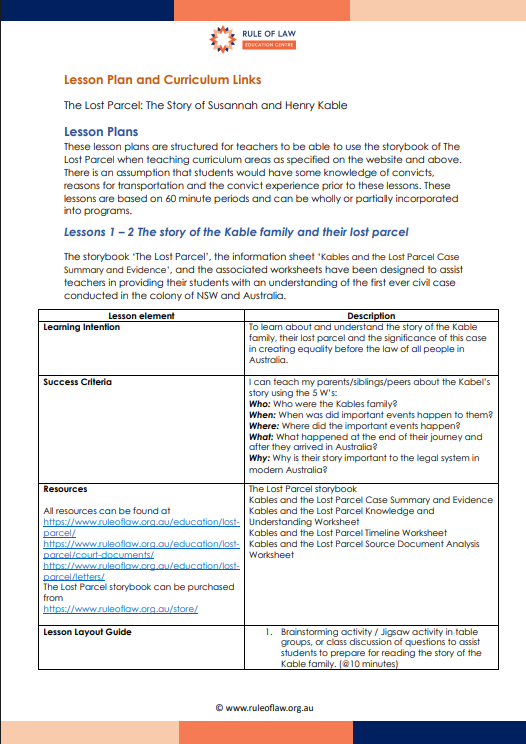
Lesson Plan and Curriculum Links
The Lost Parcel: The Story of Susannah and Henry Kable
Lesson Plans
These lesson plans are structured for teachers to be able to use the storybook of The Lost Parcel when teaching curriculum areas as specified on the website and above.
There is an assumption that students would have some knowledge of convicts, reasons for transportation and the convict experience prior to these lessons.
These lessons are based on 60 minute periods and can be wholly or partially incorporated into programs.
Lessons 1 – 2 The story of the Kable family and their lost parcel
The storybook ‘The Lost Parcel’, the information sheet ‘Kables and the Lost Parcel Case Summary and Evidence’, and the associated worksheets have been designed to assist teachers in providing their students with an understanding of the first ever civil case conducted in the colony of NSW and Australia.
Learning Intention: To learn about and understand the story of the Kable family, their lost parcel and the significance of this case in creating equality before the law of all people in Australia.
Success Criteria: I can teach my parents/siblings/peers about the Kabel’s story using the 5 W’s: Who: Who were the Kables family? When: When was did important events happen to them? Where: Where did the important events happen? What: What happened at the end of their journey and after they arrived in Australia? Why: Why is their story important to the legal system in modern Australia?
Resources:
The Lost Parcel storybook
Kables and the Lost Parcel Case Summary and Evidence
Kables and the Lost Parcel Knowledge and Understanding Worksheet
Kables and the Lost Parcel Timeline Worksheet
Kables and the Lost Parcel Source Document Analysis Worksheet
Lesson Layout Guide:
Brainstorming activity / Jigsaw activity in table groups, or class discussion of questions to assist students to prepare for reading the story of the Kable family. (@10 minutes)
What was life like in England in the 1700’s? Why were there so many prisoners in Britain?
What did the government choose to do about this problem?
What kinds of crimes did people commit to be sentenced to death?
What was the journey like? How was the colony organised when they arrived?
What was life like in the colony for convicts?
Read The Lost Parcel as a class.
Review the key aspects of the story as a class (Crimes committed, sentences, humane goaler, parcel, marriage, civil case)
Students to complete worksheets above working in groups or pairs. You could allocate one sheet per group as a jigsaw type activity to reduce workload and time for students and get them to then share the information.
Review solutions to worksheets with your class in a way that matches how you have allocated the activity and allows students to share their findings in different ways.
Lesson 3-4 – Creating a play of the story of The Lost Parcel
Students will need a copy of the Activity Sheet: Write and Perform a Short Play or Narrative to complete this activity. Given the number of characters needed, groups could have up to 11 people in them, or students could double up on some roles played.
Learning Intention: To create a play or narrative story that would help primary students understand the story of Henry and Susannah and their lost parcel.
Success Criteria: We have written a script and can perform our interpretation of the story of the Kable’s using a play or narrative format.
Resources:
The Lost Parcel storybook
Kables and the Lost Parcel Case Summary and Evidence
Kables and the Lost Parcel Knowledge and Understanding Worksheet
Kables and the Lost Parcel Timeline Worksheet
Kables and the Lost Parcel Source Document Analysis Worksheet
Lesson Layout Guide:
Review the learnings from lessons 1-2 and the key aspects of the Kable’s story as a class (Crimes committed, sentences, humane goaler, parcel, marriage, civil case)
Take students through the activity instructions as detailed on ‘Kables and the Lost Parcel Write Own Play or Narrative Worksheet’
Teachers may need to allow 2 -3 lessons of time for the groups to be able to write and perform their plays, depending on the students in the class.
Curriculum Links
The story of The Lost Parcel can be used across both Civics and Citizenship, Commerce and History Curricula. Please consult the relevant curriculum/ syllabus elaborations to create the most suitable place for the use of these resources for your students. Most links provided below are knowledge and understanding links. Many skills links have not been provided to minimise the volume of information. Please contact our team if you would like any assistance identifying curriculum links at education@ruleoflaw.org.au.
Civics and Citizenship, Commerce
Aus (v9) HASS – Civics and Citizenship
Year 6 Civics and Citizenship (AC9HS6K06): The key institutions of Australia’s system of government, how it is based on the Westminster system, and the key values and beliefs of Western democracies
Year 7 Laws and Citizens (AC9HC7K03): The key principles and features of the Australian legal system, including the Australian Constitution, the rule of law and the court system
Citizenship, diversity and identity (AC9HC7K05) How values based on freedom, respect, fairness and equality of opportunity can support social cohesion and democracy within Australian society
Year 8 Laws and Citizens (AC9HC8K04) The types of law in Australia, including criminal law and civil law, and the place of First Nations Australian customary law
NSW Commerce
Year 9/10 Core 4: Law, Society and Political Involvement (COM5- 3) Examines the role of law in society – outlines types of laws, including criminal and civil
NSW History
Year 5/6 and Year 9/10 Making a Nation
Vic Humanities F-10 Civics and Citizenship
Year 7/8 Law and Citizens (VCCCL022) Explain how Australia’s legal system aims to provide justice, including through the rule of law, presumption of innocence, burden of proof, right to a fair trial and right to legal representation
Year 9/10 Law and Citizens (VCCCL034) Discuss the key principles of Australia’s justice system, including equality before the law, independent judiciary, and right of appeal
Related Resources
-
Summary of the first civil case in NSW : Cable v Sinclair in July 1788. The Cables (Kables) were a poor convict couple and Sinclair was the powerful captain of one of the ships in the First Fleet. This is a summary of the court case and outlines the evidence given during the trial.
-
Suggested Lesson Plans for the Lost Parcel, including a suggested 3-4 period lesson plan (approximately 2-4 hours) for teachers wanting to teach the story book The Lost Parcel and the story of the Kables. This includes detailing learning intention, success criteria and outlines for the structure of the lessons.
-
Stories of the First Fleet: Knowledge and Understanding. Using short answer questions, this resource uses the book ‘The Lost Parcel’ to investigate the lives of two convicts Henry and Susannah Kable, their reasons for transportation with the First Fleet, the attitudes of the English community to their plight and their experiences in the early colony.
-
Stories of the First Fleet: Investigating Source Documents. This resource uses two source documents, a letter from Reverend Richard Johnson, and the Charge Sheet from the NSW Court of Civil Proceedings (see below) to investigate the lives of Henry and Susannah Kable and their experiences with the legal system in the early colony.
-
Read the text of Cable v Sinclair [1788] NSW KR 7, Court of Civil Jurisdiction Proceedings, was written on behalf of the Kables (who at the time were illiterate), and addressed to the Judge Advocate of the colony, David Collins. This was the first civil case that was held in the new colony of New South Wales.
Made possible through the support of donors and partners.
Explore Related Topics
-
Equality Before the Law
Outlines the core ideas behind the principle that all individuals are subject to the same laws and entitled to equal legal protection.
-
Civil Law
Civil law deals with disputes between individuals, groups and organisations. It provides fair processes for resolving conflicts, enforcing rights and awarding remedies.
-
Aboriginal and Torres Strait Islander People
The British applied the doctrine of terra nullius to justify claiming sovereignty over Australia, based on assumptions about agriculture, population, and Indigenous law.