
First Civil Case Cable v Sinclair
-
Suggested Lesson Plans for the Lost Parcel, including a suggested 3-4 period lesson plan (approximately 2-4 hours) for teachers wanting to teach the story book The Lost Parcel and the story of the Kables. This includes detailing learning intention, success criteria and outlines for the structure of the lessons.
-
Stories of the First Fleet: Knowledge and Understanding. Using short answer questions, this resource uses the book ‘The Lost Parcel’ to investigate the lives of two convicts Henry and Susannah Kable, their reasons for transportation with the First Fleet, the attitudes of the English community to their plight and their experiences in the early colony.
-
Stories of the First Fleet: Investigating Source Documents. This resource uses two source documents, a letter from Reverend Richard Johnson, and the Charge Sheet from the NSW Court of Civil Proceedings (see below) to investigate the lives of Henry and Susannah Kable and their experiences with the legal system in the early colony.
-
Timeline Worksheet. Using the details from the Lost Parcel Book or their own research, students can complete this timeline of events.
-
Write your own Play or Narrative. This activity helps students create a play or narrative story to deepen their understanding of the story of Henry and Susannah and their
lost parcel.
Susannah and Henry Kable and the Lost Parcel
Source Document Analysis
Reverend Johnson Letter
Original can be found at Historical Records of New South Wales Volume 1 Part 2 (1783-1792)
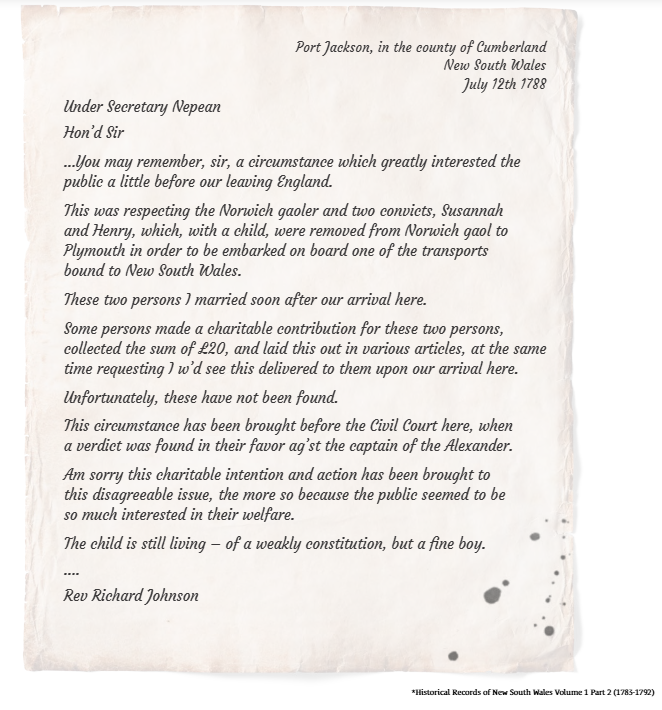
What type of document is this? Is it a primary or secondary source of information?
Who wrote this document?
Would the original letter be handwritten, typed, or both?
What date was the document written?
Who received this document and what was their role?
Why was this letter written? Give two quotes (words from the document) that support your reason.
The Charge Brought to Court
Cable v Sinclair [1788] NSW KR 7, Court of Civil Jurisdiction Proceeding.
Original can be found here:
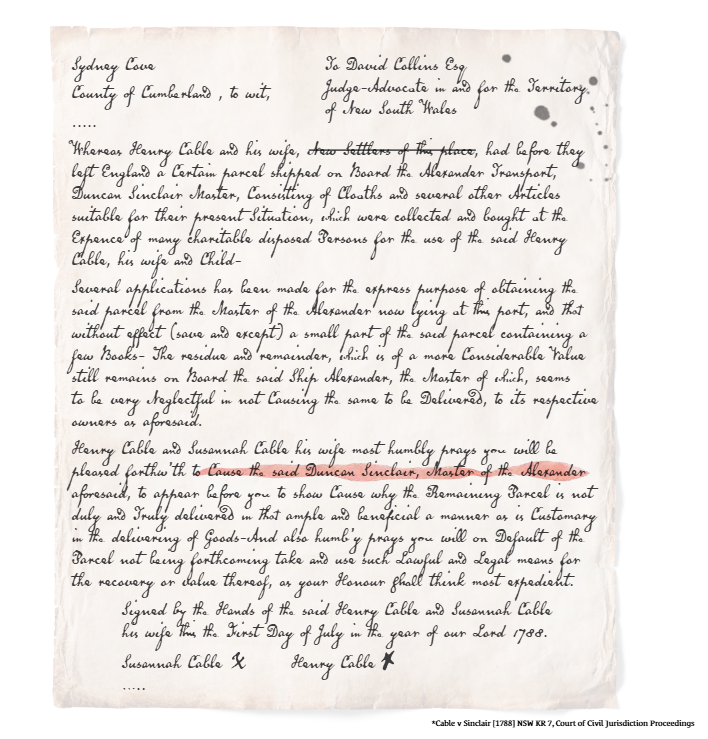
What type of document is this? Is it a primary or secondary source of information?
Who is the document addressed to?
What is the date of the document?
In official documents, the occupation of a person is usually written after his or her name. In this document, the occupation of Henry is crossed out. What should have been written for Henry?
Why would the writer of the document have not recorded a correct description of Henry’s occupation?
Who was named in the document to appear before the Court to explain what happened to the lost parcel? What was his occupation?
Susannah and Henry signed their name with an X. Why would they have done that?
What help would Henry and Susannah have needed in preparing this document?
In this document, what were Henry and Susannah asking the Ship’s Master to do?
Define the following words from the document:
Summoned. Restitution. Affidavit
Finish this sentence in your own words:
In this charge brought to court, Henry and Susannah were requesting
A key principle of the legal system is that all people should be treated equally by the law and receive equal protection from the law. How does this document show that Susannah and Henry were treated equally by the law?
Related Resources
-
Summary of the first civil case in NSW : Cable v Sinclair in July 1788. The Cables (Kables) were a poor convict couple and Sinclair was the powerful captain of one of the ships in the First Fleet. This is a summary of the court case and outlines the evidence given during the trial.
-
Suggested Lesson Plans for the Lost Parcel, including a suggested 3-4 period lesson plan (approximately 2-4 hours) for teachers wanting to teach the story book The Lost Parcel and the story of the Kables. This includes detailing learning intention, success criteria and outlines for the structure of the lessons.
-
Stories of the First Fleet: Investigating Source Documents. This resource uses two source documents, a letter from Reverend Richard Johnson, and the Charge Sheet from the NSW Court of Civil Proceedings (see below) to investigate the lives of Henry and Susannah Kable and their experiences with the legal system in the early colony.
-
Read the text of Cable v Sinclair [1788] NSW KR 7, Court of Civil Jurisdiction Proceedings, was written on behalf of the Kables (who at the time were illiterate), and addressed to the Judge Advocate of the colony, David Collins. This was the first civil case that was held in the new colony of New South Wales.
Made possible through the support of donors and partners.
Explore Related Topics
-
Equality Before the Law
Outlines the core ideas behind the principle that all individuals are subject to the same laws and entitled to equal legal protection.
-
Civil Law
Civil law deals with disputes between individuals, groups and organisations. It provides fair processes for resolving conflicts, enforcing rights and awarding remedies.
-
Aboriginal and Torres Strait Islander People
The British applied the doctrine of terra nullius to justify claiming sovereignty over Australia, based on assumptions about agriculture, population, and Indigenous law.