
First Civil Case Cable v Sinclair
-
The Lost Parcel Storybook is a true account of convicts Henry and Susannah Kable as they fight for their property rights in the new NSW penal colony. The book uses original letters, court records, and newspapers to help families and schools explore equality before the law, access to justice, and Australia’s democratic heritage.
-
One page Character Card that tells the true story of convict Henry Kable, the crime that took him here, how he met his wife Susannah, his involvement in the first civil case in the colony and how this event led to him becoming a wealthy businessman and the relation to many Kables in Australia today.
-
One page Character Card that tells the true story of Captain Duncan Sinclair, ships captain in the First Fleet who was held responsible for a parcel of goods held on the First Fleet by a convict couple
-
One page Character Card that tells the true story of Reverend Johnson in the early penal colony and his involvement in the first civil case between the convict Kable family and ship's captain, Duncan Sinclair.
-
The true story of convict Susannah Kable and the crime that brought her here, how she met Henry and had a child in prison and her experiences on the First Fleet Journey.
The Lost Parcel Story
Susannah and Henry Kable and the first civil case in NSW
How a parcel lost on the First Fleet shaped justice, fairness, equality and the rule of law in Australia.
The story culminates in the first civil case in New South Wales (Cable v Sinclair [1788] NSW KR 7, Court of Civil Jurisdiction), where the poor convict couple sued the mighty ship’s captain for their lost parcel and won! Setting the democratic foundations of our nation today that the law must be applied equally and fairly to all, and people should have equal access to the protections provided by the law.
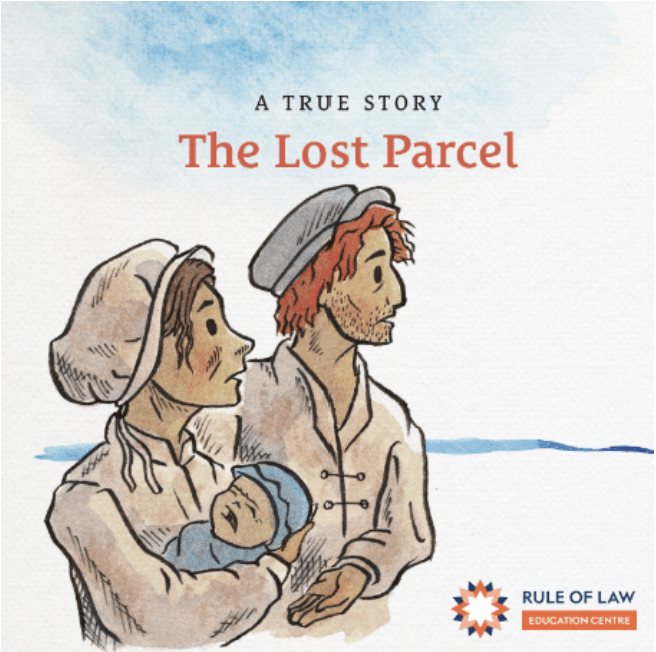
The Lost Parcel Storybook
A captivating true story of a convict couple, Henry and Susannah Kable and the disappearance of their parcel of belongings on their journey on the First Fleet.
A beautifully illustrated and well-researched picture book that uses source documents such as letters, transcripts and newspaper articles.
Aligned with the Australian Curriculum Civics and Citizenship strand, this storybook is for families and schools to help understand the principles of justice, fairness, equality and the rule of law.
Related Resources
-
Summary of the first civil case in NSW : Cable v Sinclair in July 1788. The Cables (Kables) were a poor convict couple and Sinclair was the powerful captain of one of the ships in the First Fleet. This is a summary of the court case and outlines the evidence given during the trial.
-
Suggested Lesson Plans for the Lost Parcel, including a suggested 3-4 period lesson plan (approximately 2-4 hours) for teachers wanting to teach the story book The Lost Parcel and the story of the Kables. This includes detailing learning intention, success criteria and outlines for the structure of the lessons.
-
Stories of the First Fleet: Knowledge and Understanding. Using short answer questions, this resource uses the book ‘The Lost Parcel’ to investigate the lives of two convicts Henry and Susannah Kable, their reasons for transportation with the First Fleet, the attitudes of the English community to their plight and their experiences in the early colony.
-
Stories of the First Fleet: Investigating Source Documents. This resource uses two source documents, a letter from Reverend Richard Johnson, and the Charge Sheet from the NSW Court of Civil Proceedings (see below) to investigate the lives of Henry and Susannah Kable and their experiences with the legal system in the early colony.
-
Read the text of Cable v Sinclair [1788] NSW KR 7, Court of Civil Jurisdiction Proceedings, was written on behalf of the Kables (who at the time were illiterate), and addressed to the Judge Advocate of the colony, David Collins. This was the first civil case that was held in the new colony of New South Wales.
Made possible through the support of donors and partners.
Explore Related Topics
-
Equality Before the Law
Outlines the core ideas behind the principle that all individuals are subject to the same laws and entitled to equal legal protection.
-
Civil Law
Civil law deals with disputes between individuals, groups and organisations. It provides fair processes for resolving conflicts, enforcing rights and awarding remedies.
-
Aboriginal and Torres Strait Islander People
The British applied the doctrine of terra nullius to justify claiming sovereignty over Australia, based on assumptions about agriculture, population, and Indigenous law.