
First Civil Case Cable v Sinclair
-
The Lost Parcel Storybook is a true account of convicts Henry and Susannah Kable as they fight for their property rights in the new NSW penal colony. The book uses original letters, court records, and newspapers to help families and schools explore equality before the law, access to justice, and Australia’s democratic heritage.
-
One page Character Card that tells the true story of convict Henry Kable, the crime that took him here, how he met his wife Susannah, his involvement in the first civil case in the colony and how this event led to him becoming a wealthy businessman and the relation to many Kables in Australia today.
-
One page Character Card that tells the true story of Captain Duncan Sinclair, ships captain in the First Fleet who was held responsible for a parcel of goods held on the First Fleet by a convict couple
-
One page Character Card that tells the true story of Reverend Johnson in the early penal colony and his involvement in the first civil case between the convict Kable family and ship's captain, Duncan Sinclair.
-
The true story of convict Susannah Kable and the crime that brought her here, how she met Henry and had a child in prison and her experiences on the First Fleet Journey.
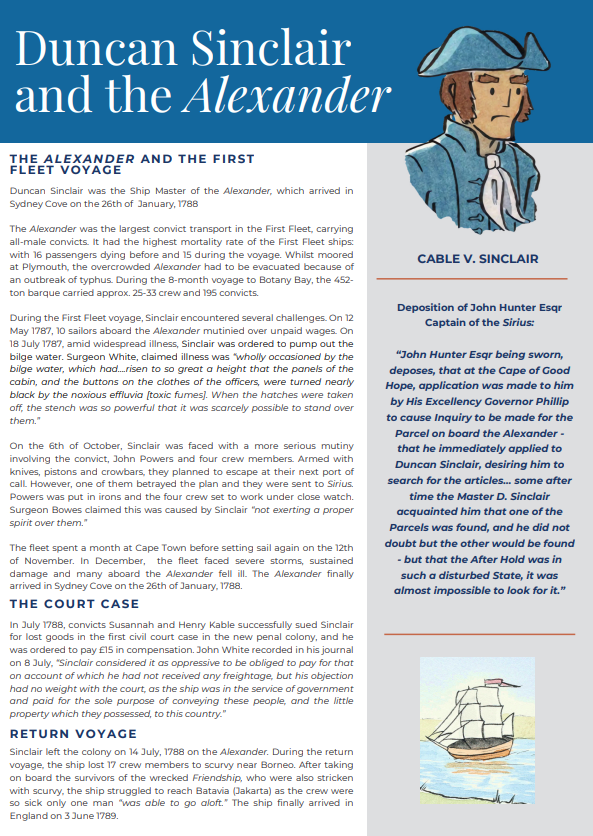
Duncan Sinclair and the Alexander
First Fleet Ship
Duncan Sinclair was the Ship Master of the Alexander, which arrived in Sydney Cove on the 26th of January, 1788.
The Alexander was the largest convict transport in the First Fleet, carrying all-male convicts. It had the highest mortality rate of the First Fleet ships: with 16 passengers dying before and 15 during the voyage. Whilst moored at Plymouth, the overcrowded Alexander had to be evacuated because of an outbreak of typhus. During the 8-month voyage to Botany Bay, the 452- ton barque carried approx. 25-33 crew and 195 convicts.
During the First Fleet voyage, Sinclair encountered several challenges. On 12 May 1787, 10 sailors aboard the Alexander mutinied over unpaid wages. On 18 July 1787, amid widespread illness, Sinclair was ordered to pump out the bilge water. Surgeon White, claimed illness was
“wholly occasioned by the bilge water, which had….risen to so great a height that the panels of the cabin, and the buttons on the clothes of the officers, were turned nearly black by the noxious effluvia [toxic fumes]. When the hatches were taken off, the stench was so powerful that it was scarcely possible to stand over them.”
On the 6th of October, Sinclair was faced with a more serious mutiny involving the convict, John Powers and four crew members. Armed with knives, pistons and crowbars, they planned to escape at their next port of call. However, one of them betrayed the plan and they were sent to Sirius. Powers was put in irons and the four crew set to work under close watch. Surgeon Bowes claimed this was caused by Sinclair “not exerting a proper spirit over them.”
The fleet spent a month at Cape Town before setting sail again on the 12th of November. In December, the fleet faced severe storms, sustained damage and many aboard the Alexander fell ill. The Alexander finally arrived in Sydney Cove on the 26th of January, 1788.
The Court Case
In July 1788, convicts Susannah and Henry Kable successfully sued Sinclair for lost goods in the first civil court case in the new penal colony, and he was ordered to pay £15 in compensation. John White recorded in his journal on 8 July,
“Sinclair considered it as oppressive to be obliged to pay for that on account of which he had not received any freightage, but his objection had no weight with the court, as the ship was in the service of government and paid for the sole purpose of conveying these people, and the little property which they possessed, to this country.”
Return Voyage
Sinclair left the colony on 14 July, 1788 on the Alexander. During the return voyage, the ship lost 17 crew members to scurvy near Borneo. After taking on board the survivors of the wrecked Friendship, who were also stricken with scurvy, the ship struggled to reach Batavia (Jakarta) as the crew were so sick only one man “was able to go aloft.” The ship finally arrived in England on 3 June 1789.
Related Resources
-
Summary of the first civil case in NSW : Cable v Sinclair in July 1788. The Cables (Kables) were a poor convict couple and Sinclair was the powerful captain of one of the ships in the First Fleet. This is a summary of the court case and outlines the evidence given during the trial.
-
Suggested Lesson Plans for the Lost Parcel, including a suggested 3-4 period lesson plan (approximately 2-4 hours) for teachers wanting to teach the story book The Lost Parcel and the story of the Kables. This includes detailing learning intention, success criteria and outlines for the structure of the lessons.
-
Stories of the First Fleet: Knowledge and Understanding. Using short answer questions, this resource uses the book ‘The Lost Parcel’ to investigate the lives of two convicts Henry and Susannah Kable, their reasons for transportation with the First Fleet, the attitudes of the English community to their plight and their experiences in the early colony.
-
Stories of the First Fleet: Investigating Source Documents. This resource uses two source documents, a letter from Reverend Richard Johnson, and the Charge Sheet from the NSW Court of Civil Proceedings (see below) to investigate the lives of Henry and Susannah Kable and their experiences with the legal system in the early colony.
-
Read the text of Cable v Sinclair [1788] NSW KR 7, Court of Civil Jurisdiction Proceedings, was written on behalf of the Kables (who at the time were illiterate), and addressed to the Judge Advocate of the colony, David Collins. This was the first civil case that was held in the new colony of New South Wales.
Made possible through the support of donors and partners.
Explore Related Topics
-
Equality Before the Law
Outlines the core ideas behind the principle that all individuals are subject to the same laws and entitled to equal legal protection.
-
Civil Law
Civil law deals with disputes between individuals, groups and organisations. It provides fair processes for resolving conflicts, enforcing rights and awarding remedies.
-
Aboriginal and Torres Strait Islander People
The British applied the doctrine of terra nullius to justify claiming sovereignty over Australia, based on assumptions about agriculture, population, and Indigenous law.