
First Civil Case Cable v Sinclair
-
The Lost Parcel Storybook is a true account of convicts Henry and Susannah Kable as they fight for their property rights in the new NSW penal colony. The book uses original letters, court records, and newspapers to help families and schools explore equality before the law, access to justice, and Australia’s democratic heritage.
-
One page Character Card that tells the true story of convict Henry Kable, the crime that took him here, how he met his wife Susannah, his involvement in the first civil case in the colony and how this event led to him becoming a wealthy businessman and the relation to many Kables in Australia today.
-
One page Character Card that tells the true story of Captain Duncan Sinclair, ships captain in the First Fleet who was held responsible for a parcel of goods held on the First Fleet by a convict couple
-
One page Character Card that tells the true story of Reverend Johnson in the early penal colony and his involvement in the first civil case between the convict Kable family and ship's captain, Duncan Sinclair.
-
The true story of convict Susannah Kable and the crime that brought her here, how she met Henry and had a child in prison and her experiences on the First Fleet Journey.
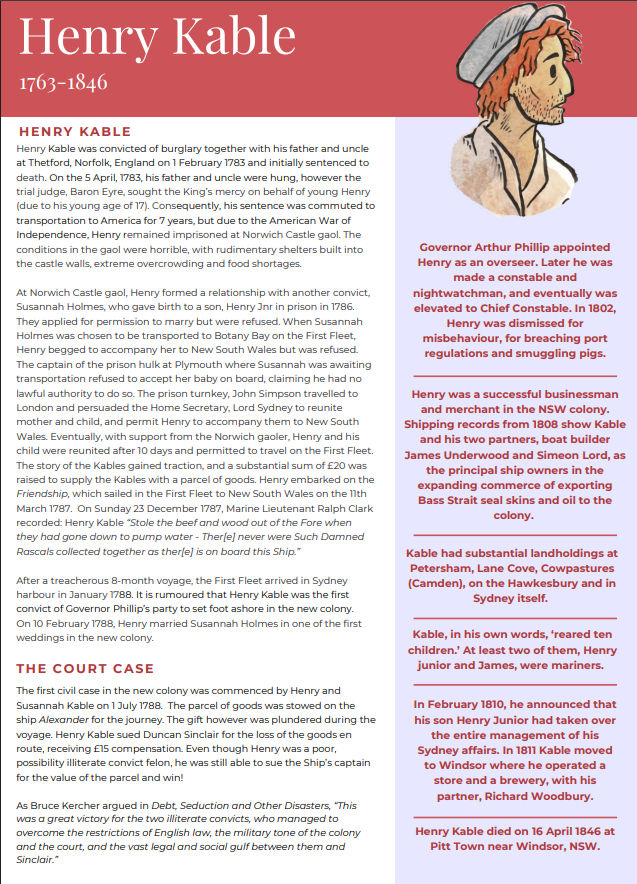
Henry Kable
1763-1846
Henry Kable was convicted of burglary together with his father and uncle at Thetford, Norfolk, England on 1 February 1783 and initially sentenced to death. On the 5 April, 1783, his father and uncle were hung, however the trial judge, Baron Eyre, sought the King’s mercy on behalf of young Henry (due to his young age of 17). Consequently, his sentence was commuted to transportation to America for 7 years, but due to the American War of Independence, Henry remained imprisoned at Norwich Castle gaol. The conditions in the gaol were horrible, with rudimentary shelters built into the castle walls, extreme overcrowding and food shortages.
At Norwich Castle gaol, Henry formed a relationship with another convict, Susannah Holmes, who gave birth to a son, Henry Jnr in prison in 1786. They applied for permission to marry but were refused. When Susannah Holmes was chosen to be transported to Botany Bay on the First Fleet, Henry begged to accompany her to New South Wales but was refused. The captain of the prison hulk at Plymouth where Susannah was awaiting transportation refused to accept her baby on board, claiming he had no lawful authority to do so. The prison turnkey, John Simpson travelled to London and persuaded the Home Secretary, Lord Sydney to reunite mother and child, and permit Henry to accompany them to New South Wales. Eventually, with support from the Norwich gaoler, Henry and his child were reunited after 10 days and permitted to travel on the First Fleet. The story of the Kables gained traction, and a substantial sum of £20 was raised to supply the Kables with a parcel of goods. Henry embarked on the Friendship, which sailed in the First Fleet to New South Wales on the 11th March 1787.
On Sunday 23 December 1787, Marine Lieutenant Ralph Clark recorded:
Henry Kable “Stole the beef and wood out of the Fore when they had gone down to pump water - Ther[e] never were Such Damned Rascals collected together as ther[e] is on board this Ship.”
After a treacherous 8-month voyage, the First Fleet arrived in Sydney harbour in January 1788. It is rumoured that Henry Kable was the first convict of Governor Phillip’s party to set foot ashore in the new colony. On 10 February 1788, Henry married Susannah Holmes in one of the first weddings in the new colony.
The Court Case
The first civil case in the new colony was commenced by Henry and Susannah Kable on 1 July 1788. The parcel of goods was stowed on the ship Alexander for the journey. The gift however was plundered during the voyage. Henry Kable sued Duncan Sinclair for the loss of the goods en route, receiving £15 compensation. Even though Henry was a poor, possibility illiterate convict felon, he was still able to sue the Ship’s captain for the value of the parcel and win! As Bruce Kercher argued in Debt, Seduction and Other Disasters:
“This was a great victory for the two illiterate convicts, who managed to overcome the restrictions of English law, the military tone of the colony and the court, and the vast legal and social gulf between them and Sinclair. “
Related Resources
-
Summary of the first civil case in NSW : Cable v Sinclair in July 1788. The Cables (Kables) were a poor convict couple and Sinclair was the powerful captain of one of the ships in the First Fleet. This is a summary of the court case and outlines the evidence given during the trial.
-
Suggested Lesson Plans for the Lost Parcel, including a suggested 3-4 period lesson plan (approximately 2-4 hours) for teachers wanting to teach the story book The Lost Parcel and the story of the Kables. This includes detailing learning intention, success criteria and outlines for the structure of the lessons.
-
Stories of the First Fleet: Knowledge and Understanding. Using short answer questions, this resource uses the book ‘The Lost Parcel’ to investigate the lives of two convicts Henry and Susannah Kable, their reasons for transportation with the First Fleet, the attitudes of the English community to their plight and their experiences in the early colony.
-
Stories of the First Fleet: Investigating Source Documents. This resource uses two source documents, a letter from Reverend Richard Johnson, and the Charge Sheet from the NSW Court of Civil Proceedings (see below) to investigate the lives of Henry and Susannah Kable and their experiences with the legal system in the early colony.
-
Read the text of Cable v Sinclair [1788] NSW KR 7, Court of Civil Jurisdiction Proceedings, was written on behalf of the Kables (who at the time were illiterate), and addressed to the Judge Advocate of the colony, David Collins. This was the first civil case that was held in the new colony of New South Wales.
Made possible through the support of donors and partners.
Explore Related Topics
-
Equality Before the Law
Outlines the core ideas behind the principle that all individuals are subject to the same laws and entitled to equal legal protection.
-
Civil Law
Civil law deals with disputes between individuals, groups and organisations. It provides fair processes for resolving conflicts, enforcing rights and awarding remedies.
-
Aboriginal and Torres Strait Islander People
The British applied the doctrine of terra nullius to justify claiming sovereignty over Australia, based on assumptions about agriculture, population, and Indigenous law.