
What is the Rule of Law?
-
This activity introduces students to the Rule of Law Index. Students then choose a country from the index and research the link between rule of law and the stability and success of a country.
-
A classroom‑ready guided video activity that teaches students the principles and benefits of the rule of law. Through short questions, matching tasks and real‑world reflections, learners explore how the rule of law protects rights, limits power, strengthens democracy and supports economic and social stability. Ideal for Legal Studies and Civics classrooms.
-
This activity assists students to apply concepts introduced in the Rule of Law Video. Included are Worksheets with fill in the blanks, a summary sheet and also flash cards with all the key rule of law values.
-
Reflection Activity designed as part of the Informed Civics Competition where students draw on the blank card what they have learned about the concept Rule of Law.
-
This activity resource guides students to analyse how rule of law principles operate in practice through the criminal case R v White, using structured tasks that test each spoke of the Rule of Law Wheel. It supports critical evaluation of equality before the law, judicial independence, accountability, human rights, and institutional checks and balances through case‑based discussion and extension questions.
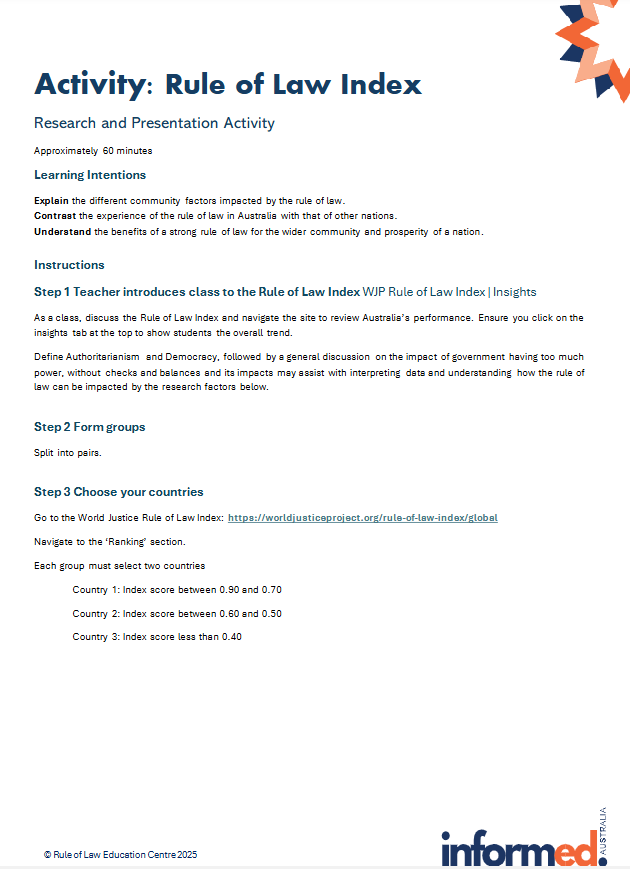
Activity: Rule of Law Index
Approximately 60 minutes
Learning Intentions
Explain the different community factors impacted by the rule of law.
Contrast the experience of the rule of law in Australia with that of other nations.
Understand the benefits of a strong rule of law for the wider community and prosperity of a nation.
Instructions
Step 1 Teacher introduces class to the World Justice Project Rule of Law Index
As a class, discuss the Rule of Law Index and navigate the site to review Australia’s performance. Ensure you click on the insights tab at the top to show students the overall trend.
Define Authoritarianism and Democracy, followed by a general discussion on the impact of government having too much power, without checks and balances and its impacts may assist with interpreting data and understanding how the rule of law can be impacted by the research factors below.
Step 2 Form groups
Split into pairs.
Step 3 Choose your countries
Go to the World Justice Rule of Law Index: https://worldjusticeproject.org/rule-of-law-index/globalNavigate to the ‘Ranking’ section.
Each group must select two countries
Country 1: Index score between 0.90 and 0.70
Country 2: Index score between 0.60 and 0.50
Country 3: Index score less than 0.40
Step 4 Research
When you click on your selected country, there is a menu on the left where you can explore by each issue or factor. For each country investigate the following:
Overall Index Score. (from the rule of law index). Using the diagram below, describe how the index has changed over time.
Constraints on government powers. Looking at the information on this page, state whether government powers (the executive) are kept in check by the legislature and the judiciary. How would this impact on the government’s use of power?
Absence of corruption. What is the score for the absence of corruption? What impact can corruption have on the rule of law? How does corruption influence a civic culture?
Open Government. What is the score for civic participation? Do further research to find out what kind of political system exists in this country, write a definition and outline how it differs from democracy.
Fundamental Rights. Describe how rights recognition has changed over time. Choose the most recognised right in this country and research one way that it is supported. What is the least recognised right and how is it denied to individuals in this country? Why is freedom of speech a critical right in a democratic society?
Crime and Security. What is the global ranking? Does this mean that crime is effectively controlled in this nation?
Regulatory Enforcement. Is due process (the rules and procedures to make everything fair) followed by administrative proceedings (when people are dealing with government)? Why is this important for the rule of law?
Civil Justice. Are civil disputes influenced by the government in a way that might change outcomes? Why did you come to that conclusion?
Criminal Justice. Describe the trend over time for the criminal justice score. Using the criminal justice subfactors below, what aspects of the criminal justice system are the most effective? Create a table that compares Australia’s scores with this country.
Step 5 Present your findings
Prepare a short PowerPoint or similar presentation. Include a direct comparison of the two countries and answer:
Do you think there is a link between respect for the rule of law and the stability and success of a country? Why or why not?
What do you think?
In 2019, former President of the Philippines, Rodrigo Duterte, said the country’s Constitution was like “a piece of toilet paper”.
What do you think he meant by this? What does this reveal about attitudes toward the rule of law of some countries?
Related Resources
-
This page explains the rule of law as the foundation of democracy, where government and citizens are equally bound by clear, fair laws. It highlights equality before the law, independent courts, checks and balances, and a culture of lawfulness that protects rights and prevents abuse of power.
-
The Rule of Law Wheel is a visual tool to explain the key principles that underpin a society governed by the rule of law. It breaks down complex legal ideas into four clear layers and helps students and the public understand how these elements work together to protect rights, limit power, and uphold justice.
Explore Related Topics
-
Equality Before the Law
Explore resources on equality before the law, including the Lost Parcel story, showing how legal rules apply fairly to all people, strengthening fairness in everyday situations.
-
Presumption of Innocence
Explore resources on the presumption of innocence, showing how the burden of proof protects the accused and safeguards fairness in criminal justice.
-
Independent and Impartial Judiciary
Explore resources on an independent and impartial judiciary, including the history of the Supreme Court & its role in delivering justice & strengthening trust in the judiciary.