
What is the Rule of Law?
-
The principles of the rule of law include equality before the law, clear and known laws, separation of powers, and an independent judiciary. The benefits are protection of rights, limits on arbitrary power, access to justice, accountability of government, and a stable, fair, and democratic society for all.
-
Explains the different ways scholars and institutions including AV Dicey, Lord Bingham, Professor Martin Krygier and the Rule of Law Education Centre define and interpret the rule of law, from minimalist approaches focused on procedural fairness to broader conceptions that include rights, accountability, and limits on power. Highlights how these varying perspectives shape public understanding, legal frameworks, and the practical application of rule‑of‑law principles in Australia.
-
This article examines the decline of the rule of law in Poland, focusing on government interference with courts, media, and independent institutions. It explains how concentrating power undermines judicial independence, democratic accountability, and checks and balances, drawing comparisons with other countries facing similar democratic erosion.
-
This page explains the rule of law as the foundation of democracy, where government and citizens are equally bound by clear, fair laws. It highlights equality before the law, independent courts, checks and balances, and a culture of lawfulness that protects rights and prevents abuse of power.
Principles and Benefits of the Rule of Law
The rule of law is a concept for all Australians and is the fundamental principle that supports our democracy. The rule of law ensures everyone, including governments, is subject to the law. It protects rights and freedoms through key principles such as equality before the law, limits on arbitrary power, and the separation of powers with an independent judiciary. Understanding the rule of law helps explain how democratic societies remain fair, stable, predictable and accountable.
Overview: What is the rule of law?
The rule of law is a set of principles or yardsticks by which laws (statutory and common law- judge-made) and actions by those with some legal authority such as regulators and the courts, can be measured to see if they comply with those principles.
‘The rule of law is an overarching principle which ensures that Australians are governed by laws which their elected representatives make and which reflect the rule of law. It requires that the laws are administered justly and fairly.’
– Robin Speed, Founder, Rule of Law Education Centre
Dicey’s Three Fundamental Principles of the Rule of Law
The rule of law has three fundamental principles that Professor Dicey articulated in his 1885 text Introduction to the Study of the Law of the Constitution. These are:
The absolute supremacy or predominance of the law as opposed to the influence of arbitrary power. It excludes the existence of arbitrariness or prerogative, or even of wider discretionary authority on the part of the government. The people are ruled by the law, and by the law alone; a man may be punished for a breach of law, but he can be punished for nothing else.
Equality for all before the law. Every person no matter their rank or condition is subject to the ordinary law. This excludes the idea of any exemption of officials or others from the duty of obedience to the law. We are all subject to the jurisdiction of the ordinary tribunals.
An independent judiciary that determines people’s rights and obligations under the law.
Modern Principles of the Rule of Law
Since 1885 these principles have been developed further and the rule of law now includes the following principles in practice:
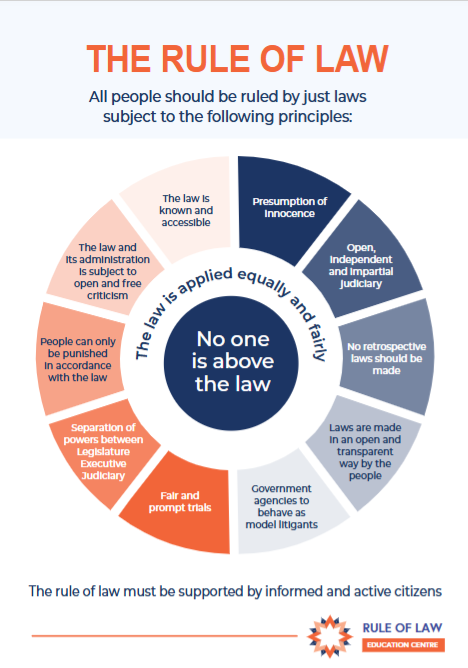
The law is applied equally and fairly, so that no one is above the law.
The separation of powers between the legislature, the executive and the judiciary.
The judicial system is independent and impartial with open justice
The law is made by representatives of the people in an open and transparent way.
The law is capable of being known by everyone, so that everyone can comply.
People can only be punished in accordance with the law
No one is subject adversely to a retrospective change of the law or prosecuted, for any offence not known to the law when committed.
Government agencies to act as model litigants
All people are presumed to be innocent until proven otherwise and are entitled to remain silent and are not required to incriminate themselves.
The law and its administration is subject to open and free criticism by the people, who may assemble without fear.
A simple definition of the rule of law that thus has near universal acceptance states:
“…most of the content of the rule of law can be summed up in two points:
(1) that the people (including, one should add, the government) should be ruled by the law and obey it and
(2) that the law should be such that people will be able (and, one should add, willing) to be guided by it.”
– Geoffrey de Q. Walker, The rule of law: foundation of constitutional democracy, (1st Ed., 1988).
In summary, in a legal system that adheres to the rule of law, the people subject to the law, should know what the law is and have reasonable certainty as to the consequences of breaking that law. The same laws should apply to all persons subject to the legal system and any determination of whether the law has been broken and the consequences of any breach, or to determine a party’s rights and obligations, should be conducted by an open and independent judicial system.
The Rule of Law Simplified: The Rule of Law Wheel
To inspire discussion of the Rule of Law in practice, we use our Rule of Law Wheel which provides a way to imagine the principles and legal traditions that contribute to maintaining the rule of law in Australia.
Benefits of the Rule of Law
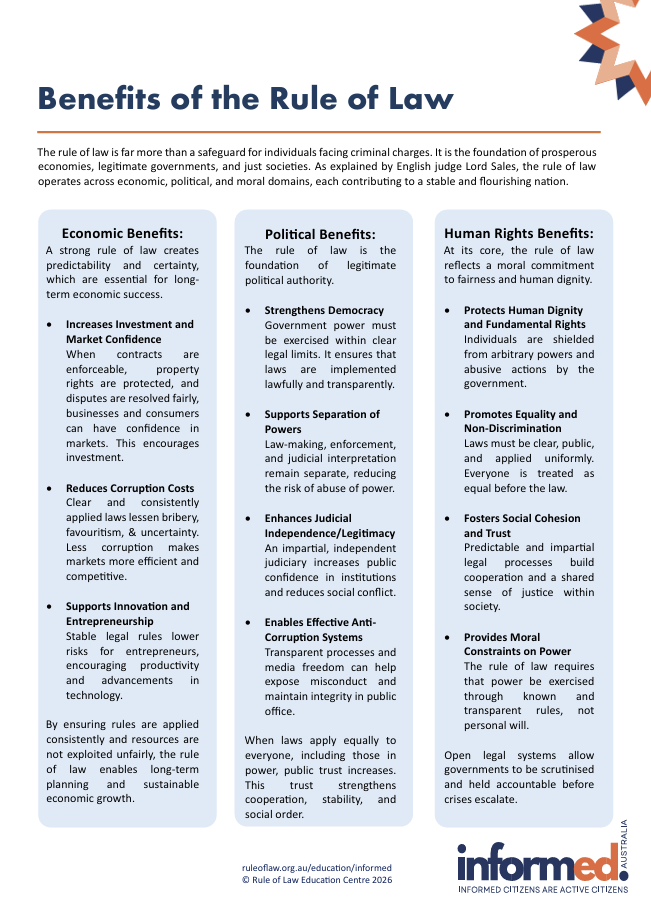
The rule of law is far more than a safeguard for individuals facing criminal charges. It is the foundation of prosperous economies, legitimate governments, and just societies. As explained by English judge Lord Sales, the rule of law operates across economic, political, and moral domains, each contributing to a stable and flourishing nation.
Economic Benefits
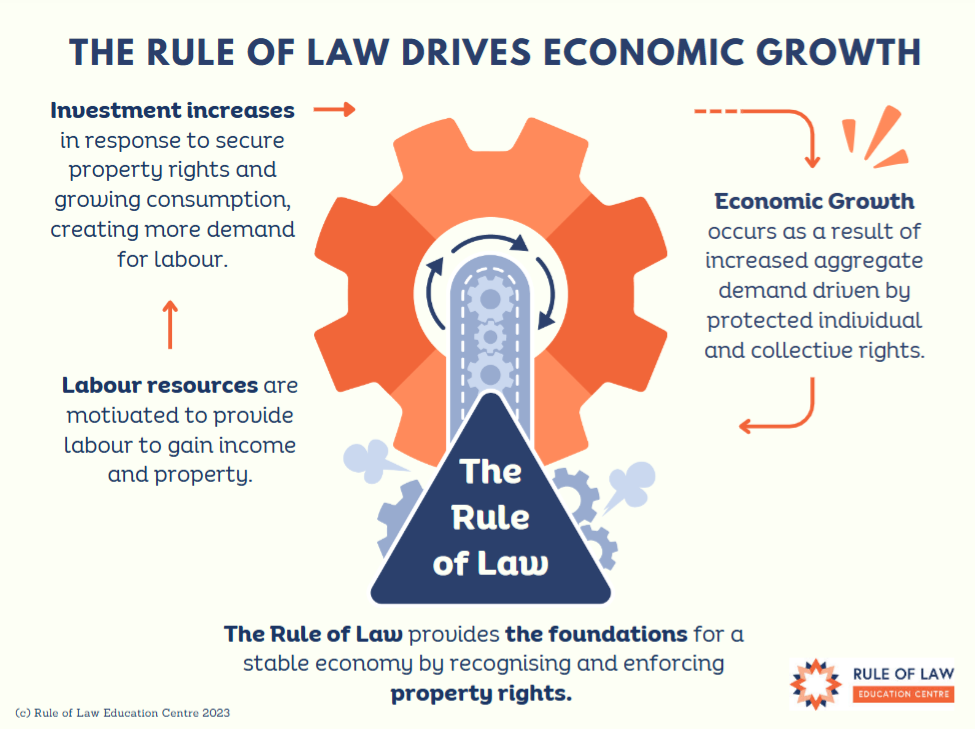
A strong rule of law creates predictability and certainty, which are essential for long-term economic success.
Increases Investment and Market Confidence: When contracts are enforceable, property rights are protected, and disputes are resolved fairly, businesses and consumers can have confidence in markets. This encourages investment.
Reduces Corruption Costs: Clear and consistently applied laws lessen bribery, favouritism, & uncertainty. Less corruption makes markets more efficient and competitive.
Supports Innovation and Entrepreneurship: Stable legal rules lower risks for entrepreneurs, encouraging productivity and advancements in technology.
By ensuring rules are applied consistently and resources are not exploited unfairly, the rule of law enables long-term planning and sustainable economic growth.
Political Benefits:
The rule of law is the foundation of legitimate political authority.
Strengthens Democracy: Government power must be exercised within clear legal limits. It ensures that laws are implemented lawfully and transparently.
Supports Separation of Powers: Law-making, enforcement, and judicial interpretation remain separate, reducing the risk of abuse of power.
Enhances Judicial Independence/Legitimacy: An impartial, independent judiciary increases public confidence in institutions and reduces social conflict.
Enables Effective Anti-Corruption Systems: Transparent processes and media freedom can help expose misconduct and maintain integrity in public office.
When laws apply equally to everyone, including those in power, public trust increases. This trust strengthens cooperation, stability, and social order.
Human Rights Benefits:
At its core, the rule of law reflects a moral commitment to fairness and human dignity.
Protects Human Dignity and Fundamental Rights: Individuals are shielded from arbitrary powers and abusive actions by the government.
Promotes Equality and Non-Discrimination: Laws must be clear, public, and applied uniformly. Everyone is treated as equal before the law.
Fosters Social Cohesion and Trust: Predictable and impartial legal processes build cooperation and a shared sense of justice within society.
Provides Moral Constraints on Power: The rule of law requires that power be exercised through known and transparent rules, not personal will.
Open legal systems allow governments to be scrutinised and held accountable before crises escalate.
The rule of law is an important idea that restricts arbitrary action and helps societies function fairly and peacefully. It means that laws apply to everyone equally, including those in power. The rule of law is not just about courts or punishment. It affects how the economy grows, how governments make decisions, and how people’s rights are protected. When laws are clear, fair, and applied consistently, people can trust governments, take part in democracy, and feel protected from misuse of power.
Related Resources
-
Principles and Benefits of the Rule of Law explained for Australian students and teachers. In this video, the Rule of Law Education Centre explores the principles of the rule of law and explains how it benefits Australians economically, politically and socially. This educational video is designed to support secondary students and teachers studying Legal Studies, Civics and Citizenship, Commerce and Australian law.
-
This page explains the rule of law as the foundation of democracy, where government and citizens are equally bound by clear, fair laws. It highlights equality before the law, independent courts, checks and balances, and a culture of lawfulness that protects rights and prevents abuse of power.
-
The Rule of Law Wheel is a visual tool to explain the key principles that underpin a society governed by the rule of law. It breaks down complex legal ideas into four clear layers and helps students and the public understand how these elements work together to protect rights, limit power, and uphold justice.
Explore Related Topics
-
Equality Before the Law
Explore resources on equality before the law, including the Lost Parcel story, showing how legal rules apply fairly to all people, strengthening fairness in everyday situations.
-
Presumption of Innocence
Explore resources on the presumption of innocence, showing how the burden of proof protects the accused and safeguards fairness in criminal justice.
-
Independent and Impartial Judiciary
Explore resources on an independent and impartial judiciary, including the history of the Supreme Court & its role in delivering justice & strengthening trust in the judiciary.