
What is the Rule of Law?
-
The principles of the rule of law include equality before the law, clear and known laws, separation of powers, and an independent judiciary. The benefits are protection of rights, limits on arbitrary power, access to justice, accountability of government, and a stable, fair, and democratic society for all.
-
Explains the different ways scholars and institutions including AV Dicey, Lord Bingham, Professor Martin Krygier and the Rule of Law Education Centre define and interpret the rule of law, from minimalist approaches focused on procedural fairness to broader conceptions that include rights, accountability, and limits on power. Highlights how these varying perspectives shape public understanding, legal frameworks, and the practical application of rule‑of‑law principles in Australia.
-
This article examines the decline of the rule of law in Poland, focusing on government interference with courts, media, and independent institutions. It explains how concentrating power undermines judicial independence, democratic accountability, and checks and balances, drawing comparisons with other countries facing similar democratic erosion.
-
This page explains the rule of law as the foundation of democracy, where government and citizens are equally bound by clear, fair laws. It highlights equality before the law, independent courts, checks and balances, and a culture of lawfulness that protects rights and prevents abuse of power.
What is the Rule of Law?
Overview
The rule of law is the foundation of Australia’s democracy. It protects human rights, limits government power, and supports social and economic stability by ensuring that both governments and citizens know the law and are bound by it.
When everyone, including those in positions of authority, are required to act within clear legal limits, society becomes fair and orderly. Power cannot be used on personal whim or through arbitrary decisions; it must be exercised lawfully and consistently. The rule of law is therefore more than simply following rules. It is the broader principle that laws must be applied equally and fairly, supported by checks, balances, and accountability mechanisms that prevent the abuse of power. However, the rule of law can quickly be weakened and eroded. It therefore depends on a strong democratic and legal culture, one that values fairness, legitimacy, and the common good, and actively defends the principles that keep power accountable.
Rule of Law Wheel
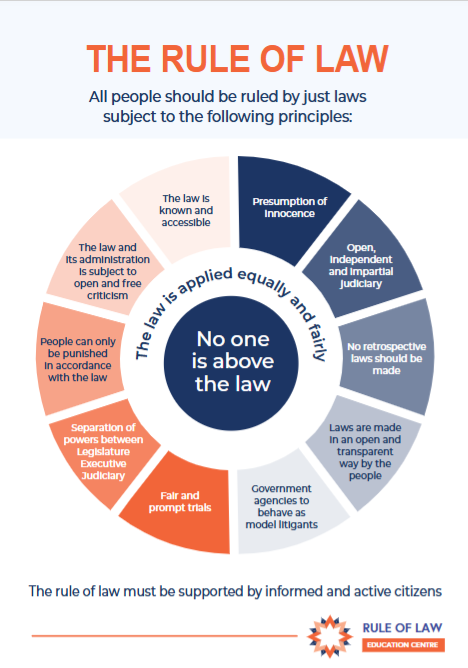
The Rule of Law Education Centre uses the Rule of Law Wheel to explain the Rule of Law.
Principle 1: The Core
People are ruled by the law, and no one is above the law.
This principle expresses the ultimate goal of the rule of law, namely, that government power is limited, and individuals are free to act unless the law prohibits their conduct.
Principle 2: The Middle Ring
The law is applied equally and fairly.
To say “no one is above the law” is to say that every person and institution is bound by the same legal standards, and that those standards are applied equally, fairly, and consistently. This enables people to follow laws not because they must, but because they see the law as legitimate, fair, and directed toward the common good.
All people must follow the law and any dispute about the law must be resolved by the independent judiciary. This is the foundation upon which all other rule of law principles rest.
Principle 3: The Wheel Spokes
This is where the rule of law becomes visible. The spokes are the practical principles that give effect to the rule of law ideal.
Each principle plays a distinct role, but together they form a system of checks and balances that constrain power, protect rights, and support economic stability. These mechanisms are how we measure the rule of law. They show whether power is being exercised lawfully, whether rights are protected, and whether justice is being delivered fairly.
Principle 4: The Support
Supported by a culture of lawfulness.
The rule of law is only as strong as the culture that sustains it. On paper, its principles can look impressive, but without public support, they are fragile. This cultural support is what ultimately limits government power and protects human rights. Constitutions, courts, and legal principles cannot defend freedom on their own. They require a society that values them, understands them, and insists that leaders comply with them. That is why informed, active, and engaged citizens are essential. When people participate, scrutinise government, and defend democratic principles, they give the rule of law its backbone. Without that support, the protections we rely on can erode far more easily than we imagine.
Related Resources
-
This activity resource guides students to analyse how rule of law principles operate in practice through the criminal case R v White, using structured tasks that test each spoke of the Rule of Law Wheel. It supports critical evaluation of equality before the law, judicial independence, accountability, human rights, and institutional checks and balances through case‑based discussion and extension questions.
-
The Rule of Law Wheel is a visual tool to explain the key principles that underpin a society governed by the rule of law. It breaks down complex legal ideas into four clear layers and helps students and the public understand how these elements work together to protect rights, limit power, and uphold justice.
-
This PowerPoint introduces teachers to the rule of law within the Year 11 Commerce and Legal Studies syllabuses, explaining the concept, its supporting principles, and why it matters in practice. It breaks down each principle using clear explanations, syllabus links, and a case‑based approach—showing how the Kristian White case illustrates the operation, fragility, and educational importance of the rule of law.
Explore Related Topics
-
Equality Before the Law
Explore resources on equality before the law, including the Lost Parcel story, showing how legal rules apply fairly to all people, strengthening fairness in everyday situations.
-
Presumption of Innocence
Explore resources on the presumption of innocence, showing how the burden of proof protects the accused and safeguards fairness in criminal justice.
-
Independent and Impartial Judiciary
Explore resources on an independent and impartial judiciary, including the history of the Supreme Court & its role in delivering justice & strengthening trust in the judiciary.