
The Criminal Justice System
-
This case note examines the trial of Greg Lynn, highlighting how jury decision‑making, evidentiary safeguards, and judicial independence protect fairness in serious criminal cases. It shows how the presumption of innocence and the standard of proof beyond reasonable doubt shaped the split verdict, illustrating core rule‑of‑law principles in practice.
-
This case note outlines how Kathleen Folbigg’s convictions were overturned after new genetic evidence cast doubt on earlier findings, highlighting the limits of forensic science, the impact of media prejudice, and the importance of appeals and judicial inquiries in correcting miscarriages of justice. It shows how evolving scientific knowledge and robust review mechanisms are essential to upholding fairness and the rule of law.
-
This case note examines how intense media attention, especially The Teacher’s Pet podcast, interacted with the legal process in the Chris Dawson trial. It highlights the safeguards courts use to protect fair‑trial rights in high‑profile cases, the difficulties of prosecuting decades‑old offences using circumstantial evidence, and the law reforms that followed, including NSW’s “no body, no parole” legislation.
-
This case note outlines how Keli Lane was convicted of murdering her newborn despite the absence of a body, relying heavily on circumstantial evidence and credibility findings. It highlights key rule‑of‑law issues, including non‑disclosure of evidence, media influence, and the challenges of ensuring a fair trial in complex, high‑profile cases
-
This case note examines the Skaf brothers’ prosecutions, highlighting how sentencing principles, jury misconduct, and parole decisions tested core rule‑of‑law safeguards. It shows how courts balanced the gravity of the offences with proportionality, totality, and fair‑trial requirements, demonstrating that even in the most serious cases, legal processes and rights must be applied equally and consistently.
-
This case note explains how Gerard Baden‑Clay’s conviction moved through multiple appeal stages, highlighting how circumstantial evidence, the presumption of innocence, and the right to appeal operate in serious criminal cases. It shows how the High Court reinstated the murder conviction, reinforcing the importance of jury reasoning, proper appellate limits, and rule‑of‑law safeguards in high‑profile trials
-
This case note explains how Bradley Edwards was convicted of two Claremont murders based on DNA, fibre, and propensity evidence in a judge‑alone trial, while being acquitted of a third due to insufficient proof. It highlights key rule‑of‑law principles, including the presumption of innocence, the high standard of proof, open justice, and the safeguards that ensure fairness even in highly publicised, complex cases.
-
This case summary explains how the High Court unanimously quashed George Pell’s convictions after finding a significant possibility of reasonable doubt, emphasising the prosecution’s burden of proof and the need for verdicts to align with unchallenged evidence. It highlights key rule‑of‑law principles, including the presumption of innocence, proper appellate review, and the requirement that guilt be proven beyond reasonable doubt.
-
This case study examines the manslaughter conviction of Senior Constable Kristian White for tasering 95‑year‑old Clare Nowland, highlighting key rule‑of‑law principles including the presumption of innocence, judicial independence, fair‑trial rights, and proportional sentencing. It also explores broader issues around police duty of care, media influence, bail decisions, and how courts balance community expectations with due process.
-
Explores how judicial discretion ensures proportionate sentencing by allowing courts to weigh the unique circumstances of an offence and offender. Using RDS v Luplau, it illustrates how appeal courts correct excessive sentences and why rigid penalties, such as COVID‑19 breach penalties, must still be applied with fairness and attention to mitigating factors.
Case Note: Kathleen Folbigg
R v Folbigg [2003] NSWSC 895
Warning: this Case Note contains refereces to harm. If this causes any distress, contact Lifeline (13 11 14) or Kids Helpline (1800 55 1800)
Pre-Learning Questions
Why is it difficult for a court to decide a case when several deaths occur in the same family without a clear medical explanation?
How can media coverage shape the public’s view of an accused person before a trial has even begun?
Why is it important that courts rely only on the evidence presented during a trial?
Introduction
Kathleen Folbigg, once labelled Australia’s “most hated woman” and its “worst female serial killer”, was unconditionally pardoned by Governor Margaret Beazley and released from prison on 5 June 2023 after serving 20 years. On 14 December 2023, the NSW Court of Criminal Appeal formally quashed her convictions.
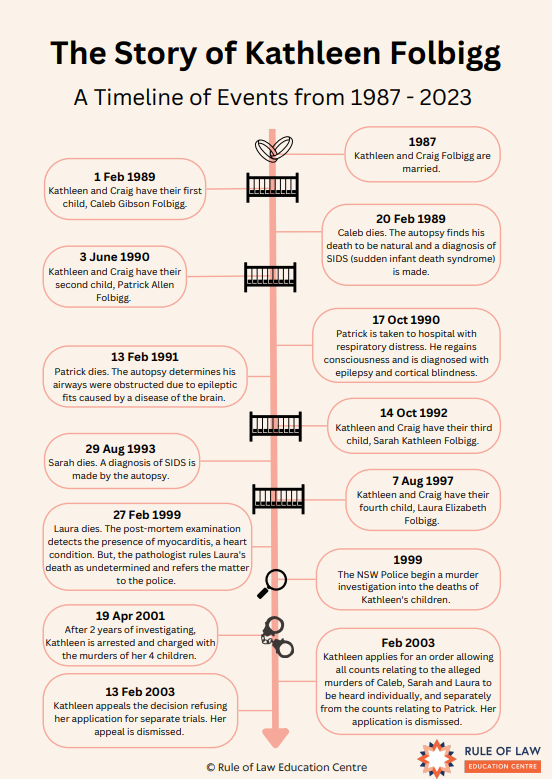
Folbigg had been found guilty in 2003 of killing her four children—Caleb, Patrick, Sarah and Laura—over a ten‑year period. This case note outlines the investigation, coronial findings, trial, appeals, and the two judicial inquiries that ultimately led to her acquittal. It is intended to be read alongside the accompanying timeline and procedural history, which provide further detail on the evidence considered.
Case Summary
In 2003, Folbigg was convicted of:
the manslaughter of her first child, Caleb
the infliction of grievous bodily harm on her second child, Patrick
the murders of Patrick, Sarah, and Laura
Multiple appeals failed. A judicial inquiry held in 2019 concluded there was “no reasonable doubt” about her guilt.
On 2 March 2021, a petition seeking her pardon (signed by leading scientists and medical experts) was submitted to the Governor of NSW. This prompted a second inquiry, which found that the children likely died from previously unidentified genetic and medical conditions. In light of this evidence, Folbigg was pardoned and released in 2023, two decades after her imprisonment.
Facts of the Case
Folbigg and her husband, Craig, had four children between 1989 and 1997. Each child died suddenly in infancy or early childhood:
Caleb (born 1 February 1989) experienced breathing difficulties attributed to a “floppy larynx”. He died on 20 February 1989. His death was certified as Sudden Infant Death Syndrome (SIDS).
Patrick (born 3 June 1990) suffered a collapse in October 1990 and was diagnosed with epilepsy and cortical blindness. He died on 13 February 1991. Autopsy findings suggested airway obstruction during a seizure.
Sarah (born 14 October 1992) a healthy baby who died on 30 August 1993. Her death was attributed to SIDS.
Laura (born 7 August 1997) initially believed to have died from myocarditis on 1 March 1999. After learning of the siblings’ deaths, the pathologist revised the finding to “undetermined” and notified police.
Following Laura’s death, NSW Police commenced an investigation into all four deaths. Folbigg had been alone with each child at the time they died or was the person who discovered them, which investigators viewed as significant. Police seized her diaries, and selected entries were later interpreted at trial as admissions of guilt.
Folbigg was arrested on 19 April 2001 and charged with the murders of all four children.
Analysis
How Did the Law Reflect Moral and Ethical Standards?
Societies generally treat the killing of children as among the most morally reprehensible acts. Infanticide is criminalised under s 22A of the Crimes Act 1900 (NSW), and international norms, such as Article 19 of the UN Convention on the Rights of the Child, affirm the obligation to protect children from violence. Infants are viewed as entirely innocent, highly vulnerable, and incapable of self‑defence, which heightens the moral condemnation of any harm done to them.
These moral expectations strongly shaped both the public response to the Folbigg case and the severity of her initial sentence. Justice Graham Barr explicitly acknowledged this in his sentencing remarks, stating that the sentence needed to “reflect the outrage of the community,” which justified imposing an unusually long 30‑year non‑parole period.
However, moral and ethical standards within the community were not uniform. As scientific evidence emerged suggesting natural causes of death, public sentiment shifted. Petitions in 2015 and 2021, signed by experts and members of the public, expressed a competing moral view: that justice required reconsidering Folbigg’s conviction.
Under s 77 of the Crimes (Appeal and Review) Act 2001 (NSW), petitions can trigger further review mechanisms, including judicial inquiries. In Folbigg’s case, they ensured that evolving community standards, and new scientific knowledge, were incorporated into the legal process.
What Was the Role of Discretion?
Discretion involves decision‑makers choosing between lawful options based on evidence, obligations, and competing interests. In the criminal justice system, discretion is exercised at every stage, from investigation to sentencing.
Key examples of discretion in the Folbigg matter include:
The pathologist’s decision to refer Laura’s death to police after learning of the siblings’ deaths.
Police discretion in gathering evidence, interpreting diary entries, charging Folbigg with murder, and granting her bail.
Craig Folbigg’s decision to provide Kathleen’s diaries to police.
Judicial discretion at trial (2003), where Justice Barr imposed a 40‑year sentence with a 30‑year non‑parole period.
Judicial discretion on appeal (2005), where the NSW Court of Criminal Appeal reduced the sentence to 30 years with a 25‑year non‑parole period.
Discretion exercised in dismissing multiple appeals.
Executive discretion, when the Governor of NSW initiated a judicial inquiry.
Inquiry Commissioner Bathurst KC’s discretion, concluding in 2022 that reasonable doubt existed, ultimately leading to Folbigg’s pardon.
Is it fair that judicial discretion can produce a 10‑year difference in sentencing?
The legal system justifies broad judicial discretion on the basis that sentencing must account for the unique circumstances of each offence and offender. While discretion can produce inconsistent outcomes, safeguards exist:
Sentencing legislation and guidelines limit arbitrary decision‑making.
Appeal rights allow review of excessive or unfair sentences and convictions.
Judges must provide detailed reasons, enabling scrutiny and accountability.
These mechanisms aim to balance flexibility with fairness.
How Did the Law Balance the Rights of Victims, Offenders and Society?
The Rights of Victims
In murder cases, victims cannot be compensated, but the justice system seeks to uphold their rights by uncovering the truth and holding offenders accountable. This applies regardless of the victim’s age or background.
The Rights of Society
Criminal proceedings must balance the accused’s privacy with society’s interest in transparency. The Folbigg case attracted intense media attention, which compromised her privacy and may have influenced public perceptions of her guilt, particularly through the publication of her diaries and traumatic personal history.
Open justice is essential to maintaining public confidence in the legal system. However, society also played a role in correcting the miscarriage of justice. The petitions signed by scientists and members of the public demonstrated that reconsidering Folbigg’s conviction was in the community’s interest. The Governor’s decision to initiate an inquiry reflected society’s evolving expectations and the importance of incorporating new scientific knowledge.
The Rights of the Accused
Folbigg’s right to a fair trial and presumption of innocence were challenged by:
intense media scrutiny
the unusual and tragic nature of four infant deaths in one family
public speculation influenced by her personal history (including her father’s murder of her mother)
Protective orders were made to reduce prejudicial publicity and safeguard her from extrajudicial punishment.
The principle often attributed to Blackstone: “It is better that ten guilty persons escape than one innocent suffer”, underpins the Australian criminal justice system. The Folbigg case has since been described as “one of the gravest miscarriages of justice in Australia’s history,” illustrating the profound harm caused when this principle is not upheld
Folbigg spent 20 years in prison before her pardon. Without the scientific petitions and subsequent inquiry, she may have served her full sentence, highlighting the importance of both legal and non‑legal mechanisms in correcting wrongful convictions.
Sentencing and Punishment
Initial Sentence (2003)
Following Folbigg’s conviction in 2003, Justice Graham Barr imposed a total sentence of 40 years’ imprisonment with a 30‑year non‑parole period. His sentencing remarks identified several key purposes of sentencing that he considered most relevant:
Rehabilitation: “Because of the intractability of her condition, the offender’s prospects of rehabilitation are negligible.”
Denunciation and community condemnation: “The need for the sentences to reflect the outrage of the community calls for… an unusually long non‑parole period.”
General deterrence: “So does the need generally to deter persons from committing crimes like these, which are so difficult to detect.”
These statements show that denunciation, general deterrence, and community protection were the dominant purposes of sentencing. Rehabilitation was considered irrelevant because Justice Barr believed Folbigg’s prospects were extremely low.
Do you agree with these purposes of sentencing? Can you think of any more that would be relevant?
Sentencing Guidelines and Mitigating Factors
Justice Barr also addressed how sentencing guidelines applied:
“Her offences fell into the worst category of cases, calling for the imposition of the maximum penalty.”
“The offender’s dysfunctional childhood provides… significant mitigation of her criminality.”
“She was throughout these events depressed and suffering from a severe personality disorder.”
“Gaol…will be particularly dangerous for the offender… she will serve her sentences the harder and is entitled to consideration.
Under NSW law, a judge may impose the maximum penalty only if the offence falls within the “worst category of cases.” In Folbigg’s case, the killing of four infants was held to meet this threshold. Justice Barr used the maximum penalty as a starting point, then applied mitigating factors (her mental health, childhood trauma, and vulnerability in custody) to arrive at the final sentence of 40 years.
If you were obliged to follow the jury’s verdict of guilty, what sentence would you impose? Do you agree with Justice Barr’s reasoning?
Sentence on Appeal (2005)
On appeal, the NSW Court of Criminal Appeal reduced Folbigg’s sentence to 30 years’ imprisonment with a 25‑year non‑parole period. Justice Sully identified two key errors in the original sentence:
The sentence was “so crushingly discouraging as to put at risk any incentive that she might have to apply herself to her rehabilitation.”
The sentence was “a life sentence by a different name,” warranting appellate intervention
Unlike Justice Barr, Justice Sully placed greater weight on rehabilitation, finding that the original sentence effectively removed any realistic prospect of future reintegration
This contrast illustrates how judicial discretion can produce significantly different outcomes even when judges are applying the same legal principles.
Do you believe all individuals should be given a sentence that strives for rehabilitation? Do the benefits outweigh the practical costs of long-term rehabilitation projects?
Legal and Non‑Legal Measures
Legal Measures
Appeals
Folbigg pursued three appeals:
one challenging the decision to hear all four charges in a single trial
two challenging her conviction and sentence
The appeal system exists to correct errors of law, procedure, or fact. However, all of Folbigg’s appeals, (except the appeal against sentence), failed because they were based on the same assumption that guided the trial: that no genetic or medical explanation existed for the children’s deaths. At that time, scientific knowledge had not advanced enough to identify the rare genetic variants later discovered.
This shows how a central feature of the justice system can also limit its ability to reach accurate outcomes. Courts make decisions using only the evidence available during the proceedings, and when scientific or technological understanding has not yet developed enough to reveal the significance of that evidence, important facts may remain unknown until later advances occur.
Judicial Inquiry
Judicial inquiries allow a judicial officer to investigate potential errors of fact or law in a conviction. They differ from appeals because they require a petition to the Governor or an application to the Supreme Court. The 2019 inquiry upheld Folbigg’s convictions. The 2021 inquiry, prompted by new scientific evidence and a petition from experts, ultimately found that reasonable doubt existed.
Although the second inquiry was effective, it was slow and heavily dependent on external advocacy. In this sense, the process demonstrates the principle that justice delayed can be justice denied, particularly when a person remains incarcerated during the review.
Non‑Legal Measures
Non‑legal measures such as media coverage, documentaries, public advocacy, and scientific commentary all played a major role throughout the Folbigg case.
Positive Impacts
Public engagement was instrumental in Folbigg’s eventual release.
Scientists conducted extensive research into genetic variants linked to sudden infant death.
Media programs, including a 2021 60 Minutes episode, brought emerging scientific evidence to public attention.
Petitions and campaigns mobilised public support and prompted the Governor to initiate the 2021 inquiry.
These actions demonstrate the media’s role in holding institutions accountable and ensuring that new evidence is not ignored.
Negative Impacts
Media coverage also caused significant prejudice:
Folbigg’s diaries and traumatic family history were widely publicised.
Sensational reporting undermined her presumption of innocence.
Public hostility created a “mob mentality” that influenced perceptions long before trial
This dual impact shows that media involvement in criminal cases is a double‑edged sword. While it can expose injustice, it can also compromise fairness. This is why the presumption of innocence is so strongly protected in Australian law and why courts impose strict protocols to shield accused persons from prejudicial publicity.
Application of Rule of Law Principles
Fair and Prompt Trials
In Australia, all people are considered equal before the law, which means both defendants and complainants are entitled to fair and prompt trials. Although equality before the law is often discussed in relation to offenders, it applies equally to victims. In this case, the four deceased children were afforded the same justice processes as any other complainant, reflecting the principle that every person’s right to life is valued equally.
Fair decision‑making strengthens public confidence in the courts. When trials are delayed or conducted unfairly, confidence in the justice system is undermined. Prompt processes are also essential to prevent innocent people from experiencing unnecessary reputational harm or prolonged loss of liberty.
The Folbigg matter demonstrates the consequences of delay. After the 2015 petition, three years passed before the Governor decided in 2018 to order an inquiry, and several more months passed before the inquiry commenced in 2019. A similar delay occurred after the 2021 petition, with a year elapsing before the second inquiry was announced. During these periods, Folbigg remained imprisoned, even though her release might have happened 1–2 years earlier had the Petition been responded to promptly.
Presumption of Innocence
The presumption of innocence is often described as the “golden thread” of the criminal justice system. It requires that every accused person be treated as innocent until proven guilty, and places the burden on the prosecution to prove each element of the offence beyond reasonable doubt.
According to s 18(1)(a) of the Crimes Act 1900 (NSW), what physical and mental elements of murder did the Prosecution need to prove beyond reasonable doubt in order to establish Folbigg’s guilt?
Several factors can weaken this presumption. Public commentary that implies guilt before trial can influence community attitudes and, in jury trials, may affect jurors’ perceptions. Extraordinary or highly emotive circumstances can also lead people to assume guilt, effectively reversing the burden of proof.
The Folbigg case illustrates both risks. Media coverage before the 2003 trial repeatedly labelled her a “baby killer” and “Australia’s most hated woman.” The media also released information that Folbigg’s father had murdered her mother and phrases ‘like father like daughter’ began to circulate.”
Although this information was inadmissible as evidence, some jurors accessed it online during the trial, compromising the presumption of innocence. This misconduct formed the basis of a 2007 appeal, which was ultimately dismissed.
The unusual nature of four infant deaths also contributed to assumptions of guilt. The prosecution relied on “Meadow’s Law,” which framed multiple unexplained infant deaths as inherently suspicious. This created pressure on the defence to prove innocence rather than requiring the Crown to prove guilt.
People Can Only Be Punished in Accordance with the Law
This principle ensures that punishment can only occur through lawful processes and according to clearly defined rules. A key safeguard is the rules of evidence, which determine what information can be presented to a jury.
The Evidence Act 1995 (NSW) sets strict rules for what evidence may be admitted at trial, including expert opinion evidence. At Folbigg’s trial, forensic pathologists and psychologists gave evidence for both the Crown and the defence, and their opinions were admitted because they were based on specialised knowledge.
Expert evidence is limited by the scientific understanding available at the time. This became significant in relation to Folbigg’s diary entries, which were treated at trial as admissions of guilt. Their meaning was contested, and later psychological evidence suggested that the entries were more likely expressions of grief and distress rather than confessions. Bathurst KC accepted this view in 2023, noting that the entries were:
“explicable as the words of a grieving, depressed and traumatised mother… and were typically cognitions of parents of children who have died from SIDS or other unexplained or accidental causes.”
The rules of evidence also require that highly prejudicial information be excluded. Details about Folbigg’s father murdering her mother were ruled inadmissible because of their potential to unfairly influence the jury. If the Crown had introduced this information, the jury would likely have been discharged and a new trial ordered.
Checks and Balances
Checks and balances operate to prevent abuses of power and to ensure that decisions remain consistent with legal standards and community expectations. Appeals are one of the main ways this safeguard functions because they allow a higher court to review the decisions of a lower court. However, appeals can only consider the evidence that was available at the time of the original proceedings.
In Folbigg’s case, the scientific evidence needed to support a natural cause of death had not yet been discovered, so the appeal process was unable to identify or correct the underlying factual error.
Conclusion
The Folbigg case highlights several important rule of law principles in practice. It demonstrates equality before the law, with justice processes applied consistently to both offenders and victims, including infants. It shows the value of checks and balances, which allow convictions to be revisited when new evidence emerges, even years later. It reinforces the importance of the presumption of innocence and the need for the prosecution to prove guilt beyond reasonable doubt, regardless of how unusual or emotive a case may be. Finally, it illustrates the complex role of media and public advocacy, which can both support and undermine justice for victims, offenders and society.
Related Resources
-
This explainer outlines how evidence is gathered, assessed, and admitted in criminal trials, showing how strict rules ensure only reliable, relevant, and lawfully obtained material is considered by the court. It highlights the different types of evidence, the role of police and prosecutors in preparing a brief of evidence, and how judges and juries evaluate admissibility and weight to protect fairness, prevent wrongful convictions, and uphold due process.
-
This poster summarises the fundamentals of Australian criminal law, outlining its purpose, sources, key offence categories, core legal principles such as the burden and standard of proof, and essential elements of a crime including actus reus and mens rea
Explore Related Topics
-
Fair and Prompt Trials
Explore resources on fair and prompt trials, showing how timely hearings and procedural fairness protect justice and public confidence.
-
Courts
Explore resources on courts, outlining the court hierarchy and providing Law Day Out materials and to support classroom understanding.
-
Presumption of Innocence
Explore resources on the presumption of innocence, showing how the burden of proof protects accused people and safeguards fairness in criminal justice.