
The Criminal Justice System
-
This case note examines the trial of Greg Lynn, highlighting how jury decision‑making, evidentiary safeguards, and judicial independence protect fairness in serious criminal cases. It shows how the presumption of innocence and the standard of proof beyond reasonable doubt shaped the split verdict, illustrating core rule‑of‑law principles in practice.
-
This case note outlines how Kathleen Folbigg’s convictions were overturned after new genetic evidence cast doubt on earlier findings, highlighting the limits of forensic science, the impact of media prejudice, and the importance of appeals and judicial inquiries in correcting miscarriages of justice. It shows how evolving scientific knowledge and robust review mechanisms are essential to upholding fairness and the rule of law.
-
This case note examines how intense media attention, especially The Teacher’s Pet podcast, interacted with the legal process in the Chris Dawson trial. It highlights the safeguards courts use to protect fair‑trial rights in high‑profile cases, the difficulties of prosecuting decades‑old offences using circumstantial evidence, and the law reforms that followed, including NSW’s “no body, no parole” legislation.
-
This case note outlines how Keli Lane was convicted of murdering her newborn despite the absence of a body, relying heavily on circumstantial evidence and credibility findings. It highlights key rule‑of‑law issues, including non‑disclosure of evidence, media influence, and the challenges of ensuring a fair trial in complex, high‑profile cases
-
This case note examines the Skaf brothers’ prosecutions, highlighting how sentencing principles, jury misconduct, and parole decisions tested core rule‑of‑law safeguards. It shows how courts balanced the gravity of the offences with proportionality, totality, and fair‑trial requirements, demonstrating that even in the most serious cases, legal processes and rights must be applied equally and consistently.
-
This case note explains how Gerard Baden‑Clay’s conviction moved through multiple appeal stages, highlighting how circumstantial evidence, the presumption of innocence, and the right to appeal operate in serious criminal cases. It shows how the High Court reinstated the murder conviction, reinforcing the importance of jury reasoning, proper appellate limits, and rule‑of‑law safeguards in high‑profile trials
-
This case note explains how Bradley Edwards was convicted of two Claremont murders based on DNA, fibre, and propensity evidence in a judge‑alone trial, while being acquitted of a third due to insufficient proof. It highlights key rule‑of‑law principles, including the presumption of innocence, the high standard of proof, open justice, and the safeguards that ensure fairness even in highly publicised, complex cases.
-
This case summary explains how the High Court unanimously quashed George Pell’s convictions after finding a significant possibility of reasonable doubt, emphasising the prosecution’s burden of proof and the need for verdicts to align with unchallenged evidence. It highlights key rule‑of‑law principles, including the presumption of innocence, proper appellate review, and the requirement that guilt be proven beyond reasonable doubt.
-
This case study examines the manslaughter conviction of Senior Constable Kristian White for tasering 95‑year‑old Clare Nowland, highlighting key rule‑of‑law principles including the presumption of innocence, judicial independence, fair‑trial rights, and proportional sentencing. It also explores broader issues around police duty of care, media influence, bail decisions, and how courts balance community expectations with due process.
-
Explores how judicial discretion ensures proportionate sentencing by allowing courts to weigh the unique circumstances of an offence and offender. Using RDS v Luplau, it illustrates how appeal courts correct excessive sentences and why rigid penalties, such as COVID‑19 breach penalties, must still be applied with fairness and attention to mitigating factors.
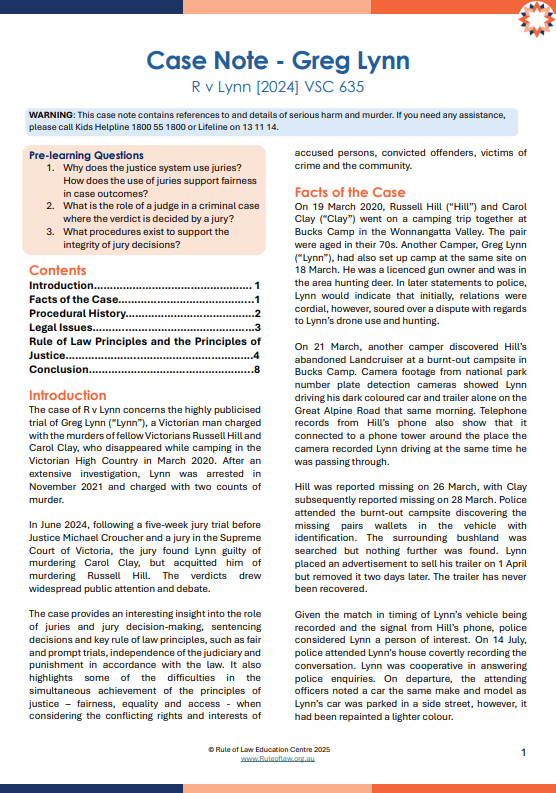
Case Note: Greg Lynn
R v Lynn [2024] VSC 635
WARNING: This case note contains references to and details of serious harm and murder. If you need any assistance, please call Kids Helpline 1800 55 1800 or Lifeline on 13 11 14.
Introduction
The case of R v Lynn concerns the highly publicised trial of Greg Lynn (“Lynn”), a Victorian man charged with the murders of fellow Victorians Russell Hill and Carol Clay, who disappeared while camping in the Victorian High Country in March 2020. After an extensive investigation, Lynn was arrested in November 2021 and charged with two counts of murder.
In June 2024, following a five-week jury trial before Justice Michael Croucher in the Supreme Court of Victoria, the jury found Lynn guilty of murdering Carol Clay, but acquitted him of murdering Russell Hill. The verdicts drew a lot of public attention and debate.
The case offers a useful window into the role of juries, how sentencing decisions are made, and how core rule of law principles operate in practice. It also shows how difficult it can be to balance fairness, equality and access to justice when the rights and interests of accused people, victims and the broader community all intersect.
Facts of the Case
On 19 March 2020, Russell Hill (“Hill”) and Carol Clay (“Clay”) went on a camping trip together at Bucks Camp in the Wonnangatta Valley. The pair were aged in their 70s.
Another Camper, Greg Lynn, had also set up camp at the same site on 18 March 2020. He was a licenced gun owner and was in the area hunting deer. In later statements to police, Lynn indicated that initially, relations were cordial, however, they soured over a dispute regarding Lynn’s drone use and hunting.
On 21 March 2020, another camper found Hill’s Landcruiser abandoned at a burnt-out campsite at Bucks Camp. That same morning, national park number-plate cameras recorded Lynn driving alone in his dark-coloured car and trailer along the Great Alpine Road. Telephone records from Hill’s phone show it connected to a nearby tower at the same time and location the cameras captured Lynn passing through.
Hill was reported missing on 26 March 2020, and Clay was reported missing two days later. When police attended the burnt-out campsite, they found both of their wallets and identification inside Hill’s vehicle, but a search of the surrounding bushland uncovered nothing further. On 1 April 2020, Lynn advertised his trailer for sale before removing the listing two days later. The trailer has never been found.
Given the timing overlap between Lynn’s vehicle being captured on camera and Hill’s phone connecting to a nearby tower, police identified Lynn as a person of interest.
On 14 July, officers attended his home and covertly recorded their conversation, during which Lynn cooperated with their questions. As they left, police noticed a car of the same make and model as Lynn’s parked in a nearby side street, but it had been repainted a lighter colour.
A photo dated 4 June 2020 showing Lynn repainting his vehicle was later found on his wife’s phone. Shortly after police first spoke with him, investigators began covert surveillance, placing listening devices and cameras in his home, car and driveway.
Park rangers inspected and recovered debris from the burnt-out scene at Bucks Camp on 15 October 2020. On forensic examination, it was found to contain bra hooks, glass, and parts of a side mounted electric mirror from a car.
In a covert police recording made on 13 November 2021, Lynn was captured talking with his wife while they watched a program about the disappearance of Hill and Clay. During the conversation, Mrs Lynn commented that the car and trailer shown on the program looked like her husband’s, noting the similarity of a distinctive mounted awning. In the days that followed, surveillance footage recorded Lynn removing the awning from his vehicle.
On 22 November 2021, Police arrested Lynn and charged him with the murders of Hill and Clay. He was remanded in custody and did not apply for bail.
Procedural History
After Lynn was arrested on 22 November 2021, police questioned him over several days. Although he had received legal advice, his solicitor was not present throughout, and on the third day Lynn chose to disregard that advice and gave police his account of events.
A four-day committal hearing began in the Melbourne Magistrates’ Court on 16 January 2023 before Magistrate Sonnet. At its conclusion, Lynn was ordered to stand trial for the murders of Hill and Clay, and a suppression order was granted over his police interview and statement.
Between December 2023 and June 2024, the court held three administrative hearings (called a voir dire) to determine whether certain evidence could be admitted at trial under the laws of evidence. Several items were ultimately ruled inadmissible because their use was assessed as carrying an unacceptable risk of undermining the fairness of Lynn’s trial.
A jury was first empanelled on 10 May 2024, but the trial was abandoned that same day for technical reasons. A new jury of 15 was sworn in on 14 May, and the trial ran for five weeks. The jury retired for deliberation on 14 June and returned its verdict on 25 June 2024, finding Lynn guilty of murdering Clay and acquitting him (i.e. found him not guilty) of the murder of Hill.
A sentencing hearing followed on 12 September 2024, and Justice Croucher imposed a 32-year sentence on 18 October 2024.
Lynn applied for leave to appeal both the conviction and the sentence in the Court of Appeal of the Supreme Court of Victoria. The appeal hearing commenced on 31 October 2025. On 11 December 2025, the Court overturned his conviction and order a retrial.
Lynn applied for bail on 19 February 2026, but the application was denied by Justice David Beach on 5 March 2026.
As of July 2026, no date has been set for the new trial.
Legal Issues
Australia’s legal system is an adversarial system, meaning each party presents its own case and challenges the other’s evidence. This structure is central to ensuring fairness and protecting the rights of the accused.
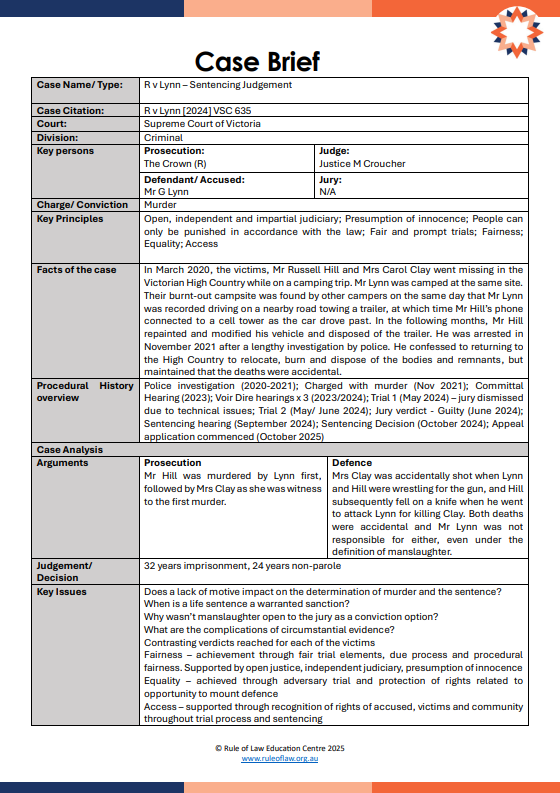
In Lynn’s trial, the prosecution argued that Hill was murdered first and Clay was killed second because she was a witness to the first murder. The defence maintained that both deaths were accidental and that Lynn was not criminally responsible for either death, even under the definition of manslaughter.
Ultimately, the jury must decide whether the prosecution has proved the elements of the offence beyond reasonable doubt, applying the legal standards that safeguard fairness, equality and access to justice.
Murder, not manslaughter
Early in the trial, Justice Croucher told the jury that three verdicts were available: murder, manslaughter or acquittal.
Manslaughter in Victoria can be classified as either:
Voluntary, where an intentional killing happens but is mitigated by other circumstances at the time, such as provocation, conflict or emotional distress; or
Involuntary, where a death is not the intended consequence of an action by the accused but is the result of either carelessness or recklessness.
As the trial progressed, both prosecution and defence agreed that manslaughter did not arise on the version of events they had presented. The prosecution alleged murder, while the defence argued both deaths were accidental and unrelated to Lynn’s actions. As neither side raised a manslaughter scenario, Justice Croucher directed the jury in his summing up to “put manslaughter out of your mind; the only charges available to you are murder.
Lack of motive
Motive is not an element of murder, so the prosecution did not need to prove why Lynn might have acted, only that the legal elements of murder were satisfied beyond reasonable doubt. Although the prosecution suggested that Lynn killed Hill after a dispute and then killed Clay to silence her, this theory was not something the jury needed to accept for a guilty verdict.
Pre-learning Questions
Why does the justice system use juries? How does the use of juries support fairness in case outcomes?
What is the role of a judge in a criminal case where the verdict is decided by a jury?
What procedures exist to support the integrity of jury decisions?
Justice Croucher directed the jury that they could not acquit simply because no clear motive was established, emphasising that motive is never required to prove murder. As he explained, “the directions given to the jury made it clear that they need not be satisfied of motive in order to find Mr Lynn guilty of murder on either charge. For motive is not an element of the crime of murder” [56].
Contrasting jury verdicts
In a criminal trial, the jury acts as the judge of fact. Their task is to decide whether the accused is guilty or not guilty beyond reasonable doubt, based solely on the evidence presented in court. Jury deliberations are strictly confidential in Australia, and jurors are not permitted to reveal anything said or done in the jury room, either during or after the trial. They also do not give reasons for their verdicts.
When the jury found Lynn guilty of murdering Clay but acquitted him of Hill’s murder, the split verdict prompted public debate about how unusual the outcome seemed and whether it reflected inconsistencies in the jury system. However, as deliberations are confidential, the jury’s reasoning will never be known. What can be inferred, however, is that the jurors were not satisfied beyond reasonable doubt that Lynn murdered Hill, based on the evidence they heard at trial.
Rule of Law Principles and the Principles of Justice
The rule of law and the principles of justice work together to ensure that legal processes produce fair and reliable outcomes. R v Lynn shows how these ideas operate in practice within the Victorian justice system.
Question: What are the elements of murder according to the Judicial College of Victoria?
Question: Using the Rule of Law Wheel, identify the rule of law principles that are important to this case. Justify your answer.
The principles of justice (fairness, equality and access) provide a framework for assessing whether the system is functioning justly and whether the rights and needs of all people are being respected.
Fairness: everyone should be treated impartially and without bias. Fairness is supported by clear, consistent legal rules and processes, including following proper legal steps to protect rights, and ensuring decisions are made in a fair and transparent way.
Equality: all people are treated the same under the law and have an equal opportunity to present their case, regardless of personal characteristics or circumstances.
Access: people understand their legal rights and can exercise them. Access includes being informed of charges, having the opportunity to appear in court, receiving a prompt trial, obtaining legal advice and being represented by a qualified lawyer.
Together, these principles help the community evaluate how effectively the justice system resolves disputes and protects the rights of individuals and the broader public.
Presumption of innocence – Fairness and Access
The presumption of innocence is a core rule of law principle that protects fairness in the trial process. It ensures that no person is punished unless a court finds them guilty according to law, and only after the prosecution has proved the charge beyond reasonable doubt.
This principle is especially important when a person’s liberty or livelihood is at risk. It strengthens access to justice by safeguarding the rights of all accused people and by supporting other key protections, including the right to silence, the right to a prompt trial, and the right to a fair and public hearing.
Beyond Reasonable Doubt
In a criminal trial, the burden of proof rests entirely with the prosecution. A key safeguard flowing from the presumption of innocence is the standard of proof required for conviction - that the prosecution must prove its case beyond reasonable doubt. This means the evidence must leave an ordinary, reasonable person with no reasonable doubt about the accused’s guilt after considering the credibility and reliability of the evidence.
Despite intense public and media interest in R v Lynn, the jury ultimately delivered a split verdict (convicting Lynn of Clay’s murder but acquitting him of Hill’s). This outcome surprised many, particularly given Lynn’s admissions about moving and burning both bodies and the evidence of steps he took to conceal the deaths. The verdict also did not align neatly with either the prosecution’s theory or Lynn’s own account of the events of 20 March 2020.
However, the result highlights the fundamental principle that suspicion, no matter how strong, cannot replace proof beyond reasonable doubt. The presumption of innocence applies to every accused person, and a conviction can only be reached when the evidence meets the required standard. Where that standard is not met, the jury must acquit.
Open, independent and impartial judiciary – Fairness, Equality and Access
An independent judiciary is essential to ensuring fair trials in Australia. Under the constitutional principle of the separation of powers, judges are independent from government and public opinion, and make decisions based solely on the law and the evidence before them. They are also responsible for ensuring that trials follow procedural fairness. In this way, judicial independence supports all three principles of justice: fairness, equality and access.
Throughout R v Lynn, the protection of individual rights remained central. Justice Croucher’s decisions during the voir dire hearings, particularly the exclusion of certain police questioning that did not adequately protect Lynn’s rights, demonstrated the judiciary’s independence and its role in safeguarding a fair trial. Even though the excluded material came from authorities investigating the case, the court prioritised the accused’s rights to ensure the integrity of the proceedings.
Judicial independence was also evident at sentencing. Justice Croucher recognised the lengthy period Lynn had already spent on remand (over 1,000 days) and credited this time towards his final sentence, reflecting the principle of proportionate justice.
Lynn also retained his right to silence throughout the process, choosing voluntarily to give a statement to police and later to give evidence in his own defence before the jury.
Fair and prompt trials – Fairness, Equality and Access
A fair trial protects people from wrongful conviction and the loss of fundamental rights such as liberty, property and reputation. Procedural fairness ensures that proceedings are structured to uphold fairness, safeguard equality before the law, and maintain access to justice for both victims and accused persons.
Admissibility of evidence
Lynn’s committal hearing ensured that only charges supported by sufficient evidence proceeded to trial, protecting him from unfounded prosecution. Later, a series of voir dire hearings tested whether particular evidence met the strict standards required by the rules of evidence. This prevented the jury from hearing material that was unreliable, improperly obtained or unfairly prejudicial.
Evidence that is not collected or handled lawfully cannot be admitted, as it risks misleading the jury or distorting the meaning and relevance of the remaining evidence.
Some important outcomes of the Voir Dire hearings in the case of Lynn were:
Ruling 1 – The accused’s written statement and covert July 2020 recording were excluded because police failed to properly caution him and advise him of his rights.
Ruling 2 – The November 2021 Record of Interview was ruled inadmissible due to oppressive police questioning that undermined the right to silence.
Ruling 3 – Evidence discovered after the interview, including Clay’s blood on the vehicle canopy, was excluded because it flowed from admissions obtained through improper conduct.
Ruling 4 – Evidence of Lynn’s possession of firearms (other than the gun at the scene), hunting knives and swords was excluded due to the danger of unfair prejudice.
These rulings ensured the jury considered only evidence capable of supporting a fair, impartial and legally sound verdict, protecting Lynn’s right to a trial free from improper influence.
Judicial discretion
Justice Croucher exercised judicial discretion to balance fairness with openness. Suppression orders were made over parts of the police questioning to reduce prejudicial publicity and protect the impartiality of the jury, while still maintaining transparency in the court process.
Justice delayed is justice denied
In sentencing, Justice Croucher also highlighted the significant delays facing matters in the Supreme Court of Victoria. Such delays affect fairness, rights, and access to justice for both accused persons and victims.
Lynn waited almost three years between being charged in November 2021 and being sentenced in October 2024. This undermines the long-recognised right to a prompt trial, reflected in the Magna Carta, the ICCPR and the Charter of Human Rights and Responsibilities Act 2006 (Vic). Delay also places emotional and financial strain on the families, friends and communities of both victims and accused persons.
Juries as decision makers
A key element of a fair trial is allowing an accused person to be judged by their peers. Jurors, drawn from the broader community, listen to the evidence and decide guilt or innocence, reinforcing fairness, impartiality and community standards. The use of juries ensures accountability while preventing decisions from being concentrated solely in the hands of state authorities.
The rights of victims
This case also shows the difficult divide between emotional justice and legal justice. Hill’s family, despite their profound loss, were not legally recognised as “victims” because Lynn was acquitted of Hill’s murder. This outcome caused understandable frustration, especially given that Lynn admitted to moving and burning Hill’s body in the same way as Clay’s.
The result highlights the tension between what feels just and what the law requires. While the outcome may seem unsatisfying, it reinforces a core principle of the justice system, namely, that a conviction can only be entered when guilt is proven beyond reasonable doubt, and every accused person is entitled to a fair trial based solely on proven facts, not public sentiment.
Appeals
The hierarchical structure of the Victorian court system supports the ability of offenders to appeal the decisions in their case to higher courts on either legal grounds or the length of the sentence imposed. This is an important feature of the system designed to support fairness and consistency.
Appeals enable the decisions of judges to be reviewed by a judge in a higher court and overruled or overturned if:
elements of the trial were found to be in breach of procedural fairness; or
if the law has been applied incorrectly; or
if the sentence imposed is deemed to be disproportionate to the crime.
Lynn applied for leave to appeal his conviction and 32-year sentence. On 31 October 2025, the Court of Appeal heard that application.
The application raised the following five grounds seeking to either overturn the conviction or to reduce the sentence:
The prosecutor breached procedural fairness by failing to ask Lynn key questions in cross examination, preventing the jury from fully assessing his responses
The use of evidence from a police ballistics expert, alleging that its presentation amounted to a serious departure from the standards of a fair trial;
Two further grounds relate to the jury’s deliberations, with the defence arguing that the jury followed an impermissible reasoning pathway and that the verdict therefore unsafe and unsatisfactory; and
That the 32-year sentence imposed is manifestly excessive.
On 11 December 2025 the court overturned Lynn’s conviction. The guilty verdict was set aside, and a new trial was ordered. As the conviction was quashed, the Court did not need to consider his application for leave to appeal against sentence.
The Court found that Lynn’s trial was compromised by serious breaches of procedural fairness. In closing address, the prosecution challenged the credibility of Lynn and another witness without putting those matters to them in evidence examination, contrary to the rule in Browne v Dunn, and unfairly attacked the reliability of its own firearms expert that had not been tested with the witness. These repeated departures from proper standards created a substantial miscarriage of justice capable of affecting the verdict. Given the seriousness of the charge and the integrity of the remaining evidence, the Court determined that the interests of justice require a new trial.
Lynn applied for bail on 19 February 2026, but the application was denied by Justice David Beach on 5 March 2026. As of July 2026, no date has been set for the new trial.
Punished in accordance with the law - Fairness and Equality
In Australia, we have freedom under the law. This means people can only be punished for breaches of the law in accordance with the law. It is important that:
Punishment fit the crime, supporting fairness in outcomes for offenders.
Only the law defines offences and penalties, ensuring equality and consistency for people convicted of similar conduct.
Sentences are proportionate, taking into account the seriousness of the offending, the circumstances of the offender (aggravating and mitigating factors), and the rights of victims and the community.
Although juries determine guilt, judges alone impose the sentence. They must apply the relevant legislation and publish clear reasons for the penalty chosen. This transparency supports fairness, promotes consistency and ensures judges remain accountable to the rule of law.
Factors considered in sentencing
Sentencing hearings occur after a guilty plea or conviction. They promote fairness and equality by allowing both prosecution and defence to present all relevant information to the court. Judges then use these submissions to determine the most appropriate punishment. Victims may also provide a Victim Impact Statement, explaining how the crime has affected their life and wellbeing.
Fairness recognises that people are not all the same, so sentencing must account for individual circumstances. Judicial discretion allows judges to consider both mitigating factors (such as remorse, mental illness or personal circumstances) and aggravating factors (such as the level of harm or repeat offending) when determining a fair and proportionate sentence.
Justice Croucher considered a wide range of factors, including:
Lynn’s evidence and concerns about police methods that may have infringed his rights
Disputed facts about the circumstances of murder, including consideration of the importance of motive, spontaneity and the order of deaths
Lynn’s post-offence conduct
Victim Impact Statements
The nature and gravity of the offending
Lynn’s personal circumstances
Aggravating and mitigating factors
Comparable sentencing decisions
Standard sentencing practices for murder
Whether a life sentence or fixed term was appropriate under the Crimes Act 1958 (Vic)
The purposes of sentencing under s 5(1) of the Sentencing Act 1991 (Vic)
These considerations show how broad and detailed the sentencing process is, ensuring that the final sentence is fair, proportionate and grounded in both the seriousness of the crime and the circumstances of the offender.
Justice Croucher also found that many of Lynn’s actions were clearly aimed at concealing the crime, making them a significant aggravating factor. However, he accepted the defence submission that Lynn was entitled to the full benefit of his acquittal for Hill’s death. As a result, the judge considered Lynn’s post-offence conduct only in relation to Clay.
Purposes of sentencing
The purposes of sentencing give judges a shared set of objectives to consider when deciding a penalty. They support fairness and ensure offenders are punished strictly in accordance with the law.
Under s 5(1) of the Sentencing Act 1991 (Vic), the purposes of sentencing are:
General deterrence, denunciation and just punishment
Specific deterrence and protection of the community
Rehabilitation
Parsimony – the sentence must be no more severe than necessary to achieve its purposes.
The principles of just punishment and parsimony require judges to impose the least severe sentence that still meets these objectives. In his sentencing remarks, Justice Croucher confirmed his intention to follow these principles. While he did not specify how much weight each purpose carried, such statements are important because they show that the judge is applying the correct legal framework and that the offender is being sentenced through a fair, transparent process consistent with procedural fairness.
Use of case comparisons in sentencing
Case comparisons can help identify current sentencing practices or provide context for broadly similar offences. However, their value is limited because each case involves a unique mix of aggravating and mitigating factors. As Justice Croucher noted, sentencing hearings differ from trials because “sentences are not precedents to be applied or distinguished.” [169]
A sentencing judge must therefore focus on the specific circumstances of the case and the statutory principles in the Sentencing Act. This supports fairness by ensuring each sentence is tailored to the facts, the offender and the purposes of sentencing, rather than relying on rigid comparisons.
Post sentencing consideration: Parole
The Adult Parole Board of Victoria explains that parole helps prisoners transition back into the community near the end of their sentence. It is a supervised release with strict conditions. Parole supports fairness by recognising the human right to liberty, while also protecting the community’s right to safety.
Lynn received a non-parole period of 24 years, meaning he may be considered for supervised release if he meets the required conditions.
Sentence credit
Recognising time already served is an important fairness safeguard. It compensates for delays in the justice system and acknowledges the loss of liberty experienced by accused persons held on remand.
The court credited Lynn with 1,061 days already served, consistent with s 18 of the Sentencing Act 1991 (Vic) and the right to be tried without undue delay under Article 14(3)(c) of the ICCPR.
Conclusion
The case of R v Lynn demonstrates the rule of law in action. Justice is achieved by applying clear, consistent legal principles, even under intense public scrutiny. It shows how the presumption of innocence, proof beyond reasonable doubt, judicial discretion and fair process operate as essential safeguards against the misuse of power or pressure to reach a particular outcome.
Ultimately, the case reminds us that adherence to the rule of law, especially when outcomes are difficult or unpopular, is what preserves the integrity of Australia’s justice system and enables the fair administration of justice.
Question: Identify where Presumption of Innocence is protected in the International Covenant on Civil and Political Rights (ICCPR), and the Charter of Human Rights and Responsibilities Act 2006 (Vic).
Related Resources
-
This explainer outlines the role of juries as impartial fact‑finders who decide guilt or innocence based solely on the evidence presented in court. It highlights how jury service promotes democratic participation, safeguards against arbitrary state power, and ensures that criminal justice outcomes reflect community values, while also acknowledging challenges such as juror bias, media influence, and the complexity of modern trials.
-
This poster summarises the fundamentals of Australian criminal law, outlining its purpose, sources, key offence categories, core legal principles such as the burden and standard of proof, and essential elements of a crime including actus reus and mens rea
Explore Related Topics
-
Courts
Explore resources on courts, outlining the court hierarchy and providing Law Day Out materials and to support classroom understanding.
-
Civil Law
Explore how civil law handles disputes and remedies, including our complete library of civil case notes illustrating principles in real situations.
-
The Presumption of Innocence
Explore how the presumption of innocence and burden of proof protect people and safeguards fairness in criminal justice.