
The Criminal Justice System
Crime: Investigation Process and Bail
-
The criminal justice system defines offences, investigates wrongdoing, determines guilt through fair and transparent processes, and imposes proportionate punishment according to law. Each stage, from investigation and arrest, to bail, trial, sentencing, and punishment, must operate lawfully, protect individual rights, and uphold the rule of law by ensuring that state power is exercised fairly, consistently, and with proper safeguards.
-
This explainer examines recent debates over Queensland’s bail laws, showing how media‑driven public pressure and concerns about youth crime have prompted proposals that weaken the presumption of innocence and shift the burden of proof onto accused young people. It highlights why reactive reforms risk undermining core rule of law principles and argues for evidence‑based, proportionate responses that target recidivism without eroding fundamental legal protections.
-
This explainer outlines how police investigate crime using powers such as search, seizure, arrest, and warrants, while emphasising the legal checks, like reasonable suspicion, oversight bodies, and admissibility rules, that prevent misuse of authority and protect individual rights.
-
This explainer outlines how bail protects the presumption of innocence while managing risks to community safety. It explains the purpose of bail, the factors police and courts must consider and how rule‑of‑law principles ensure decisions are fair, transparent and based on evidence rather than public pressure.
-
This explainer clarifies the difference between summary and indictable offences and how each type moves through the criminal justice system. It outlines which matters are heard in the Local Court, which proceed to higher courts and how the classification of an offence affects procedure, rights and sentencing.
Crime: Criminal Trial Process
-
This explainer outlines how the adversary system structures criminal trials by giving both the prosecution and defence an equal opportunity to present their case before an impartial judge or jury. It highlights how fairness, equality of representation, and judicial impartiality underpin the system, while also noting concerns about resource imbalances and the importance of procedural justice in upholding the rule of law.
-
This explainer outlines the main participants in a criminal courtroom and explains how each contributes to a fair and lawful trial. It highlights how impartial judging, the separation of powers, the burden and standard of proof, and the rights of the accused work together to ensure justice is done and seen to be done.
-
This explainer outlines how criminal charges are laid and how an accused person may plead guilty or not guilty, shaping whether a matter proceeds to sentencing or to a full trial. It highlights the differences between summary and indictable offences, the role of plea bargaining, and how early guilty pleas can reduce sentences, while not‑guilty pleas require the prosecution to prove the case in court.
-
This explainer outlines the prosecution’s duty to prove an accused person’s guilt and explains why juries may only convict if satisfied beyond reasonable doubt. It highlights how this high standard protects the presumption of innocence, prevents wrongful convictions, and ensures that criminal justice operates fairly, transparently, and in line with core rule‑of‑law principles.
-
This explainer outlines how evidence is gathered, assessed, and admitted in criminal trials, showing how strict rules ensure only reliable, relevant, and lawfully obtained material is considered by the court. It highlights the different types of evidence, the role of police and prosecutors in preparing a brief of evidence, and how judges and juries evaluate admissibility and weight to protect fairness, prevent wrongful convictions, and uphold due process.
-
This explainer outlines the major legal defences an accused person may rely on to avoid or reduce criminal liability, including duress, consent, self‑defence, mental illness, and intoxication. It highlights the strict evidentiary requirements for each defence and shows how they operate to ensure that only morally and legally blameworthy conduct results in conviction, reinforcing fairness and due process in the criminal justice system.
-
This explainer outlines the role of juries as impartial fact‑finders who decide guilt or innocence based solely on the evidence presented in court. It highlights how jury service promotes democratic participation, safeguards against arbitrary state power, and ensures that criminal justice outcomes reflect community values, while also acknowledging challenges such as juror bias, media influence, and the complexity of modern trials.
-
This explainer outlines the criminal standard of proof and why prosecutors must prove guilt beyond reasonable doubt. It explains how the standard protects the presumption of innocence, what “reasonable doubt” means in practice and how judges direct juries to apply it. The resource highlights the importance of high proof standards in safeguarding fairness and preventing wrongful convictions.
Crime: Sentencing and Punishment
-
This explainer outlines how post‑sentence regimes—such as Continuing Detention Orders and Extended Supervision Orders—allow high‑risk offenders to be detained or strictly monitored after completing their custodial sentences. It highlights the significant rule‑of‑law concerns these regimes raise, including retrospective punishment, limits on liberty, the blending of civil and criminal standards, and the challenge of balancing community protection with the rights of offenders, victims, and society.
-
This explainer outlines significant reforms to NSW sentencing law, including the replacement of bonds and suspended sentences with new community‑based orders (Conditional Release Orders, Community Correction Orders, and strengthened Intensive Correction Orders). It highlights how these changes aim to improve community safety, streamline guilty‑plea processes, and modernise sentencing options while preserving judicial discretion and ensuring proportionate, evidence‑based penalties.
-
Outlines how sentencing depends on judicial independence and careful consideration of the unique facts of each case. Using R v Dowdle, it illustrates why rigid mandatory sentencing rules can produce unjust outcomes and why judges must retain discretion to balance punishment, deterrence, rehabilitation, and the offender’s circumstances.
-
This resource explains how mandatory sentencing limits judicial discretion, shifts power to prosecutors, and risks disproportionate punishment. It outlines key rule of law concerns, including separation of powers, reduced fairness, and higher prison populations, while contrasting mandatory minimums with established sentencing purposes and principles that ensure proportional, evidence‑based outcomes.
The Role of Juries
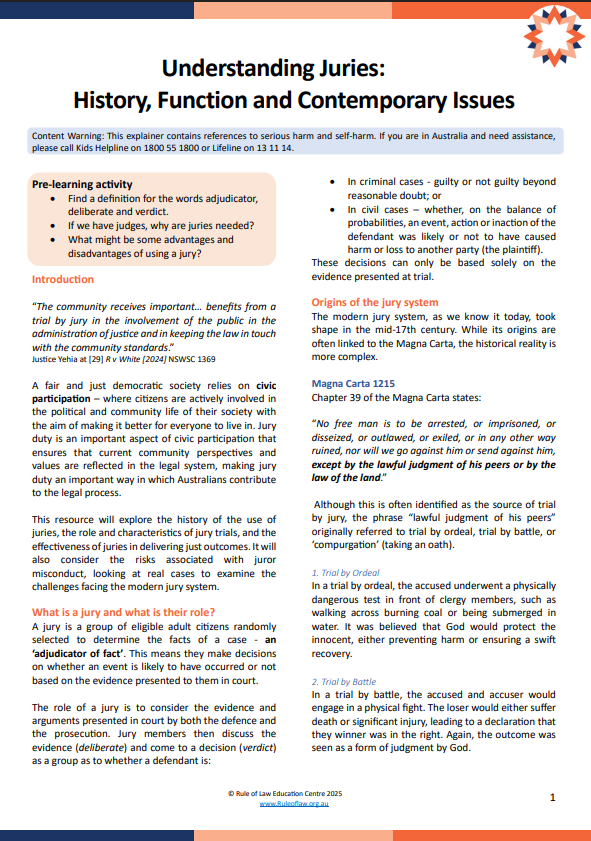
Juries are an integral part of the criminal trial process and the importance of their role should not be underestimated. Australian democracy is underpinned by citizen participation. The jury system enables Australian citizens who are over the age of 18 to participate in the legal system and is central to Australia’s justice system.
The Australian Constitution states ‘the trial on indictment of any offence against any law of the Commonwealth shall be by jury’ and as such, juries are typically used for federal offences which are the most serious of criminal offences, as well as crimes subject to state laws.
“The community receives important… benefits from a trial by jury in the involvement of the public in the administration of justice and in keeping the law in touch with the community standards.” – Justice Yehia at [29] R v White [2024] NSWSC 1369
Introduction
Juries are used in both criminal and civil cases. Jury trials occur in State District, Supreme Courts, and Federal Courts. Jurors are randomly selected from the Australian electoral roll and added to a jury roll. People on the jury roll are randomly selected and sent a summons to attend court, where they may be selected as a juror for a specific trial. All Australians eligible to vote can be summoned as jurors subject to some exclusions and exemptions. For criminal trials juries typically consistent of 12 people. In a criminal trial the juries role is to hear the evidence, listen to the arguments and determine whether the defendant is guilty or not guilty of the offences. Juries in criminal trials were required to reach unanimous verdicts prior to 2005. Today, a jury can reach a verdict by a majority of 11 or 10 jurors in certain circumstances (Jury Act 1977, section 55F).
In New South Wales, a defendant charged with an indictable offence may apply to have their case tried by a Judge alone (Criminal Procedure Act 1986, section 132). Trial by judge alone is not available in all Australian jurisdictions. For example, it is not offered in Victoria which is why Cardinal George Pell trials were heard by a jury. Judge alone trials are available in NSW, Western Australia, Queensland, South Australia and the ACT. In certain circumstance a judge alone trial may be more appropriate. For example where an accused is so high-profile or notorious that their right to a fair trial may be jeopardised because a jury may not be able to be unbiased or impartial. This was why the Claremont Serial Killings case was heard before a judge alone. Judge alone trials are not available if the accused has been charged with a Commonwealth offence (such as drug importation or terrorism).
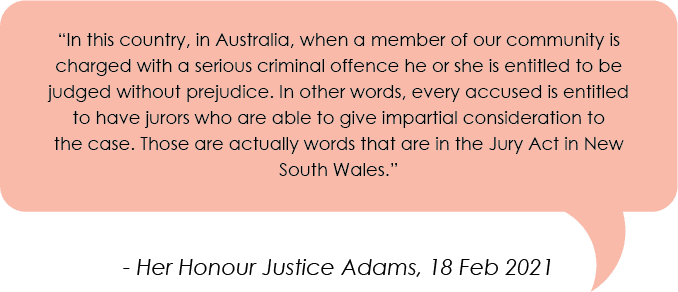
Applications for a judge alone trial will be rejected if they potentially put at risk justice being achieved for the parties. The law must seek to protect the rights of both the victim and the accused and the form of trial requires a balancing exercise in an effort to achieve fairness. The law also attempts to satisfy objective community standards.
Jury service and its relationship to rule of law principles
Jury trials provide a safeguard against the arbitrary or oppressive enforcement of criminal justice by those in authority. Juries ensure community representation informs the balancing of evidence and allows community perspective to be incorporated into the judging of those accused. Juries force lawyers to use plain english and make court proceedings accessible to the whole community. The jury system is an integral part of the criminal trial process and the community plays its part in the administration of justice. Citizen participation in establishing rules applicable to them is an essential principle of the rule of law, which is why rule of law principles need to be understood and upheld by every Australian.
What is a jury and what is their role?
A jury is a group of eligible adult citizens randomly selected to determine the facts of a case – an ‘adjudicator of fact’. This means they make decisions on whether an event is likely to have occurred or not based on the evidence presented to them in court.
The role of a jury is to consider the evidence and arguments presented in court by both the defence and the prosecution. Jury members then discuss the evidence (deliberate) and come to a decision (verdict) as a group as to whether a defendant is:
In criminal cases – guilty or not guilty beyond reasonable doubt; or
In civil cases – whether, on the balance of probabilities, an event, action or inaction of the defendant was likely or not to have caused harm or loss to another party (the plaintiff).
These decisions can only be based solely on the evidence presented at trial.
Origins of the jury system
The modern jury system, as we know it today, took shape in the mid-17th century. While its origins are often linked to the Magna Carta, the historical reality is more complex.
Magna Carta 1215
Chapter 39 of the Magna Carta states:
“No free man is to be arrested, or imprisoned, or disseized, or outlawed, or exiled, or in any other way ruined, nor will we go against him or send against him, except by the lawful judgment of his peers or by the law of the land.”
Although this is often identified as the source of trial by jury, the phrase “lawful judgment of his peers” originally referred to trial by ordeal, trial by battle, or ‘compurgation’ (taking an oath)
1. Trial by Ordeal
In a trial by ordeal, the accused underwent a physically dangerous test in front of clergy members, such as walking across burning coal or being submerged in water. It was believed that God would protect the innocent, either preventing harm or ensuring a swift recovery.
2. Trial by Battle
In a trial by battle, the accused and accuser would engage in a physical fight. The loser would either suffer death or significant injury, leading to a declaration that they winner was in the right. Again, the outcome was seen as a form of judgment by God.
3. Compurgation and the Rise of Early Juries
By the mid-13th century, a new form of trial emerged: ‘compurgation’, or trial by oath. In this system, the accused swore an oath of innocence, supported by the testimony of 11 or 12 individuals who would vouch for their credibility. If they failed to gather enough supporters, they would then be subjected to trial by ordeal.
Over time, compurgation evolved into a system of inquests. In these cases, 24 ‘good and lawful men’ from the community were summoned to investigate and provide a verdict based on their personal knowledge of the case. These early juries were self-informing, meaning jurors were chosen because they already knew the parties involved and the details of the dispute. Self-informing juries began to decline in the early fifteenth century as small villages grew into larger towns and cities, where anonymity was more likely.
Juries in the early Australian Colony
In the early years of the New South Wales settlement, trials were conducted by military officers or magistrates, who were generally wealthy landowners without formal legal training. Civilian juries were first introduced by the New South Wales Supreme Court in 1824.
However, the Australian Courts Act 1828 effectively abolished juries because it legislated that trials had to be conducted before a panel of military personnel instead. It was not until the Jury Trials Amending Act 1833 was passed that criminal trials with a civilian jury were restored in the colony.
Juries in Modern Australia
Is there a right to trial by jury in Australia?
A common misconception is that Australians have a constitutional right to a jury trial in all cases. However, this is not true. Section 80 of the Australian Constitution states:
“The trial on indictment of any offence against any law of the Commonwealth shall be by jury.”
This means that jury trials are only mandatory for federal indictable offences, the most serious criminal offences such as terrorism and major drug importation offences covered by Commonwealth legislation.
At the state level, jury trials are governed by legislation. For example, section 131 of the Criminal Procedure Act 1986 (NSW) states that criminal trials in the Supreme Court or District Court are generally to be conducted before a jury. However, a jury trial is not an absolute right in state trials either. Courts have a discretion to order a judge-alone trial if a party applies and the court determines that it is in the interests of justice to do so.
Who is eligible for jury duty?
All Australian citizens listed on the Electoral Roll are eligible for jury service in their state or territory unless they are disqualified by legislation. For example, Schedule 1 of the Jury Act 1977 (NSW), identifies people as having committed serious criminal offences or who is an Australian lawyer as being ineligible, and the Schedule 2 of the Juries Act 2000 (Vic) prohibits Electoral Commissioners from participating.
Individuals can also request to be excused from jury duty under certain circumstances in the relevant legislation. For example, Schedule 2 of the Jury Act 1977 (NSW) enables dentists, pharmacists or members of the clergy (such as priests) to ask to be exempt from jury duty. In contrast, s21 of the Jury Act 1995 (Qld) lists the criteria that must be applied by judges and sheriff’s in determining whether a person may be excused from jury duty, such as whether inclusion on a jury would cause significant financial hardship to the individual or inconvenience to the public.
Discussion:
Why are some people excluded? (HINT: think about fairness!)
Why is it important to allow people to ask to be exempt?
Did you know?
There are no age restrictions for jury service. However, since individuals under 18 are not eligible to vote and are not included on the Electoral Roll, they cannot be selected for jury duty.
How are juries chosen?
As every state and territory have their own legal systems, different legislation governs the jury system in each state and territory.
Activity:
Research the process of jury selection in your state or territory and create a flow chart showing the steps.
How many jurors are selected for a trial?
In Australia, juries are used in both civil and criminal cases. The number of jurors required can vary depending on:
the jurisdiction the case is being heard in (geographical or court);
the estimated length of the trial; and
whether the case is civil or criminal.
Generally, criminal juries are made up of 12 people, with civil cases varying widely across Australian jurisdictions.
NSW: Criminal trials require 12 jurors (minimum 10); civil trials use 4 jurors.
VIC: Criminal trials require 12 jurors (minimum 10); civil trials use 6 jurors.
QLD: Criminal trials require 12 jurors (minimum 10); civil trials use 4 jurors.
SA: Criminal trials require 12 jurors (minimum 10); civil juries are unlawful.
WA: Criminal trials require 12 jurors (minimum 10); civil trials use 6 jurors.
TAS: Criminal trials require 12 jurors (minimum 10); civil trials use 7 jurors.
Federal: Criminal trials require 12 jurors (minimum 10); civil trials use 12 jurors.
In lengthy trials, more than 12 jurors may be empanelled or sworn in to reduce the risk of the trial being aborted due to juror unavailability, such as a juror becoming unwell and no longer being able to serve. In this case, typically up to 15 jurors are permitted, however, in Western Australia the maximum is 18, and in Tasmania, 14.
Before deliberations start, the jury is reduced to 12, with surplus jurors randomly selected to leave the panel.
What is deliberation?
After the trial concludes, the empanelled jurors retire to deliberate – discuss with each other the evidence, arguments and information presented to them in order to reach a decision. This is a confidential process that requires all jurors to understand and adhere to the trial Judge’s instructions in order to reach a fair verdict.
How many jurors make a decision?
Historically, juries were required to reach a unanimous verdict. However, this is no longer always the case – except in the Federal Court.
For example, previously, in NSW criminal cases, all 12 jurors had to agree on the exact same decision before a verdict could be reached. Following amendments in 2006 to the Jury Act 1977 (NSW), if deliberations continue for an extended period without reaching a unanimous decision, the court may accept a majority verdict, such as 11 out of 12 jurors.
The list below identifies legislation that allows for majority verdicts in criminal cases in each Australian jurisdiction.
In NSW, majority verdicts are permitted under s55F of the Jury Act 1977.
In Victoria, they are authorised by s46 of the Juries Act 2000.
In Queensland, they are provided for in s59A of the Jury Act 1995.
In South Australia, they are set out in s57 of the Juries Act 1927.
In Western Australia, they appear in s114 of the Criminal Procedure Act 2004.
In Tasmania, they are authorised by s43 of the Juries Act 2003.
In the Northern Territory, they are contained in s368 of the Criminal Code Act 1983.
In the ACT, they are provided for in s38 of the Juries Act 1967.
Question:
List all of the costs you can think of that might happen in a court case for both defence and prosecution.
What do you think the ideal number of jurors making a decision should be and why?
Decisions
After deliberations, the jury will reach a verdict (decision). They will re-enter the court, where the judge will ask the foreperson (the juror chosen by the other jurors to be the spokesperson) if a decision has been made, and what it is. This verdict determines the conviction (guilty), acquittal (not guilty), or the civil liability (responsibility) of the defendant(s).
What happens when a jury can’t agree?
If the jury is not able to come to a unanimous decision or a majority decision, it is called a ‘Hung Jury’. In this case, the judge releases (discharges) the jury from their duties and the prosecution must decide whether to retry the case before a new jury.
Although hung juries are relatively rare in Australia (occurring in 3–8% of trials), they can lead to costly retrials or case dismissals, potentially obstructing justice for the innocent party.
How do juries help to achieve fairness?
There are a number of safeguards built into the jury system to ensure fairness for the accused and to protect juries from being targeted by media or parties to a case.
In Australia, juries:
Do not have to give reasons for their decision.
Deliberations are confidential: jurors are not allowed to discuss anything relating to the case outside of the jury room, even after completion of the trial.
Jurors remain anonymous: Jurors cannot be identified by name to anyone both during and after a trial process, They are only identified by their juror number during the trial. In Australia, laws relating to juries make it a criminal offense for jurors to identify themselves or to disclose any details about deliberations during and after the trial has concluded. This strict confidentiality contrasts with practices in other countries, such as the United States, where jurors are permitted to speak publicly about their experiences and may even give media interviews. Juror anonymity in Australia ensures fairness by protecting jurors from external influences and pressures, supporting the integrity and confidentiality of the deliberation process.
Prospective jurors are screened to remove conflicts of interest: Both prosecution and defence can challenge jurors to ensure impartiality, and empanelled jurors swear an oath to remain fair and unbiased.
The judge gives the jury directions: The presiding judge provides jurors with legal instructions to ensure they focus on evidence in the trial and apply legal principles correctly. Before deliberations begin, the judge also gives the jury a “summing up” to explain the law and instruct jurors on their responsibilities. This process aims to minimise errors or unfair verdicts. To ensure consistency, the script for judges for these instructions are given in the “Bench Book,” a guide containing all required procedures that judges must follow to ensure equality and fairness in court.
Don’t decide on penalties in criminal cases or remedies in civil cases: This responsibility lies with the judge who will take into account a number of factors, including comparable historical cases, legislation and the purposes of punishment to make a decision.
Advantages and challenges of the jury system
Advantages of Juries
Juries enhance democratic participation by involving the public directly in legal decision-making. Their presence necessitates the use of plain language, making trials more accessible; and promotes transparency, because evidence and submissions must be understood by average members of the community. By involving the perspectives of everyday people, juries ensure that decision-making in serious disputes before the law incorporate community values, meeting society’s needs.
Furthermore, respectful debate and collaborative decision-making among a diverse range of jurors enhances deliberations, ensuring that the differing worldviews that make up the Australian community are given a voice and taken into account.
Challenges of the Jury System
Despite various safeguards built into the jury system, factors such as the personal biases of jurors, the nature of complex evidence presented in trials that requires expertise to deeply understand it, and external influences, such as media coverage and social media commentary can undermine the fairness of jury trials.
Ensuring inclusive juries also remains a critical consideration across Australian jurisdictions. Of particular concern is the inability of individuals who are deaf or blind to participate in juries, despite being taxpayers and eligible to vote in elections.
In addition, juror misconduct, including independent research (such as jurors using google or social media to search for a case or relevant law, going to a crime scene or disclosing case details or deliberations to outside parties), can result in mistrials due to a juror having relied on evidence or opinion not tested in court. Juror misconduct can lead to the discharge of a jury, meaning that a mistrial has occurred. This leads to a new trial with a new jury starting again, which is very costly for the state and could lead to delays in justice for victims and accused persons.
The effect of jury trials on justice outcomes
According to the Bureau of Crime Statistics and Research (BOCSAR), in NSW, 81% of trials heard in the District Court between July 2023 and June 2024 were decided by juries, with jury trials leading to more convictions than judge-alone trials. Of that number, 56% of defendants were found guilty of at least one charge by the jury, with 39% acquitted of all charges.
In addition, judge-alone trials have a 12% increase in the probability of an acquittal compared to jury trials.
Conclusion
Juries play an important role in ensuring that justice system outcomes remain in touch with society’s values, standards, expectations and needs. Juries also provide community members with the opportunity to contribute to one of the most critical systems that maintain social cohesion in Australia – our justice system.
Related Resources
-
This explainer outlines the main participants in a criminal courtroom and explains how each contributes to a fair and lawful trial. It highlights how impartial judging, the separation of powers, the burden and standard of proof, and the rights of the accused work together to ensure justice is done and seen to be done.
-
A practical guide to the formal and informal roles citizens play in sustaining Australia’s democratic system. It explains how participation—through voting, jury service, civic engagement, and everyday respectful behaviour—protects democratic stability and prevents authoritarianism. The resource traces the development of voting rights, emphasises the role of juries as community decision‑makers, and connects rights with responsibilities essential to a healthy civic culture.
Explore Related Topics
-
Equality Before the Law
Outlines the core ideas behind the principle that all individuals are subject to the same laws and entitled to equal legal protection.
-
Civil Law
Civil law deals with disputes between individuals, groups and organisations. It provides fair processes for resolving conflicts, enforcing rights and awarding remedies.
-
The Courts
Courts in Australia interpret and apply the law, resolve disputes and ensure government power is exercised lawfully. The court system is structured in a hierarchy, with each level handling different types of matters.