
The Criminal Justice System
Crime: Investigation Process and Bail
-
The criminal justice system defines offences, investigates wrongdoing, determines guilt through fair and transparent processes, and imposes proportionate punishment according to law. Each stage, from investigation and arrest, to bail, trial, sentencing, and punishment, must operate lawfully, protect individual rights, and uphold the rule of law by ensuring that state power is exercised fairly, consistently, and with proper safeguards.
-
This explainer examines recent debates over Queensland’s bail laws, showing how media‑driven public pressure and concerns about youth crime have prompted proposals that weaken the presumption of innocence and shift the burden of proof onto accused young people. It highlights why reactive reforms risk undermining core rule of law principles and argues for evidence‑based, proportionate responses that target recidivism without eroding fundamental legal protections.
-
This explainer outlines how police investigate crime using powers such as search, seizure, arrest, and warrants, while emphasising the legal checks, like reasonable suspicion, oversight bodies, and admissibility rules, that prevent misuse of authority and protect individual rights.
-
This explainer outlines how bail protects the presumption of innocence while managing risks to community safety. It explains the purpose of bail, the factors police and courts must consider and how rule‑of‑law principles ensure decisions are fair, transparent and based on evidence rather than public pressure.
-
This explainer clarifies the difference between summary and indictable offences and how each type moves through the criminal justice system. It outlines which matters are heard in the Local Court, which proceed to higher courts and how the classification of an offence affects procedure, rights and sentencing.
Crime: Criminal Trial Process
-
This explainer outlines how the adversary system structures criminal trials by giving both the prosecution and defence an equal opportunity to present their case before an impartial judge or jury. It highlights how fairness, equality of representation, and judicial impartiality underpin the system, while also noting concerns about resource imbalances and the importance of procedural justice in upholding the rule of law.
-
This explainer outlines the main participants in a criminal courtroom and explains how each contributes to a fair and lawful trial. It highlights how impartial judging, the separation of powers, the burden and standard of proof, and the rights of the accused work together to ensure justice is done and seen to be done.
-
This explainer outlines how criminal charges are laid and how an accused person may plead guilty or not guilty, shaping whether a matter proceeds to sentencing or to a full trial. It highlights the differences between summary and indictable offences, the role of plea bargaining, and how early guilty pleas can reduce sentences, while not‑guilty pleas require the prosecution to prove the case in court.
-
This explainer outlines the prosecution’s duty to prove an accused person’s guilt and explains why juries may only convict if satisfied beyond reasonable doubt. It highlights how this high standard protects the presumption of innocence, prevents wrongful convictions, and ensures that criminal justice operates fairly, transparently, and in line with core rule‑of‑law principles.
-
This explainer outlines how evidence is gathered, assessed, and admitted in criminal trials, showing how strict rules ensure only reliable, relevant, and lawfully obtained material is considered by the court. It highlights the different types of evidence, the role of police and prosecutors in preparing a brief of evidence, and how judges and juries evaluate admissibility and weight to protect fairness, prevent wrongful convictions, and uphold due process.
-
This explainer outlines the major legal defences an accused person may rely on to avoid or reduce criminal liability, including duress, consent, self‑defence, mental illness, and intoxication. It highlights the strict evidentiary requirements for each defence and shows how they operate to ensure that only morally and legally blameworthy conduct results in conviction, reinforcing fairness and due process in the criminal justice system.
-
This explainer outlines the role of juries as impartial fact‑finders who decide guilt or innocence based solely on the evidence presented in court. It highlights how jury service promotes democratic participation, safeguards against arbitrary state power, and ensures that criminal justice outcomes reflect community values, while also acknowledging challenges such as juror bias, media influence, and the complexity of modern trials.
-
This explainer outlines the criminal standard of proof and why prosecutors must prove guilt beyond reasonable doubt. It explains how the standard protects the presumption of innocence, what “reasonable doubt” means in practice and how judges direct juries to apply it. The resource highlights the importance of high proof standards in safeguarding fairness and preventing wrongful convictions.
Crime: Sentencing and Punishment
-
This explainer outlines how post‑sentence regimes—such as Continuing Detention Orders and Extended Supervision Orders—allow high‑risk offenders to be detained or strictly monitored after completing their custodial sentences. It highlights the significant rule‑of‑law concerns these regimes raise, including retrospective punishment, limits on liberty, the blending of civil and criminal standards, and the challenge of balancing community protection with the rights of offenders, victims, and society.
-
This explainer outlines significant reforms to NSW sentencing law, including the replacement of bonds and suspended sentences with new community‑based orders (Conditional Release Orders, Community Correction Orders, and strengthened Intensive Correction Orders). It highlights how these changes aim to improve community safety, streamline guilty‑plea processes, and modernise sentencing options while preserving judicial discretion and ensuring proportionate, evidence‑based penalties.
-
Outlines how sentencing depends on judicial independence and careful consideration of the unique facts of each case. Using R v Dowdle, it illustrates why rigid mandatory sentencing rules can produce unjust outcomes and why judges must retain discretion to balance punishment, deterrence, rehabilitation, and the offender’s circumstances.
-
This resource explains how mandatory sentencing limits judicial discretion, shifts power to prosecutors, and risks disproportionate punishment. It outlines key rule of law concerns, including separation of powers, reduced fairness, and higher prison populations, while contrasting mandatory minimums with established sentencing purposes and principles that ensure proportional, evidence‑based outcomes.
Pleas and Charges
Overview
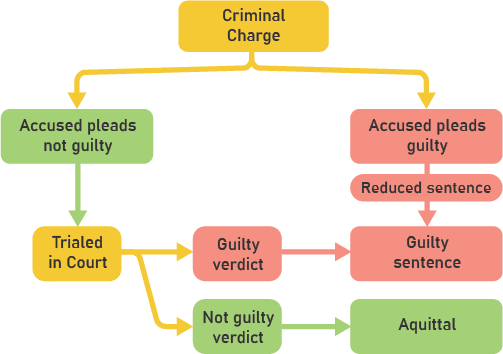
When charged with a criminal offence, the accused is given an opportunity to plead guilty or not guilty. This means that either the accused admits their guilt, forgoes a trial and accepts their sentence, or the accused claims that they are innocent, and must undergo a trial to prove it in a court of law. This process is illustrated below:
Charges
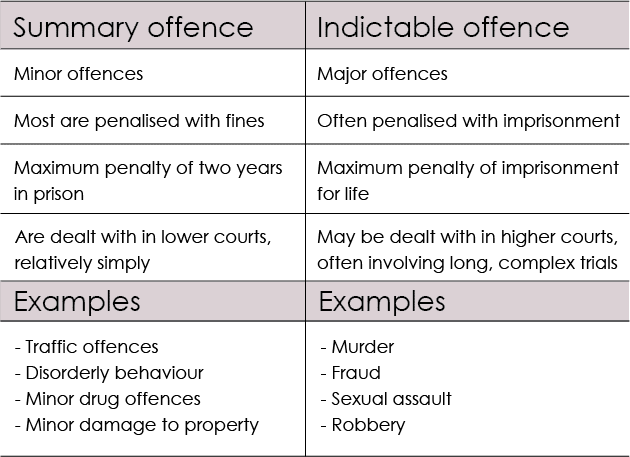
A charge is a government accusation against an individual, which asserts that they have committed an offence. A charge is usually lain upon a person following an arrest, and is then disputed in a courtroom if a trial takes place. In the context of criminal law, there are two types of offences that one can be charged with: summary offences and indictable offences.
Some lesser indictable offences, such as stealing, may be dealt with ‘summarily’ if the Prosecution and Defence agree that the particular offence is not deemed serious, meaning that it will be treated as a summary offence. To this end, the matter would be handled quickly and with less formality, possess the maximum penalty of two years imprisonment, and be heard in a lower court.
Guilty Pleas
When an individual has been served with a charge, they maintain the right, should they believe it necessary, to engage in ‘plea bargaining’. This process is a negotiation between the Defence and the Prosecution to reassess the charges against the accused, potentially reducing the severity or number of charges in exchange for the accused to plead guilty without contest. Regardless of if plea bargaining is used, those who enter into a guilty plea at the earliest opportunity are entitled to a reduction of their sentence of up to 25%. The reason behind this is that if a guilty person pleads guilty, they remove the need for a trial to be held, and are able to fast-track their process to the sentencing stage.
Not Guilty Pleas
Alternatively, the accused may choose to plead ‘not guilty’ if they believe they are innocent of the charge they have been served with. The court will then set a date for a hearing or trial in which the accused’s Defence must disprove their guilt on their behalf. However, if they are found guilty through the proceedings of a trial, their sentence will be substantially more severe than if they had pleaded guilty.
Related Resources
-
This explainer clarifies the difference between summary and indictable offences and how each type moves through the criminal justice system. It outlines which matters are heard in the Local Court, which proceed to higher courts and how the classification of an offence affects procedure, rights and sentencing.
-
This explainer outlines the presumption of innocence, showing why people must be treated as innocent until proven guilty and why the prosecution carries the burden of proving guilt beyond reasonable doubt. It highlights how this principle protects individual rights, limits state power, and ensures fair, evidence‑based justice.
Explore Related Topics
-
Fair and Prompt Trials
Explore resources on fair and prompt trials, showing how timely hearings and procedural fairness protect justice and public confidence.
-
Courts
Explore resources on courts, outlining the court hierarchy and providing Law Day Out materials and to support classroom understanding.
-
Presumption of Innocence
Explore resources on the presumption of innocence, showing how the burden of proof protects accused people and safeguards fairness in criminal justice.