
The Criminal Justice System
Crime: Investigation Process and Bail
-
The criminal justice system defines offences, investigates wrongdoing, determines guilt through fair and transparent processes, and imposes proportionate punishment according to law. Each stage, from investigation and arrest, to bail, trial, sentencing, and punishment, must operate lawfully, protect individual rights, and uphold the rule of law by ensuring that state power is exercised fairly, consistently, and with proper safeguards.
-
This explainer examines recent debates over Queensland’s bail laws, showing how media‑driven public pressure and concerns about youth crime have prompted proposals that weaken the presumption of innocence and shift the burden of proof onto accused young people. It highlights why reactive reforms risk undermining core rule of law principles and argues for evidence‑based, proportionate responses that target recidivism without eroding fundamental legal protections.
-
This explainer outlines how police investigate crime using powers such as search, seizure, arrest, and warrants, while emphasising the legal checks, like reasonable suspicion, oversight bodies, and admissibility rules, that prevent misuse of authority and protect individual rights.
-
This explainer outlines how bail protects the presumption of innocence while managing risks to community safety. It explains the purpose of bail, the factors police and courts must consider and how rule‑of‑law principles ensure decisions are fair, transparent and based on evidence rather than public pressure.
-
This explainer clarifies the difference between summary and indictable offences and how each type moves through the criminal justice system. It outlines which matters are heard in the Local Court, which proceed to higher courts and how the classification of an offence affects procedure, rights and sentencing.
Crime: Criminal Trial Process
-
This explainer outlines how the adversary system structures criminal trials by giving both the prosecution and defence an equal opportunity to present their case before an impartial judge or jury. It highlights how fairness, equality of representation, and judicial impartiality underpin the system, while also noting concerns about resource imbalances and the importance of procedural justice in upholding the rule of law.
-
This explainer outlines the main participants in a criminal courtroom and explains how each contributes to a fair and lawful trial. It highlights how impartial judging, the separation of powers, the burden and standard of proof, and the rights of the accused work together to ensure justice is done and seen to be done.
-
This explainer outlines how criminal charges are laid and how an accused person may plead guilty or not guilty, shaping whether a matter proceeds to sentencing or to a full trial. It highlights the differences between summary and indictable offences, the role of plea bargaining, and how early guilty pleas can reduce sentences, while not‑guilty pleas require the prosecution to prove the case in court.
-
This explainer outlines the prosecution’s duty to prove an accused person’s guilt and explains why juries may only convict if satisfied beyond reasonable doubt. It highlights how this high standard protects the presumption of innocence, prevents wrongful convictions, and ensures that criminal justice operates fairly, transparently, and in line with core rule‑of‑law principles.
-
This explainer outlines how evidence is gathered, assessed, and admitted in criminal trials, showing how strict rules ensure only reliable, relevant, and lawfully obtained material is considered by the court. It highlights the different types of evidence, the role of police and prosecutors in preparing a brief of evidence, and how judges and juries evaluate admissibility and weight to protect fairness, prevent wrongful convictions, and uphold due process.
-
This explainer outlines the major legal defences an accused person may rely on to avoid or reduce criminal liability, including duress, consent, self‑defence, mental illness, and intoxication. It highlights the strict evidentiary requirements for each defence and shows how they operate to ensure that only morally and legally blameworthy conduct results in conviction, reinforcing fairness and due process in the criminal justice system.
-
This explainer outlines the role of juries as impartial fact‑finders who decide guilt or innocence based solely on the evidence presented in court. It highlights how jury service promotes democratic participation, safeguards against arbitrary state power, and ensures that criminal justice outcomes reflect community values, while also acknowledging challenges such as juror bias, media influence, and the complexity of modern trials.
-
This explainer outlines the criminal standard of proof and why prosecutors must prove guilt beyond reasonable doubt. It explains how the standard protects the presumption of innocence, what “reasonable doubt” means in practice and how judges direct juries to apply it. The resource highlights the importance of high proof standards in safeguarding fairness and preventing wrongful convictions.
Crime: Sentencing and Punishment
-
This explainer outlines how post‑sentence regimes—such as Continuing Detention Orders and Extended Supervision Orders—allow high‑risk offenders to be detained or strictly monitored after completing their custodial sentences. It highlights the significant rule‑of‑law concerns these regimes raise, including retrospective punishment, limits on liberty, the blending of civil and criminal standards, and the challenge of balancing community protection with the rights of offenders, victims, and society.
-
This explainer outlines significant reforms to NSW sentencing law, including the replacement of bonds and suspended sentences with new community‑based orders (Conditional Release Orders, Community Correction Orders, and strengthened Intensive Correction Orders). It highlights how these changes aim to improve community safety, streamline guilty‑plea processes, and modernise sentencing options while preserving judicial discretion and ensuring proportionate, evidence‑based penalties.
-
Outlines how sentencing depends on judicial independence and careful consideration of the unique facts of each case. Using R v Dowdle, it illustrates why rigid mandatory sentencing rules can produce unjust outcomes and why judges must retain discretion to balance punishment, deterrence, rehabilitation, and the offender’s circumstances.
-
This resource explains how mandatory sentencing limits judicial discretion, shifts power to prosecutors, and risks disproportionate punishment. It outlines key rule of law concerns, including separation of powers, reduced fairness, and higher prison populations, while contrasting mandatory minimums with established sentencing purposes and principles that ensure proportional, evidence‑based outcomes.
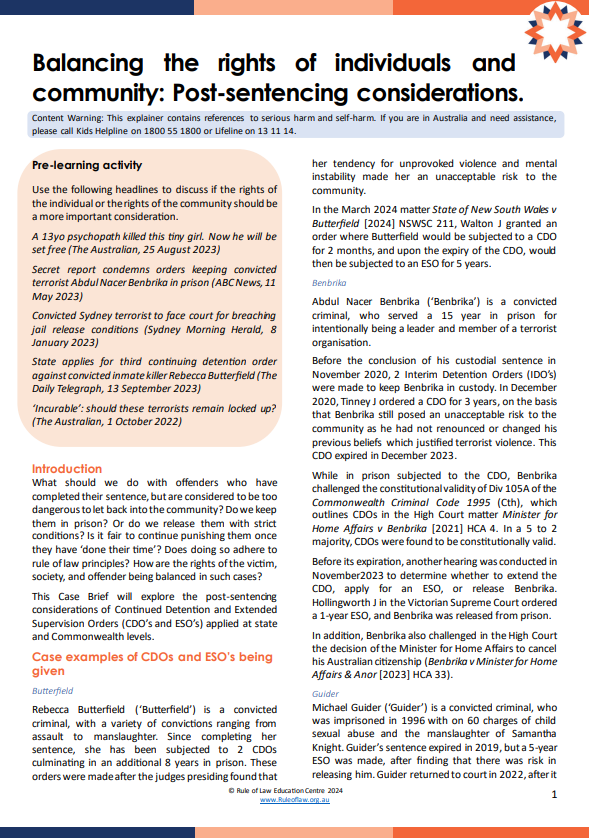
Post-Sentencing Considerations
Balancing the rights of individuals and the community
Pre-learning activity
Use the following headlines to discuss whether the rights of the individual or the rights of the community should be a more important consideration.
A 13yo psychopath killed this tiny girl. Now he will be set free (The Australian, 25 August 2023)
Secret report condemns orders keeping convicted terrorist Abdul Nacer Benbrika in prison (ABC News, 11 May 2023)
Convicted Sydney terrorist to face court for breaching jail release conditions (Sydney Morning Herald, 8 January 2023)
State applies for third continuing detention order against convicted inmate killer Rebecca Butterfield (The Daily Telegraph, 13 September 2023)
‘Incurable’: should these terrorists remain locked up? (The Australian, 1 October 2022)
Introduction
What should we do with offenders who have completed their sentence, but are considered too dangerous to let back into the community? Do we keep them in prison? Or do we release them with strict conditions? Is it fair to continue punishing them once they have ‘done their time’? Does doing so adhere to Rule of Law principles? How are the rights of the victim, society, and offender being balanced in such cases?
This Case Brief will explore the post-sentencing considerations of Continued Detention and Extended Supervision Orders (CDO’s and ESO’s) applied at state and Commonwealth levels.
Case examples of CDOs and ESO’s being given
Butterfield
Rebecca Butterfield (‘Butterfield’) is a convicted criminal, with a variety of convictions ranging from assault to manslaughter. Since completing her sentence, she has been subjected to 2 CDOs culminating in an additional 8 years in prison. These orders were made after the presiding judges found that her tendency for unprovoked violence and mental instability made her an unacceptable risk to the community.
In the March 2024 matter, State of New South Wales v Butterfield [2024] NSWSC 211, Walton J granted an order where Butterfield would be subjected to a CDO for 2 months, and upon the expiry of the CDO, would then be subjected to an ESO for 5 years.
Benbrika
Abdul Nacer Benbrika (‘Benbrika’) is a convicted criminal, who served 15 years in prison for intentionally being a leader and member of a terrorist organisation.
Before the conclusion of his custodial sentence in November 2020, 2 Interim Detention Orders (IDO’s) were made to keep Benbrika in custody. In December 2020, Tinney J ordered a CDO for 3 years on the basis that Benbrika still posed an unacceptable risk to the community as he had not renounced or changed his previous beliefs which justified terrorist violence. This CDO expired in December 2023.
While in prison subjected to the CDO, Benbrika challenged the constitutional validity of Div 105A of the Commonwealth Criminal Code 1995 (Cth), which outlines CDOs in the High Court matter Minister for Home Affairs v Benbrika [2021] HCA 4. In a 5 to 2 majority, CDOs were found to be constitutionally valid.
Before its expiration, another hearing was conducted in November 2023 to determine whether to extend the CDO, apply for an ESO, or release Benbrika. Hollingworth J in the Victorian Supreme Court ordered a 1-year ESO, and Benbrika was released from prison.
In addition, Benbrika also brough a High Court challenge to the decision of the Minister for Home Affairs to cancel his Australian citizenship (Benbrika v Minister for Home Affairs & Anor [2023] HCA 33).
Guider
Michael Guider (‘Guider’) is a convicted criminal who was imprisoned in 1996 on 60 charges of child sexual abuse and the manslaughter of Samantha Knight. Guider’s sentence expired in 2019, however, a 5-year ESO was made after finding that there was risk in releasing him. Guider returned to court in 2022 for breaching the conditions of the ESO after it was discovered that he had photographs of persons aged under 18 on his phone.
What are Post-Sentencing Regimes?
Post-sentencing preventative regimes are primarily designed to ensure the safety and protection of the community. They are applied when offenders are considered to pose an unacceptable risk of committing a further serious, violent, sexual, or terrorism related offence in the community (high-risk offenders). These regimes commence following the offender’s release at the conclusion of their custodial sentence.
In NSW, serious violent and sexual offences include rape, aggravated sexual assault, sexual assault, abuse of a child, murder, conspiring to commit murder, and grievous bodily harm to another person as defined throughout the Crimes Act 1900 (NSW). State-based terror offences are contained in s310J of the same Act, and includes membership to a terrorist organisation.
In NSW, if an offender whose sentence is about to expire is considered to represent an unacceptable risk of serious reoffending, the NSW Attorney General can apply to the Supreme Court of NSW to either:
Detain the offender in custody for a longer period of time via a Continuing Detention Order (CDO); or
Place strict monitoring and supervision conditions on the offender when released into the community via an Extended Supervision order (ESO).
Continuing Detention Orders
In NSW, a CDO allows for high-risk offenders to be imprisoned in a correctional centre to a maximum period of five years after their sentence expires. An application can be made for the court to renew the order after the time period has concluded.
Extended Supervision Orders
In NSW, an ESO allows for the strict supervision of high-risk violent and sexual offenders in the community by Community Corrections Officers. Supervision can include electronic monitoring, restrictions on who offenders associate with and where they go, regular reporting to a Community Corrections Officer, and participation in rehabilitation programs.
Before granting either a CDO or ESO, the Supreme Court must be satisfied that it is highly likely that the offender poses an unacceptable risk of committing another serious offence if not kept in detention or under supervision.
As at 1 January 2023, in NSW there were:
3 offenders in custody on a CDO; and
147 offenders subject to an ESO.
Legislative Framework
NSW
In New South Wales, both orders are legislated under the:
Crimes (High Risk Offenders) Act 2006 (NSW);
Crimes (Serious Sex Offenders) Act 2006 (NSW); and
Terrorism (High Risk Offenders) Act 2017 (NSW)
Other States
Other Australian States also have similar legislative frameworks in place, as outlined below:
Victoria: Serious Offenders Act 2018 (VIC)
Queensland: Dangerous Prisoners (Sexual Offenders) Act 2003 (QLD)
South Australia: Criminal Law (High Risk Offenders) Act 2015 (SA)
Western Australia: High Risk Serious Offenders Act 2020 (WA)
Northern Territory: Serious Sex Offenders Act 2013 (NT)
Tasmania: Terrorism (Preventative Detention) Act 2005 (TAS); Dangerous Criminals and High Risk Offenders Act 2021 (TAS).
Australian Capital Territory: N/A
Commonwealth CDO
CDO’s can also be found in Commonwealth legislation under Division 105A of the Criminal Code Act 1995 (Cth). However, these can only be granted against a terrorist offender who is deemed to pose an unacceptable risk of committing a serious Part 5.3 (Terrorism) offence if released into the community.
Legal Issues and the Rule of Law
The Rule of Law requires that laws are applied equally and fairly to all people to protect their rights. Only in rare circumstances should we depart from its principles to protect community interests.
While protection of community interests is a key factor when creating legislation, Rule of Law principles also need to be considered to ensure that the rights of the offender are also considered and supported.
The Rule of Law issues surrounding these particular post sentencing considerations are summed up in Fardon v Attorney-General (Qld) (2004) 223 CLR 575 at 592 [20].
“Difficult questions involving the reconciliation of rights to liberty and concerns for the protection of the community … typically arise in the case of a small number of unfortunate individuals who suffer disorders which make them dangerous to others…”
From this quote, and your own knowledge, to what extent does this area of the law balance the rights of victims, offenders, and society
People can only be punished in accordance with the law.
The principle requiring that individuals should only be punished for crimes they have committed, not ones they might commit in the future, was established in the Magna Carta in 1215.
Allowing orders to be made that extend penalties for offenders who have completed a sentence determined on the merits of evidence, aggravating and mitigating factors and seriousness, can be seen as a double punishment which undermines the integrity of the justice system. In addition, continuing detention and monitoring post sentence may be in breach the obligations related to liberty and arbitrary detention contained in Article 9(1) of the ICCPR.
Fair Trials
Article 14 of the ICCPR and a key Rule of Law principle requires that all people have the right to a fair and prompt trial and are considered equal before the law. Criminal and civil laws operate in tandem to protect these rights, and the needs and interests of both the community and individuals.
CDO’s and ESO’s present a complication as they are effectively a combination of criminal and civil procedures and standards. When these operate together, they may diminish the rights afforded to offenders and undermine equality and fairness, especially given the different standard of proof required in civil and criminal matters (the burden of proof and the balance of probabilities).
No retrospective laws should be made.
Retrospective laws are laws that alter what people’s rights and responsibilities were in the past. As well as being a fundamental Rule of Law principle, it is also regulated at international law by Article 15 of the ICCPR. Both strongly oppose retrospective laws because they contravene the principle of the law being known at the time the act was done.
CDOs and ESOs pose a real threat to the Rule of Law as they are able to, and have been, used retrospectively. As seen in the case examples, there are offenders with already or soon to be expired custodial sentences who have been subjected to these penalties under legislation, despite it not being in force when they committed their offences or when they were sentenced.
Case Study: Guider
When Guider was released from prison and placed on an ESO, the matter was a civil matter, and was dealt with in accordance to civil procedure and standards. However, as he faces new charges of breach of ESO conditions, these will be heard according to the criminal procedure and standards.
Case Study: Butterfield
After being jailed in 2003, she has already been subjected to 2 CDOs, spanning 8 years. She was given her initial sentence 3 years before the NSW legislation was enacted.
Further, there is a question of whether to extend jail sentences for convicted terrorists. 21 people convicted of terror offences in the early 2000’s are due for release between 2022-2027, significantly before the preventative regimes were enacted.
Case Study: Benbrika
Sentenced in 2005 for terrorism offences, due to be released in November 2020 but was granted a CDO for another 3 years. His initial sentence was given before the legislation was enacted in 2016.
Separation of Powers
The Supreme Court, not the Executive Government, is charged with the decision as to whether a CDO or ESO is granted. This is consistent with the doctrine of the separation of powers.
The November 2023 High Court Case of NZYQ upheld that it is the exclusive responsibility of the judiciary to impose punishment, and not the role of the Executive, such as the removal of citizenship, in response to criminal activities.
2024 Statutory Review
The Commonwealth Parliamentary Joint Committee on Intelligence and Security has commenced a review into the operation, effectiveness and implications of CDO’s and ESO’s. This review follows a report and recommendations published by the Independent National Security Legislation Monitor (INSLM).
One of the recommendations made in the report was that Div 105A be amended to abolish continuing detention orders and that this division be amended to “include rehabilitation and reintegration of the subjects of a post-sentence order back into the community” as an explicit objective.
Related Resources
-
Explains the rule‑of‑law principle that individuals may only be punished in accordance with laws that clearly define offences and penalties. Highlights that punishment must be lawful, proportionate, and imposed through the justice system, not by governments, groups, or individuals acting outside legal authority.
-
Explains how retrospective laws operate in Australia, including how they change the legal consequences of past actions and why they challenge legal certainty and the rule of law. Outlines the common‑law presumption against retrospectivity, the role of the Principle of Legality, and the parliamentary scrutiny mechanisms that help prevent unjust or arbitrary retrospective legislation.
Explore Related Topics
-
Fair and Prompt Trials
Explore resources on fair and prompt trials, showing how timely hearings and procedural fairness protect justice and public confidence.
-
Courts
Explore resources on courts, outlining the court hierarchy and providing Law Day Out materials and to support classroom understanding.
-
Presumption of Innocence
Explore resources on the presumption of innocence, showing how the burden of proof protects accused people and safeguards fairness in criminal justice.