
Roles of the Executive Government
-
This poster looks at what the job description for the Attorney General would include based upon the key concept that the Attorney-General must ensure the law is allowed to take its course. This means the Attorney-General must uphold established legal traditions and processes such as the presumption of innocence and fair and prompt trials.
-
This poster looks at the Executive Government, it’s people, roles and checks on power.
-
This explainer outlines Arthur Phillip’s leadership of the First Fleet, his establishment of British law in the new colony, and his efforts to ensure survival, fairness, and stability while navigating conflict with military officers and tensions with Indigenous peoples.
-
This explainer highlights William Bligh’s brief, turbulent governorship, focusing on his attempts to break the New South Wales Corps’ control over trade, end the rum economy, and support struggling farmers. His reforms provoked the Corps, leading to the Rum Rebellion and his arrest, though he was later cleared. Despite lasting controversy, his actions helped re‑establish lawful authority in the colony.
-
This explainer shows how Lachlan Macquarie stabilised New South Wales by restoring law and order, redirecting convict labour to public works, and supporting emancipists. It highlights his major building program with Francis Greenway, the introduction of official currency, and reforms that helped shift the colony toward a free, organised society. It also notes how opposition from wealthy settlers and the Bigge Inquiry forced his resignation, even though his leadership laid foundations for future self‑government.
-
This explainer outlines how John Hunter struggled to regain control of New South Wales after years of unchecked power by the New South Wales Corps. It highlights the Corps’ corruption, its dominance over trade and law, and the obstacles Hunter faced as they blocked information and undermined his authority. Despite being recalled to England over false accusations, his reputation was later restored, and his writings became valuable records of early colonial life.
-
This explainer outlines how Philip Gidley‑King worked to strengthen and expand the colony between 1800 and 1806. It highlights his efforts to build the economy through coal, whaling, and farming, his support for emancipists, and his push for fair opportunity. It also shows how constant resistance from the New South Wales Corps—especially John Macarthur—undermined his authority, eventually damaging his reputation and forcing his resignation.
-
This explainer shows how Lord Sydney, Thomas Townshend, shaped the principles that guided the founding of New South Wales. It outlines why he adopted the name Sydney in honour of Algernon Sidney, whose ideas about liberty, equality, and the rule of law deeply influenced him. It also highlights his key decisions as Home Secretary: choosing Arthur Phillip as governor, creating the First Charter of Justice, and ensuring the new colony offered convicts the chance for rights, reform, and eventual freedom.
Executive Government Poster
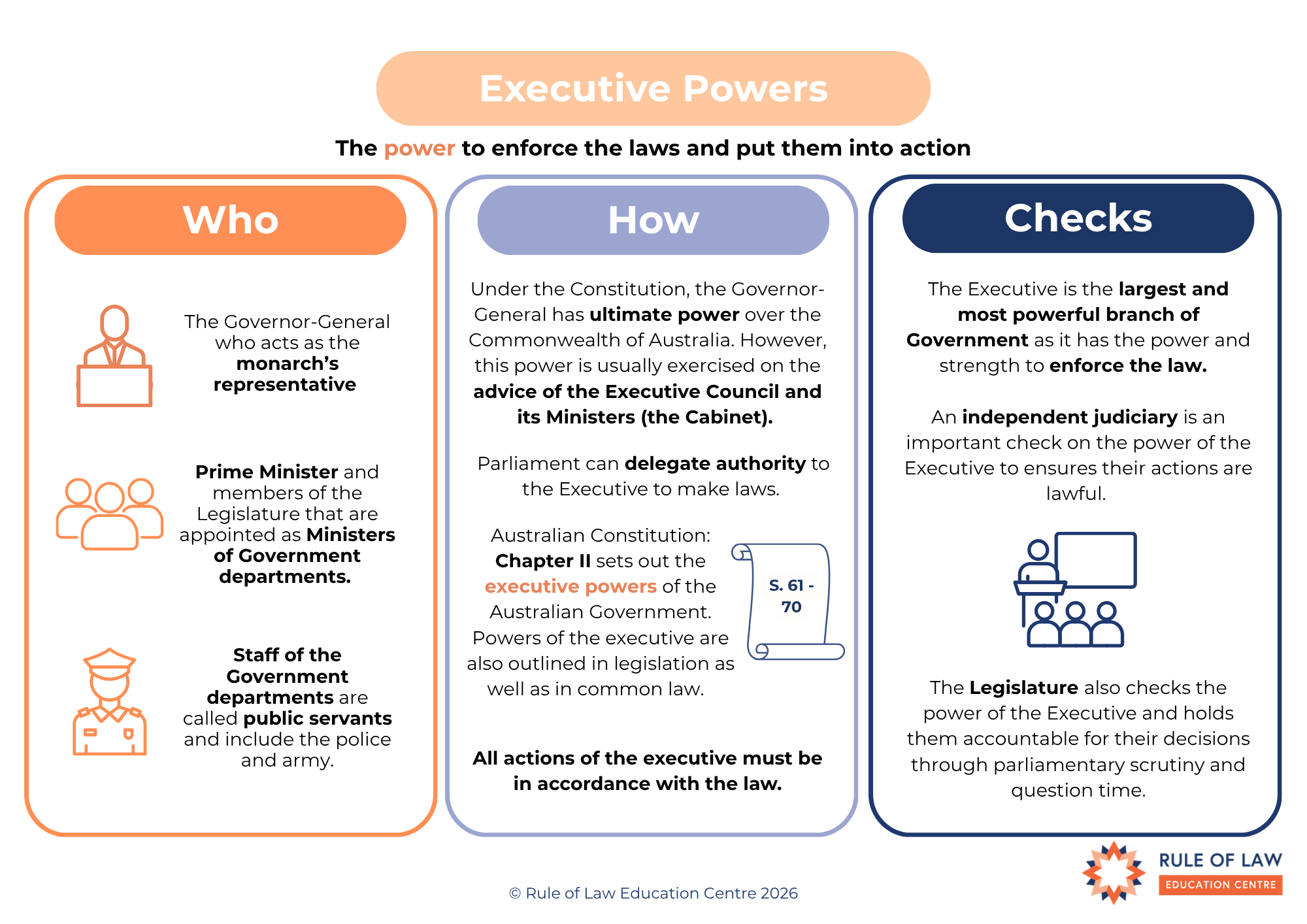
The Executive Government as part of the Separation of Powers has the power to enforce the laws and put them into action. This poster looks at who is in the Executive Government, where their power comes from and what checks and balances there are on the exercise of their power.
Who is in the Executive?
The Governor-General who acts as the monarch’s representative.
Prime Minister and members of the Legislature that are appointed as Ministers of Government departments.
Staff of the Government departments are called public servants and include the police and army.
What do they do and where is their authority from?
Under the Constitution, the Governor-General has ultimate power over the Commonwealth of Australia. However, this power is usually exercised on the advice of the Executive Council and its Ministers (the Cabinet).
Parliament can delegate authority to the Executive to make laws.
Australian Constitution: Chapter II sets out the executive powers of the Australian Government. Powers of the executive are also outlined in legislation as well as in common law.
Checks and Balances on the Executive
The Executive is the largest and most powerful branch of Government as it has the power and strength to enforce the law.
An independent judiciary is an important check on the power of the Executive to ensure their actions are lawful.
The Legislature also checks the power of the Executive and holds them accountable for their decisions through parliamentary scrutiny and question time.
All actions of the executive must be in accordance with the law.
Related Resources
-
This explainer shows how Lord Sydney, Thomas Townshend, shaped the principles that guided the founding of New South Wales. It outlines why he adopted the name Sydney in honour of Algernon Sidney, whose ideas about liberty, equality, and the rule of law deeply influenced him. It also highlights his key decisions as Home Secretary: choosing Arthur Phillip as governor, creating the First Charter of Justice, and ensuring the new colony offered convicts the chance for rights, reform, and eventual freedom.
-
This resource explains how the British applied the doctrine of terra nullius to justify claiming sovereignty over Australia, based on assumptions about agriculture, population, and Indigenous law. It outlines the profound impacts on Indigenous peoples and shows how Mabo (No 2) overturned the fiction, recognising ongoing connection to Country and leading to the Native Title Act 1993.
Explore Related Topics
-
Law is Known and Accessible
Explore resources on accessible law, highlighting why clear, and public rules are essential for fairness and social participation by enabling informed decision‑ making & transparent governance.
-
Democracy
Explore resources on democracy, highlighting how accountability and representative institutions ensure power is exercised fairly and transparently through open processes, civic engagement and responsible governance.
-
Open and Transparent Laws
Explore resources on transparent lawmaking, highlighting how accessible processes strengthen accountability and uphold democratic principles through responsible decision‑making.