
Separation of Powers
-
This explainer outlines the separation of powers in Australia and how power is divided between the legislature, executive and judiciary. It explains how separating law‑making, law‑administration and law‑interpretation prevents the concentration of power, protects rights and supports the rule of law.
-
This explainer outlines why structural safeguards like the separation of powers can provide stronger and more consistent protection for rights than a standalone bill of rights. It examines how independent courts and constitutional limits on power help prevent government overreach and uphold the rule of law.
-
This explainer outlines the role of key institutions in Australia’s legal and democratic system, including courts, parliaments and executive bodies. It explains how these institutions interact, exercise power and provide checks and balances to maintain the rule of law.
-
This explainer outlines a comparative case study examining the importance of an independent judiciary in upholding the rule of law. It explores how different legal systems protect judicial independence and why impartial courts are essential for fairness, accountability and public confidence.
-
This explainer outlines Australia’s governance structures and how authority is organised across different institutions and levels of government. It explains how these structures distribute power, support accountability and help ensure decisions are made lawfully and in the public interest.
Informed Factsheet: What Institutions Form our Government
What institutions form our government?
Governance refers to the way a state is managed by the authority or authorities placed in charge. The institutions that have governance in Australia are the Parliament, the Government, and the Courts.
The Australian Constitution is divided into Chapters that reflect the way Australia is to be governed.
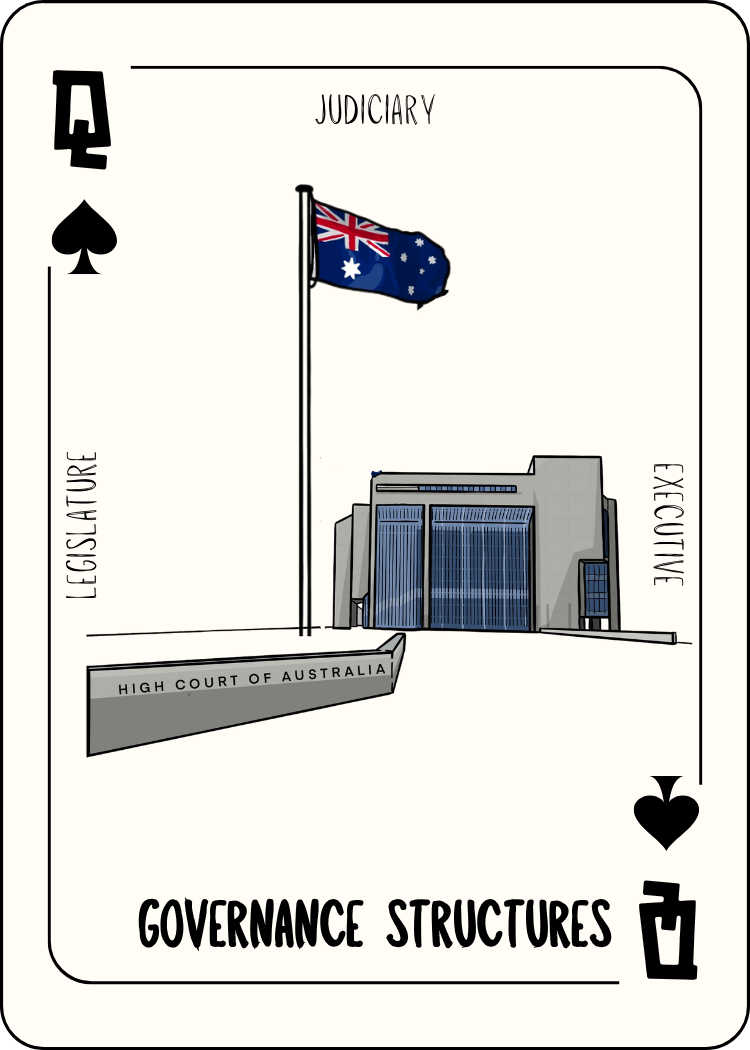
The structure consists of three key branches: the Legislature, the Executive and the Judiciary, each with specific roles and institutions. Powers between these bodies are distributed by the Constitution in a way that ensures that no one branch has complete power or control over the decisions made for the country and its people. This system is called the Separation of Powers.
Australia’s system of government reflects its British heritage and the coming together of the colonies (states) at Federation as both a constitutional monarchy and a federation, meaning it has a monarch with limited powers and multiple levels of government.
1. Legislature (Parliament)
The Legislature has the power to make and change laws.
Members are elected to Parliament through a vote by the people. There is a bi-cameral system with two Houses of Parliament: the House of Representatives and the Senate. The Governor-General gives final Assent to Bills passed. This structure and Parliamentary rules and procedures, provide an important check on legislative power. They ensure laws are not made in secret or without adequate scrutiny and debate. Chapter I of the Australian Constitution explicitly outlines (enumerates) the areas Federal Government can make laws for, meaning State Governments have residual (what’s not listed) and concurrent powers (ones that overlap).
This is called the ‘Division of Powers’. Parliamentary sovereignty means the Legislature has the power to make (or unmake) any law within its legal powers. If there is an inconsistency, Federal laws override State Laws. An independent judiciary also provides a check on the Legislature to ensure all legislation is lawful and made within the powers of the Legislature.
Parliamentary Sovereignty is also held in check through regular elections where the people have the power to elect/re-elect Members of Parliament who make laws on behalf of the people. This accountability is supported by freedom of speech,freedom of the media and an implied freedom of political communication.
2. Executive (Government)
The Executive has the power to enforce the laws and put them into action.
It consists of government departments that are headed up by Ministers of the government of the day, who are members of the Cabinet. Each Minister is given different portfolios – areas that they are responsible for managing.
Chapter II of the Australian Constitution sets out the executive powers of the Australian Government. Powers of the executive are also outlined in legislation as well as in common law. All actions of the executive must be in accordance with the law.
Under the Constitution, the Governor General has ultimate power over the Commonwealth of Australia. However, this power is usually exercised on the advice of the Executive Council and its Ministers. Parliament can also delegate authority to the Executive to make laws.
The Executive is the largest and most powerful branch of Government as it has the power and strength to enforce the law. An independent judiciary is an important check on the power of the Executive to ensures their actions are lawful.
The Legislature also checks the power of the Executive and holds them accountable for their decisions through parliamentary scrutiny and question time.
3. Judiciary (Courts)
The Judiciary has the power to interpret laws and resolve disputes about the law that arise between the state, organisations and individuals.
Chapter III of the Australian Constitution establishes the High Court of Australia as the highest court i.e. final court of appeal. The judiciary make decisions which create law in the form of case law (common law). The decisions of lower courts are reviewable on appeal to higher courts. The High Court also makes decisions about how the Constitution should be interpreted.
The Judiciary must be independent and impartial. They are independent so they can be an effective check on the power of the Legislature and Executive. This allows them to make decisions based on the law and not government policy. They have the power to strike down any laws made by the Legislature that are outside their power, or to declare actions of the Executive unlawful. The Constitution protects judges pay (remuneration) and length of service from government interference. They must also be impartial as they administer justice fairly and equally to all, irrespective of their own personal opinions and bias. Parliamentary Sovereignty means the Legislature can override a Courts interpretation of an ordinary law by passing or amending a law.
NSW Curriculum Alignment
Stage 4 and 5 Commerce
CO5-GOL-01: explains the role of government and the law in society
Related Resources
-
This explainer outlines Australia’s governance structures and how authority is organised across different institutions and levels of government. It explains how these structures distribute power, support accountability and help ensure decisions are made lawfully and in the public interest.
-
This activity outlines how the separation of powers operates in practice by examining the roles of the legislature, executive and judiciary. Students analyse government actions and sort responsibilities to understand how dividing power prevents overreach and supports accountability under the rule of law.
-
This activity outlines the separation of powers using a concentric‑circles model to help students visualise how different branches of government exercise and limit power. Through structured analysis, students explore how these roles interact to protect rights, maintain independence and uphold the rule of law.
Explore Related Topics
-
Checks and Balances on Power
Explore resources on checks and balances, explaining how oversight limits power and ensures decisions remain lawful and accountable, supporting transparency, restraint, & responsible government action.
-
The Division of Powers
Explore resources on the division of powers, showing how legislative authority is shared between the Commonwealth and states, supporting effective governance and accountability
-
Independent and Impartial Judiciary
Explore resources on an independent and impartial judiciary, including the history of the Supreme Court & its role in delivering justice & strengthening trust in the judiciary.