
Separation of Powers
-
This activity outlines how the separation of powers operates in practice by examining the roles of the legislature, executive and judiciary. Students analyse government actions and sort responsibilities to understand how dividing power prevents overreach and supports accountability under the rule of law.
-
This activity outlines the separation of powers using a concentric‑circles model to help students visualise how different branches of government exercise and limit power. Through structured analysis, students explore how these roles interact to protect rights, maintain independence and uphold the rule of law.
-
Reflection Activity designed as part of the Informed Civics Competition where students draw on the blank card what they have learned about the concept Governance Structures (Separation of Powers).
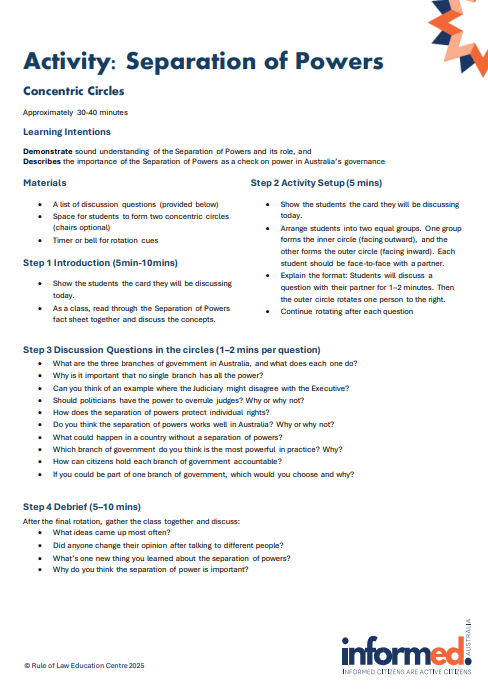
Activity: Separation of Powers
Concentric Circles
Approximately 30-40 minutes
Learning Intentions
Demonstrate sound understanding of the Separation of Powers and its role, and
Describe the importance of the Separation of Powers as a check on power in Australia’s governance
Materials
A list of discussion questions (provided below)
Space for students to form two concentric circles (chairs optional)
Timer or bell for rotation cues
Step 1 Introduction (5min-10mins)
Show the students the card they will be discussing today.
As a class, read through the Separation of Powers fact sheet together and discuss the concepts.
Step 2 Activity Setup (5 mins)
Show the students the card they will be discussing today.
Arrange students into two equal groups. One group forms the inner circle (facing outward), and the other forms the outer circle (facing inward). Each student should be face-to-face with a partner.
Explain the format: Students will discuss a question with their partner for 1–2 minutes. Then the outer circle rotates one person to the right.
Continue rotating after each question
Step 3 Discussion Questions in the circles (1–2 mins per question)
What are the three branches of government in Australia, and what does each one do?
Why is it important that no single branch has all the power?
Can you think of an example where the Judiciary might disagree with the Executive?
Should politicians have the power to overrule judges? Why or why not?
How does the separation of powers protect individual rights?
Do you think the separation of powers works well in Australia? Why or why not?
What could happen in a country without a separation of powers?
Which branch of government do you think is the most powerful in practice? Why?
How can citizens hold each branch of government accountable?
If you could be part of one branch of government, which would you choose and why?
Step 4 Debrief (5–10 mins)
After the final rotation, gather the class together and discuss:
What ideas came up most often?
Did anyone change their opinion after talking to different people?
What’s one new thing you learned about the separation of powers?
Why do you think the separation of power is important?
Related Resources
-
This explainer outlines the role of key institutions in Australia’s legal and democratic system, including courts, parliaments and executive bodies. It explains how these institutions interact, exercise power and provide checks and balances to maintain the rule of law.
-
This explainer outlines Australia’s governance structures and how authority is organised across different institutions and levels of government. It explains how these structures distribute power, support accountability and help ensure decisions are made lawfully and in the public interest.
-
This activity outlines how the separation of powers operates in practice by examining the roles of the legislature, executive and judiciary. Students analyse government actions and sort responsibilities to understand how dividing power prevents overreach and supports accountability under the rule of law.
Explore Related Topics
-
Checks and Balances on Power
Explore resources on checks and balances, explaining how oversight limits power and ensures decisions remain lawful and accountable, supporting transparency, restraint, & responsible government action.
-
The Division of Powers
Explore resources on the division of powers, showing how legislative authority is shared between the Commonwealth and states, supporting effective governance and accountability
-
Independent and Impartial Judiciary
Explore resources on an independent and impartial judiciary, including the history of the Supreme Court & its role in delivering justice & strengthening trust in the judiciary.