
Laws
-
This factsheet provides a clear overview of how laws in Australia are created, applied and enforced, explaining the purpose of laws, the role of statute law, common law and legal precedent, and the importance of the rule of law in a democratic society. It outlines key syllabus concepts including effective law‑making, bicameral and unicameral parliaments, the doctrine of precedent, and major types of law such as criminal, civil, administrative and constitutional. Designed as a concise one‑page resource, it helps students understand how legal institutions operate across different jurisdictions and why fairness, accountability and legal certainty are essential in Australia’s legal system.
-
This explainer outlines how statute law, common law and delegated legislation are created, changed and applied in Australia, outlining the parliamentary stages of law‑making, the development of common law through judicial decisions and precedent, and the role of executive bodies in making delegated legislation under enabling Acts. It connects directly to syllabus concepts such as the origin and development of common law, features of the doctrine of precedent, steps in the legislative process, parliamentary supremacy, and reasons for changes in the law, including social values, technology and community safety. By showing how each source of law operates within Australia’s democratic framework and the rule of law, the resource helps students understand how legal authority is exercised fairly, transparently and accountably.
-
This factsheet explains the difference between rules and laws by comparing their source, jurisdiction and penalties, helping students understand how regulations operate in everyday life and within Australia’s legal system. It outlines how rules are created and enforced within specific groups or organisations, while laws are made by Federal, State, Territory and Local governments and apply to everyone within a jurisdiction, with penalties enforced by police, government bodies and courts. By linking these ideas to syllabus concepts such as the nature and function of laws, non‑legal rules, jurisdictions and penalties, the factsheet supports students in recognising how laws protect rights, maintain order and promote fairness in society.
-
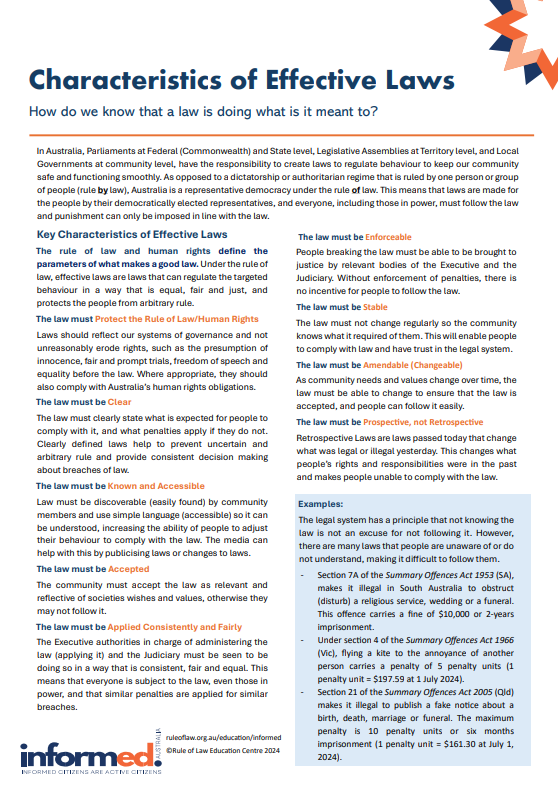
This factsheet outlines the key characteristics of effective laws in Australia’s representative democracy, explaining how laws must protect the rule of law, uphold human rights, and regulate behaviour in ways that are clear, known, accepted, consistent and fair. It highlights syllabus concepts such as accessibility, enforceability, stability, prospectivity, and the need for laws to be amendable as community values change. By showing how effective laws prevent arbitrary power and support equality before the law, the factsheet helps students understand why legal certainty and accountability are essential in Australia’s legal system.
-
This explainer outlines how hate speech laws in Australia operate across a spectrum, from criminal offences such as incitement to violence to civil prohibitions on discrimination, humiliation and provocation. It outlines the difference between criminal and civil standards of proof and uses the Characteristics of Effective Laws framework to evaluate whether hate speech laws are clear, accepted, fair, enforceable and protective of human rights. By examining how these laws balance freedom of speech with safety, equality and community standards, the factsheet helps students critically assess whether hate speech legislation achieves its purpose within Australia’s rule‑of‑law system.
Characteristics of effective laws
How do we know that a law is doing what is it meant to?
In Australia, Parliaments at Federal (Commonwealth) and State level, Legislative Assemblies at Territory level, and Local Governments at community level, have the responsibility to create laws to regulate behaviour to keep our community safe and functioning smoothly. As opposed to a dictatorship or authoritarian regime that is ruled by one person or group of people (rule by law), Australia is a representative democracy under the rule of law. This means that laws are made for the people by their democratically elected representatives, and everyone, including those in power, must follow the law and punishment can only be imposed in line with the law.
Key Characteristics of Effective Laws
The rule of law and human rights define the parameters of what makes a good law. Under the rule of law, effective laws are laws that can regulate the targeted behaviour in a way that is equal, fair and just, and protects the people from arbitrary rule.
The law must Protect the Rule of Law/Human Rights
Laws should reflect our systems of governance and not unreasonably erode rights, such as the presumption of innocence, fair and prompt trials, freedom of speech and equality before the law. Where appropriate, they should also comply with Australia’s human rights obligations.
The law must be Clear
The law must clearly state what is expected for people to comply with it, and what penalties apply if they do not. Clearly defined laws help to prevent uncertain and arbitrary rule and provide consistent decision making about breaches of law.
The law must be Known and Accessible
Law must be discoverable (easily found) by community members and use simple language (accessible) so it can be understood, increasing the ability of people to adjust their behaviour to comply with the law. The media can help with this by publicising laws or changes to laws.
The law must be Accepted
The community must accept the law as relevant and reflective of societies wishes and values, otherwise they may not follow it.
The law must be Applied Consistently and Fairly
The Executive authorities in charge of administering the law (applying it) and the Judiciary must be seen to be doing so in a way that is consistent, fair and equal. This means that everyone is subject to the law, even those in power, and that similar penalties are applied for similar breaches.
The law must be Enforceable
People breaking the law must be able to be brought to justice by relevant bodies of the Executive and the Judiciary. Without enforcement of penalties, there is no incentive for people to follow the law.
The law must be Stable
The law must not change regularly so the community knows what it required of them. This will enable people to comply with law and have trust in the legal system.
The law must be Amendable (Changeable)
As community needs and values change over time, the law must be able to change to ensure that the law is accepted, and people can follow it easily.
The law must be Prospective, not Retrospective
Retrospective Laws are laws passed today that change what was legal or illegal yesterday. This changes what people’s rights and responsibilities were in the past and makes people unable to comply with the law.
Examples:
The legal system has a principle that not knowing the law is not an excuse for not following it. However, there are many laws that people are unaware of or do not understand, making it difficult to follow them.
Section 7A of the Summary Offences Act 1953 (SA), makes it illegal in South Australia to obstruct (disturb) a religious service, wedding or a funeral. This offence carries a fine of $10,000 or 2-years imprisonment.
Under section 4 of the Summary Offences Act 1966 (Vic), flying a kite to the annoyance of another person carries a penalty of 5 penalty units (1 penalty unit = $197.59 at 1 July 2024).
Section 21 of the Summary Offences Act 2005 (Qld) makes it illegal to publish a fake notice about a birth, death, marriage or funeral. The maximum penalty is 10 penalty units or six months imprisonment (1 penalty unit = $161.30 at July 1, 2024).
Related Resources
-
This activity helps students evaluate whether a law is clear, consistent, enforceable and fair by applying a simple checklist. It supports understanding of what makes laws effective and how these features uphold the rule of law.
-
This video uses the Rule of Law Education Centre’s checklist to assess whether proposed hate‑speech laws are clear, fair, enforceable and protective of human rights. It explains how the laws aim to keep Australians safe while balancing freedom of speech, and shows how different types of hate speech attract different penalties depending on their seriousness.
Explore Related Topics
-
Law is Known and Accessible
Explore resources on accessible law, highlighting why clear, and public rules are essential for fairness and social participation by enabling informed decision‑ making & transparent governance.
-
Democracy
Explore resources on democracy, highlighting how accountability and representative institutions ensure power is exercised fairly and transparently through open processes, civic engagement and responsible governance.
-
Open and Transparent Laws
Explore resources on transparent lawmaking, highlighting how accessible processes strengthen accountability and uphold democratic principles through responsible decision‑making.