
Laws
-
This factsheet provides a clear overview of how laws in Australia are created, applied and enforced, explaining the purpose of laws, the role of statute law, common law and legal precedent, and the importance of the rule of law in a democratic society. It outlines key syllabus concepts including effective law‑making, bicameral and unicameral parliaments, the doctrine of precedent, and major types of law such as criminal, civil, administrative and constitutional. Designed as a concise one‑page resource, it helps students understand how legal institutions operate across different jurisdictions and why fairness, accountability and legal certainty are essential in Australia’s legal system.
-
This explainer outlines how statute law, common law and delegated legislation are created, changed and applied in Australia, outlining the parliamentary stages of law‑making, the development of common law through judicial decisions and precedent, and the role of executive bodies in making delegated legislation under enabling Acts. It connects directly to syllabus concepts such as the origin and development of common law, features of the doctrine of precedent, steps in the legislative process, parliamentary supremacy, and reasons for changes in the law, including social values, technology and community safety. By showing how each source of law operates within Australia’s democratic framework and the rule of law, the resource helps students understand how legal authority is exercised fairly, transparently and accountably.
-
This factsheet explains the difference between rules and laws by comparing their source, jurisdiction and penalties, helping students understand how regulations operate in everyday life and within Australia’s legal system. It outlines how rules are created and enforced within specific groups or organisations, while laws are made by Federal, State, Territory and Local governments and apply to everyone within a jurisdiction, with penalties enforced by police, government bodies and courts. By linking these ideas to syllabus concepts such as the nature and function of laws, non‑legal rules, jurisdictions and penalties, the factsheet supports students in recognising how laws protect rights, maintain order and promote fairness in society.
-
This factsheet outlines the key characteristics of effective laws in Australia’s representative democracy, explaining how laws must protect the rule of law, uphold human rights, and regulate behaviour in ways that are clear, known, accepted, consistent and fair. It highlights syllabus concepts such as accessibility, enforceability, stability, prospectivity, and the need for laws to be amendable as community values change. By showing how effective laws prevent arbitrary power and support equality before the law, the factsheet helps students understand why legal certainty and accountability are essential in Australia’s legal system.
-
This explainer outlines how hate speech laws in Australia operate across a spectrum, from criminal offences such as incitement to violence to civil prohibitions on discrimination, humiliation and provocation. It outlines the difference between criminal and civil standards of proof and uses the Characteristics of Effective Laws framework to evaluate whether hate speech laws are clear, accepted, fair, enforceable and protective of human rights. By examining how these laws balance freedom of speech with safety, equality and community standards, the factsheet helps students critically assess whether hate speech legislation achieves its purpose within Australia’s rule‑of‑law system.
Law-Making Processes
How Statute Law and Common Law are Made
Pre-Learning Questions
What is the difference between common law and statute law?
Why does Parliament sometimes give law‑making power to other bodies?
Why might laws need to change over time?
Introduction
Australia’s legal system is built on three primary sources of law: statute law, common law, and delegated legislation. Each source has its own law-making processes, from the parliamentary steps involved in creating statute law, to the way judges develop common law through decisions and apply the doctrine of precedent, to the creation of delegated legislation by the executive under powers granted by Parliament.
Under the principle of parliamentary supremacy, statute law prevails over both common law and delegated legislation when inconsistences occur. This rule reflects the idea that Parliament is, in theory, the ultimate law-maker in Australia today.
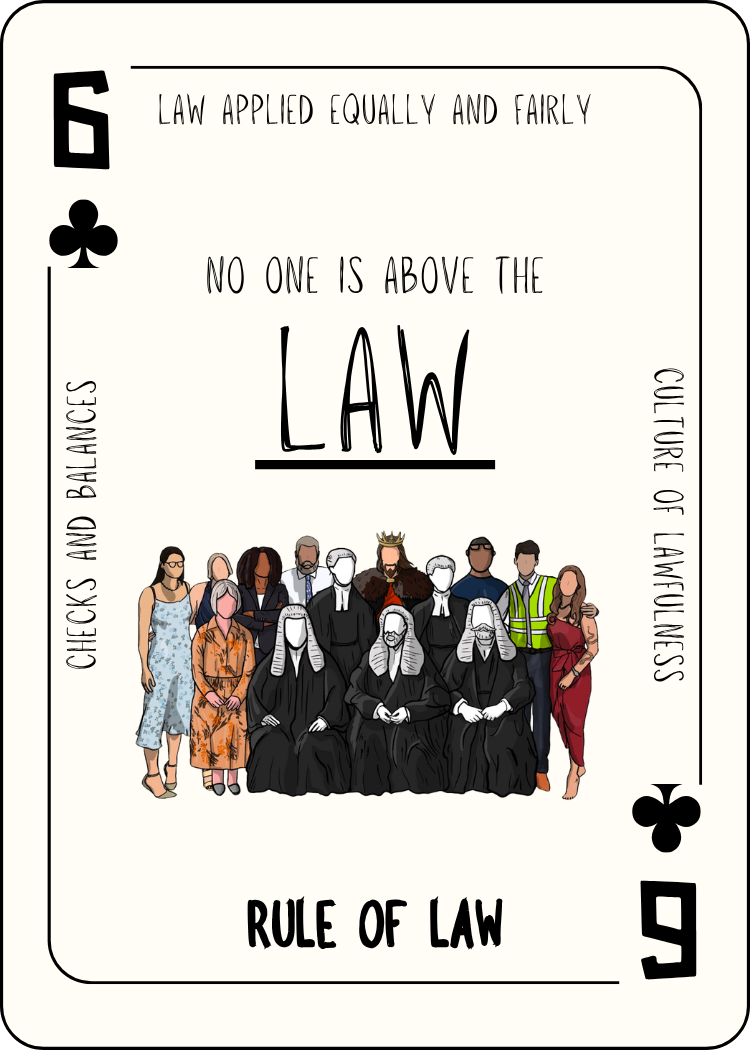
Understanding how these different types of law are created, interpreted, and updated, including reasons for changes in the law, is central to appreciating Australia’s democratic system of governance. Together, the processes help uphold key democratic values by ensuring accountability and transparency in decision-making, maintaining equality before the law, and reinforcing the principle that all people, including those in power, must follow the law.
Common Law
The origin and development of common law in Australia
Common law began as an English legal tradition. It was called ‘common’ because it applied ‘commonly’ to everyone across the English realm, replacing earlier local customs and feudal practices. Under feudalism (a medieval social hierarchy where lords controlled land and peasants owed labour and loyalty) laws often varied from region to region. The emerging common law system created a single, centralised body of law that applied to all subjects of the Crown.
Australia inherited this common law tradition from Britain. When convicts and free settlers arrived in 1788, they brought English law with them as their legal “birthright”:
“For as the law is the birthright of every subject, so wherever they go, they carry their laws with them” - William Blackstone, Commentaries on the laws of England
“[The] Magna Carta as the foundation of the liberties of Englishmen was the understanding that the colonists brought to Australia. It was an understanding that all subjects under the British Crown enjoyed ancient rights dating to Magna Carta including those of due process, trial by jury, and habeas corpus” - The Honourable Virginia Bell AC
The First Charter of Justice (1787) established formal courts in the penal colony of New South Wales. These courts applied English common law and legal traditions where suitable, and over time, evolved into a distinct Australian common law shaped by local conditions.
Today, common law refers to the law developed by judges through court decisions when no relevant statute or delegated legislation exists.
Features of the Doctrine of Precedent
A key feature of the common law system is the principle of stare decisis (Latin for “to stand by things decided”). This principle requires courts to treat like cases alike. In practice, this means that courts must follow earlier judicial decisions (known as precedents) when resolving later cases with similar facts. This approach supports consistency, predictability and stability in the law.
How common law is made and the application of precedent
When a dispute comes before a court, an independent and impartial judge interprets existing law and may create new legal principles where gaps exist. For this reason, common law is also known as case law or judge‑made law.
Legal Scholar, Katy Barnett uses a hypothetical example to illustrate the creation and use of common law.
Imagine a man comes to court after being bitten by a fox. There is no legislation dealing with fox bites, so the judge cannot simply apply a statutory rule. Instead, the judge turns to past cases to find situations that are similar enough to provide guidance.
In the Judge’s research, she finds several cases involving dog bites and one involving a monkey bite. These cases are not perfect matches, but they are close enough to help the Judge reason by analogy.
The Judge examines the principles used in those earlier cases. For example, dog-bite cases may treat domesticated animals in a particular way, while monkey-bite cases may treat wild animals differently.
The Judge must decide which analogy fits best. She may conclude that a fox is more like a dog, because both are canines, and apply the principle from the dog-bite cases. Alternatively, she may decide that a fox is more like a monkey, because both are wild animals, and apply the principle from the monkey-bite case.
If neither analogy fits well, she may develop a new legal principle specifically for fox bites.
Once the judge has selected or developed the appropriate principle, she applies it to the facts of the case to reach a decision.
How common law is changed
Common law can be changed in two main ways.
First, Parliament can change or overrule common law by passing a new statute. If the statute deals with the same legal issue, the written law takes priority under parliamentary supremacy. From that point on, the common law principle no longer applies in situations covered by the statute.
Second, the courts themselves can change the common law, but only within the structure of the court hierarchy. A higher court, such as the High Court of Australia, may depart from an earlier decision and create a new legal principle. When this happens, the new decision becomes a binding precedent for all lower courts. By choosing not to follow an earlier authority and establishing a new rule, the higher court effectively updates or replaces the existing common law.
Common law and the rule of law
The common law contributes significantly to the operation of the rule of law in Australia. As judge‑made law, it develops through the resolution of individual disputes where no other law exists, allowing courts to refine legal principles over time. This has both advantages and limitations.
First, common law promotes predictability and stability through the doctrine of precedent, which requires courts to treat like cases alike. This consistency supports equality before the law and allows individuals to anticipate how the law will be applied in future disputes.
However, common law is often less accessible than statute law because its principles are scattered across numerous judicial decisions rather than consolidated in a single, authoritative source.
Second, common law is technically retrospective when first applied because courts develop legal principles only when a dispute is brought before them. Courts manage this retrospectivity carefully to ensure the law applies only to active and future cases, while past, finalised decisions remain undisturbed. This is also true when a higher court overrules an earlier precedent; past settled cases are not affected by the change.
Third, it is important that judges operate within institutional constraints. When interpreting and applying the law, it is not the role of a judge to conduct community or interest‑group consultations, nor to assess broad social or economic consequences. Judges must decide cases solely on the evidence presented in court and within the boundaries of the specific dispute. These constraints ensure that judicial decisions are grounded in law rather than political or economic pressures, and they safeguard judicial independence, procedural fairness, and equality before the law.
Fourth, the common law plays a vital role in protecting individual rights and freedoms through the principle of legality (the presumption that Parliament does not intend to interfere with fundamental rights unless it uses clear and explicit language), and by independently reviewing the actions of government to keep them lawful and accountable.
Finally, through transparent reasoning, independent and impartial judging, and the careful development and application of legal principles, the common law ensures that legal authority is exercised equally and fairly to everyone, rather than through arbitrary or unlawful power.
Statute Law
How statute law is made and the steps in the legislative process
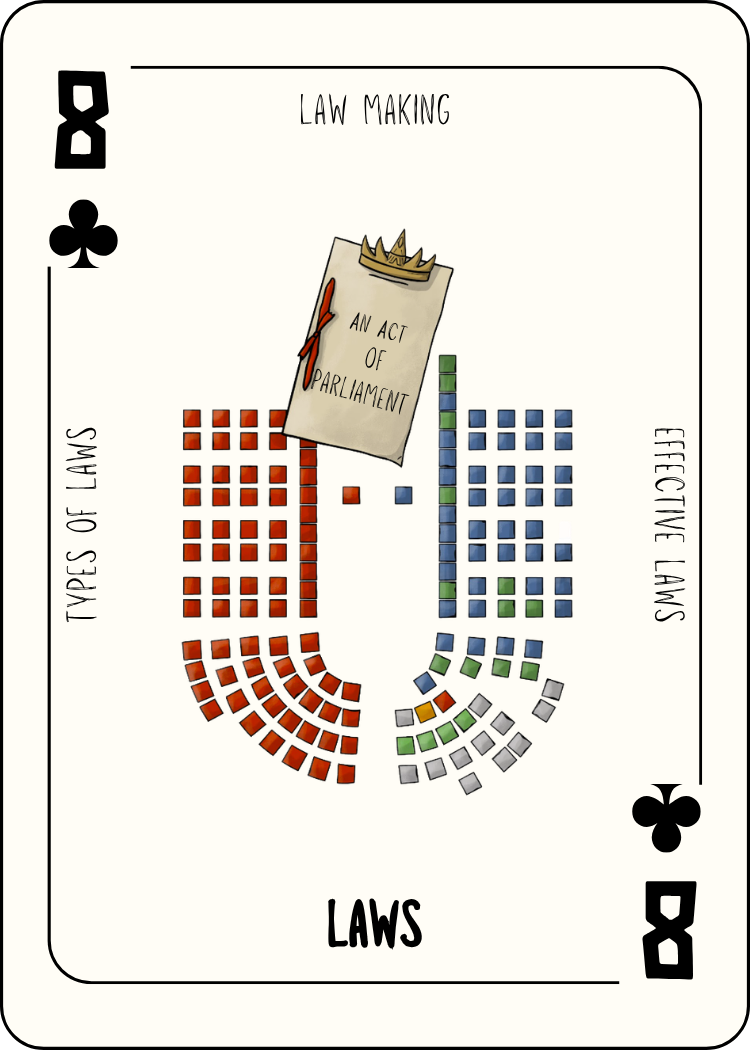
Statute law, also called legislation, is made by the elected representatives of the people in Parliament. All statutes begin as a bill, which must pass through several stages of debate and voting before becoming law.
Australia has one Federal Parliament, which makes federal laws, and each state and territory has its own parliament or legislative assembly that make state laws. Most Australian parliaments are bicameral, meaning they have two houses, a lower house (House of Representatives or Legislative Assembly) and an upper house (Senate or Legislative Council). Queensland, the Northern Territory and the ACT are unicameral, with only one house. Bicameralism provides an additional layer of scrutiny before laws are passed, and acts as a check and balance on government power.
A new law usually begins as an idea responding to a community need. A member of parliament (MP) takes up that idea, and special government lawyers then draft it into a formal written proposal called a Bill.
The MP introduces the Bill to Parliament. If the MP sits in the lower house, the bill begins there; if the MP sits in the upper house, it begins in that house. The Bill then moves through several stages of debate, committee review and amendment. It can move back and forth between the two houses multiple times, a process sometimes referred to as “parliamentary ping‑pong.”
If a bill fails to pass a vote and both houses refuse to compromise, it becomes a dead bill. If both houses agree to the final version, the bill is sent for Royal Assent to the Governor General, after which it becomes an Act of Parliament and is a legally enforceable law.
How statute law is changed
Parliament can change an existing law in two ways:
Amending a law (changing a part/section of a law)
Repealing a law (removing it completely so it has no legal force)
To amend or repeal a law, Parliament must pass a new Bill through the same law-making process. The Bill must be approved by a majority vote in both the lower house and the upper house, and then receive Royal Assent. Once this process is complete, the amendment or repeal becomes law.
Statute law and the rule of law
Statute law also plays a central role in upholding the rule of law by ensuring laws are made in an open way by the people (or their representatives). While the common law develops gradually, case by case, Parliament can make laws proactively as society changes, drawing on broad evidence and public consultation. This legislative process helps ensure that the legal system remains clear, accessible, largely prospective, and democratically accountable.
Parliament can draw on public consultation, expert advice, community input, and scrutiny from committees when making law. This enables it to consider national security, broad social impacts, economic consequences, and the interests of different groups. If Parliament strikes the wrong balance when making a law, voters can hold it accountable at the next election, ultimately ensuring the laws are made on behalf of the people.
Unlike the common law, which responds to disputes, Parliament can legislate proactively. Statutes allow Parliament to set clear, prospective rules so people know the law in advance and can organise their lives accordingly. Have a look at this checklist for effective laws.
Parliament can make retrospective laws, but this is generally discouraged because it allows people to be punished for conduct that was not unlawful at the time, undermining fairness and certainty.
Parliament can also act quickly when urgent circumstances arise. In emergencies or rapidly changing conditions, it can introduce and pass legislation within hours if necessary. As courts cannot initiate cases or create rules unless a dispute is brought before them, statute law provides the flexibility needed to respond to unforeseen events while remaining accountable to the public and subject to scrutiny.
However, even in emergency circumstances it is essential that the usual checks and balances of the law making process are not overlooked. While the rapid passage of legislation, such as large omnibus bills debated late at night, may enable an immediate response to a crisis, it can reduce transparency, limit meaningful parliamentary scrutiny, and weaken public accountability. Striking a balance between efficiency and oversight is therefore critical to maintaining confidence in the legislative process.
Delegated legislation
Delegated legislation is law made by a body other than Parliament, such as ministers, government departments, local councils or other authorised agencies. These bodies can only make delegated legislation if an Act of Parliament (known as the parent or enabling Act) grants them the power to do so. This type of law is also called subordinate or secondary legislation because Parliament has delegated part of its law‑making authority.
Types of delegated legislation
Delegated legislation can take many forms, including regulations, rules, by-laws, ordinances, orders, and determinations. These instruments have legal force but do not need to be debated and passed by Parliament, because the enabling Act has already authorised their creation.
Role of delegated legislation
Delegated legislation plays an important role in Australia’s legal system by allowing law-making
to be more efficient, specialised, and responsive. It is used because it:
Saves time: Parliament avoids debating detailed, technical or administrative matters.
Uses expertise: Specialists in areas such as health, taxation, transport or aviation can draft precise rules.
Provides flexibility: Rules can be updated quickly to respond to changing circumstances, emergencies or new information without passing a new Act.
Delegated legislation and the rule of law
Delegated legislation can create tension with the rule of law because it allows the executive branch to make rules rather than merely administer the law.
Under the separation of powers, law‑making and law‑enforcing functions are generally kept separate to prevent concerntration of power. However, delegated legislation gives law‑making authority to executive officials in certain circumstances. In doing so, Parliament transfers part of its core constitutional role of law making to unelected ministers or bodies.
To address this concern, a range of checks and balances apply to delegated legislation to help provide a level of parliamentary oversight and accountability (as seen below).
How is delegated legislation overturned?
Delegated legislation can be overturned in several ways, the most common being parliamentary disallowance and judicial review. It remains subject to both parliamentary oversight and court scrutiny because delegated legislation is made under powers granted by Parliament.
One key mechanism is parliamentary disallowance. After delegated legislation is made, it must be tabled (presented) in Parliament. Once tabled, either house of Parliament may vote to disallow, or veto, the instrument. If disallowed, the delegated legislation ceases to have legal effect.
Delegated legislation may also be overturned through judicial review. Courts can examine whether the rule‑maker acted within the scope of authority granted by the parent Act. If the court finds that the delegated legislation goes beyond this authority (known as acting ultra vires) or if it is inconsistent with the parent statute, improperly made, or otherwise invalid, the court can declare it void. When this occurs, the delegated legislation is treated as though it never had legal force.
In addition to parliamentary and judicial oversight, delegated legislation may cease through repeal or expiry mechanisms. Many parent Acts have sunset clauses, which cause delegated legislation to automatically expire after a set period unless it is actively renewed. Delegated legislation also loses legal effect if the parent Act is repealed, because the legal foundation for the subordinate rules no longer exists.
Together, these mechanisms ensure that delegated legislation remains accountable, lawful, and subject to democratic and judicial checks and balances.

The reasons for changes in the law
Laws change because society changes. As community values evolve, public attitudes about what is fair, acceptable or harmful shift over time. Parliament often updates legislation to reflect these new social standards and to ensure the law aligns with the expectations of citizens.
Technological advances also drive legal change. New digital environments and inventions create challenges that older laws cannot address, requiring modern responses to issues such as cyberbullying, online privacy, digital surveillance and artificial intelligence.
Another major reason for reform is the need to protect the community. When new risks emerge or existing harms become more visible, governments strengthen or introduce laws to keep people safe. This can be seen in measures such as tougher penalties for domestic violence and expanded bans on smoking in public places.
Changing living conditions also influence law‑making. As populations grow, workplaces modernise and lifestyles shift, new rules are needed to regulate everyday life. Updated workplace health and safety standards and modern planning regulations are examples of laws responding to these practical changes.
Finally, Parliament sometimes changes the law to promote social change. In these cases, legislation is used not only to regulate behaviour but to encourage equality, protect rights or guide public conduct in a particular direction, helping to shape a fairer and more inclusive society.
Conclusion
Australia’s legal system relies on statute law, common law and delegated legislation working together to maintain a fair and accountable democracy. Each source of law performs a distinct function, yet none operates alone. The system only works when each branch stays within its constitutional limits and acts as a check and balance on the others. Through democratic law‑making, independent judicial reasoning and lawful executive action, power is exercised according to established principles rather than arbitrary decision‑making, ensuring the law evolves in step with the community’s needs and values.

Related Resources
-
Delegated legislation allows Parliament to authorise government departments, councils and other bodies to create detailed rules—such as regulations, by‑laws and ordinances—under powers granted by an Act. It enables laws to be updated quickly, adapted to changing circumstances and informed by specialist expertise, but it also receives less direct democratic scrutiny than primary legislation. This video explores the benefits and risks of delegated law‑making, including concerns about executive overreach, limited public awareness and the use of “Henry VIII clauses” that permit delegated laws to amend Acts. It emphasises the need for strong parliamentary oversight, transparency and safeguards to ensure delegated legislation remains consistent with the rule of law and the separation of powers.
-
This activity helps students evaluate whether a law is clear, consistent, enforceable and fair by applying a simple checklist. It supports understanding of what makes laws effective and how these features uphold the rule of law.
Explore Related Topics
-
Law is Known and Accessible
Explore resources on accessible law, highlighting why clear, and public rules are essential for fairness and social participation by enabling informed decision‑ making & transparent governance.
-
Democracy
Explore resources on democracy, highlighting how accountability and representative institutions ensure power is exercised fairly and transparently through open processes, civic engagement and responsible governance.
-
Open and Transparent Laws
Explore resources on transparent lawmaking, highlighting how accessible processes strengthen accountability and uphold democratic principles through responsible decision‑making.