
Democracy
-
Systems of government affect people’s rights and freedoms. Some protect inherent human dignity, while others prioritise those in power. Monarchy, republic, democracy, dictatorship, and communism are key forms. Democracy, supported by the rule of law, best safeguards human rights by ensuring accountability, transparency, and protection against corruption and disorder.
-
Democracy, supported by the rule of law, protects human rights, freedoms and fair justice through elected representatives and accountable government. In contrast, totalitarianism relies on rule by law, where leaders hold absolute power, restrict freedoms, control information, and enforce obedience through fear, denying citizens equality, rights and genuine political influence.
-
Australia’s path to democracy developed gradually over more than 200 years, influenced by ancient Greek ideas, English legal traditions and the Magna Carta. With key moments such as the arrival of English law with the First Fleet, the introduction of independent judiciary and free press and the chartist movement at the Eureka Rebellion. Democratic features such as voting rights, secret ballots and checks and balances were introduced at different times across the colonies, culminating in Federation in 1901
-
The Eureka Stockade had a significant impact on the development of democracy in the colonies and later within the Federation of Australia.
The Eureka Rebellion was a key moment where the people demanded equal and fair treatment and the right to take part in the democratic process.
Not long after Eureka, a new system of administration in the Goldfields of Victoria was introduced that upheld Chartist principles such as: universal male suffrage, secret ballot, abolishment of property qualifications for voting and the system of one man, one vote; and payment of members.
-
Australia and the United States share British legal roots, valuing individual rights and the rule of law. Their paths to nationhood diverged—America through war and Australia through peaceful federation—shaping different constitutional structures. Despite this, both systems preserve core principles limiting government power and protecting citizens’ freedoms.
-
This explainer outlines the core features of democracy, including free and fair elections, accountable government, equal participation and the protection of rights. It shows how democratic systems rely on the rule of law, transparency and active, informed citizens to ensure power is exercised responsibly and in the public interest.
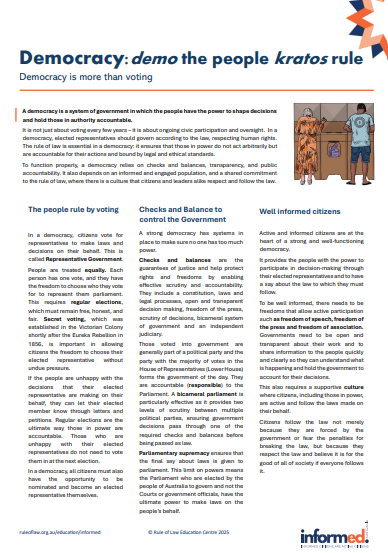
Democracy: ‘demo’ the people ‘kratos’ rule
Democracy is more than voting
A democracy is a system of government in which the people have the power to shape decisions and hold those in authority accountable.
It is not just about voting every few years – it is about ongoing civic participation and oversight. In a democracy, elected representatives should govern according to the law, respecting human rights.
The rule of law is essential in a democracy: it ensures that those in power do not act arbitrarily but are accountable for their actions and bound by legal and ethical standards.
To function properly, a democracy relies on checks and balances, transparency, and public accountability. It also depends on an informed and engaged population, and a shared commitment to the rule of law, where there is a culture that citizens and leaders alike respect and follow the law.
The people rule by voting
In a democracy, citizens vote for representatives to make laws and decisions on their behalf. This is called Representative Government.
People are treated equally. Each person has one vote, and they have the freedom to choose who they vote for to represent them parliament. This requires regular elections, which must remain free, honest, and fair. Secret voting, which was established in the Victorian Colony shortly after the Eureka Rebellion in 1856, is important in allowing citizens the freedom to choose their elected representative without undue pressure.
If the people are unhappy with the decisions that their elected representative are making on their behalf, they can let their elected member know through letters and petitions. Regular elections are the ultimate way those in power are accountable. Those who are unhappy with their elected representatives do not need to vote them in at the next election. In a democracy, all citizens must also have the opportunity to be nominated and become an elected representative themselves.
Checks and Balance to control the Government
A strong democracy has systems in place to make sure no one has too much power.
Checks and balances are the guarantees of justice and help protect rights and freedoms by enabling effective scrutiny and accountability. They include a constitution, laws and legal processes, open and transparent decision making, freedom of the press, scrutiny of decisions, bicameral system of government and an independent judiciary.
Those voted into government are generally part of a political party and the party with the majority of votes in the House of Representatives (Lower House) forms the government of the day. They are accountable (responsible) to the Parliament. A bicameral parliament is particularly effective as it provides two levels of scrutiny between multiple political parties, ensuring government decisions pass through one of the required checks and balances before being passed as law.
Parliamentary supremacy ensures that the final say about laws is given to parliament. This limit on powers means the Parliament who are elected by the people of Australia to govern and not the Courts or government officials, have the ultimate power to make laws on the people’s behalf.
Well informed citizens
Active and informed citizens are at the heart of a strong and well-functioning democracy.
It provides the people with the power to participate in decision-making through their elected representatives and to have a say about the law to which they must follow.
To be well informed, there needs to be freedoms that allow active participation such as freedom of speech, freedom of the press and freedom of association. Governments need to be open and transparent about their work and to share information to the people quickly and clearly so they can understand what is happening and hold the government to account for their decisions.
This also requires a supportive culture where citizens, including those in power, are active and follow the laws made on their behalf.
Citizens follow the law not merely because they are forced by the government or fear the penalties for breaking the law, but because they respect the law and believe it is for the good of all of society if everyone follows it.
Related Resources
-
This activity guides students through the 1975 dismissal of the Whitlam Government to explore how Australia’s democratic institutions operate during political crisis. It helps learners examine the roles of the Governor‑General, Parliament and the Constitution, and shows how checks and balances, accountability and the rule of law shape democratic stability.
-
Students develop a road map that shows the elements that can lead to the erosion of democracy and the rise of authoritarianism. Adding elements such as stops, landmarks, side roads or scenes to develop understanding of threats to democracy.
-
The Eureka Stockade had a significant impact on the development of democracy in the colonies and later within the Federation of Australia.
The Eureka Rebellion was a key moment where the people demanded equal and fair treatment and the right to take part in the democratic process.
Not long after Eureka, a new system of administration in the Goldfields of Victoria was introduced that upheld Chartist principles such as: universal male suffrage, secret ballot, abolishment of property qualifications for voting and the system of one man, one vote; and payment of members.
Explore Related Topics
-
Laws
Explore resources on laws, explaining how rules are created, interpreted and enforced to maintain order, protect rights and support a functioning society through clear processes, accountability and fair application.
-
Federation of Australia
Explore resources on Federation, outlining how Australia became a nation, divided powers, and established the constitutional structures & democratic principles that govern today.
-
What is the Rule of Law?
Explore resources explaining the rule of law, showing how a collection of principles works to limit government power and protect rights through clear rules, accountability & fairness.