
Democracy
-
This activity guides students through the 1975 dismissal of the Whitlam Government to explore how Australia’s democratic institutions operate during political crisis. It helps learners examine the roles of the Governor‑General, Parliament and the Constitution, and shows how checks and balances, accountability and the rule of law shape democratic stability.
-
Students develop a road map that shows the elements that can lead to the erosion of democracy and the rise of authoritarianism. Adding elements such as stops, landmarks, side roads or scenes to develop understanding of threats to democracy.
-
Examine how different systems of government impact human rights. Students research 3 countries using a Media Article Source document of a ceremony and military parade held on 3rd September 2025 in Beijing, China, to mark 80 years since Japan’s surrender at the end of World War II. The Source document is a group photo taken of the attendees that included Vladimir Putin (Russia), Xi Jinping (China), Kim Jong-Un (North Korea) and Daniel Andrews (former Victorian Premier). The activity engages students to consider who was in the photo and what is known about the forms of government they represent, and their human rights records.
-
This student activity looks at national sovereignty and is a fun way to explain the four main elements that are required for a country to be internationally recognised as a sovereign state.
-
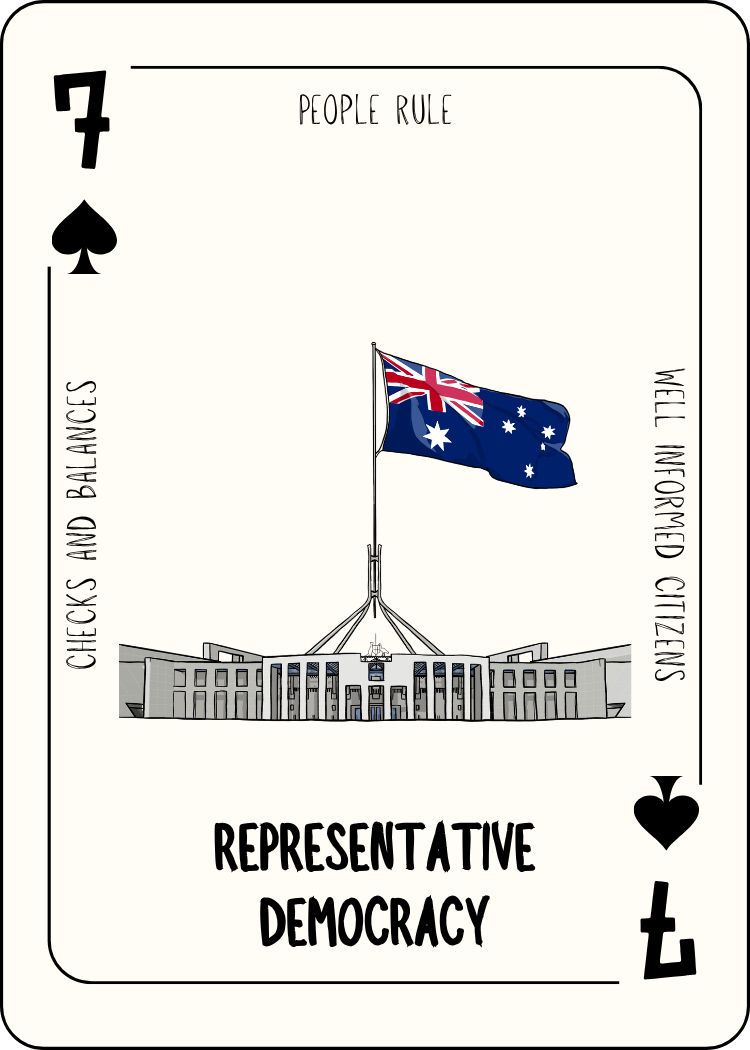
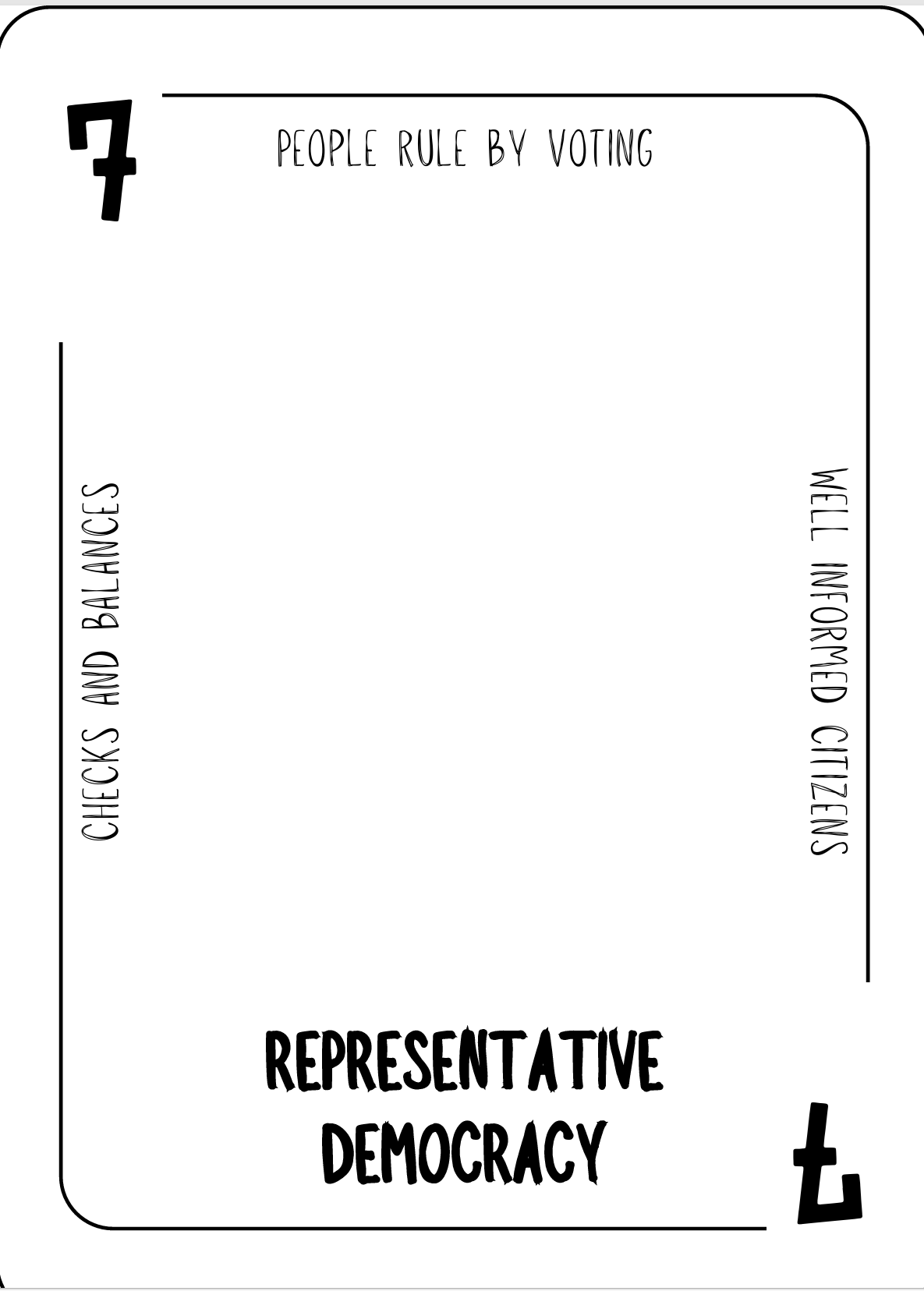
Reflection Activity designed as part of the Informed Civics Competition where students draw on the blank card what they have learned about the concept Representative Democracy.
Whitlam Dismissal 1975: Democracy and Constitutional Crisis Analysis Task
Learning Intentions:
Identifies the elements of a democracy
Evaluate whether the Whitlam dismissal reflects a strong or weak democracy
Discuss and justify whether reform is needed
Background Information
Read a summary of the events in the ‘50th Anniversary of the Dismissal’ by Victorian Commercial Teachers Association - [Click here] .
This article is commissioned by the Victorian Commercial Teachers Association (VCTA)to acknowledge the significance of the 50th Anniversary of the ‘Whitlam Dismissal’ event in Australian political history. VCTA is very grateful for the assistance of Tom McIlroy, Political Editor, The Guardian Australia, for the time and effort that went into researching and producing this piece for VCTA and its members.
Activity 1: What is a democracy
Read the Rule of Law Education Centre Fact Sheet on Democracy as a class. The teacher should highlight that democracy is more than just voting is a system of representative government in which the people have the power to shape decisions and hold those in authority accountable.
Note about Constitutional Conventions: Australia’s system of government does not just rely on what is written in the Constitution. It also depends on a set of unwritten rules called constitutional conventions regarding responsible government. For example, it is a constitutional convention to have the office of Prime Minster, who forms government and has the confidence of the lower house. Another convention is that the Governor General will act on the advice of the responsible minster. These traditions and practices have developed over time, and despite not being written down as laws, are followed by those in power to protect the rule of law and responsible government.
Task:
Using Rule of Law Education Centre’s factsheet on Democracy, complete the table below by identifying different elements of a democracy.
The dismissal of the Whitlam Government in 1975 remains one of the most significant events in Australian political history. This classroom activity helps students investigate the Constitutional Crisis, the role of the Governor-General, Parliament and the Australian Constitution, and consider how democratic principles, checks and balances, accountability and the rule of law operate during periods of political uncertainty
The People Rule by Voting
Checks and Balances to Control the Government
Active and Informed Citizens
Activity 2: Whitlam Scenario Analysis
1. Read the VCTA ‘50th Anniversary of the Dismissal’ and highlight which elements of democracy from the table are relevant in the Dismissal.
2. Define and discuss the following terms:
Responsible Government
Reserve powers
3. The VCTA document includes quotes from three key primary sources/figures: Gough Whitlam, Malcolm Fraser and Sir John Kerr.
Who were they, and what roles did they play in the Dismissal?
Use these quotes to support or critique their decisions/actions in relation to responsible government, the rule of law and reserve powers.
4. Although the Dismissal was a dramatic moment, consider the response from the community and those in power.
How does this compare to how other countries respond to election results or leadership changes?
Why is a ‘culture of lawfulness’ so important in supporting democracy?
5. In what ways did the Dismissal challenge democratic principles outlined in the table?
What weaknesses did it highlight in our democracy?
Have any of these weaknesses been addressed? Do they need to be addressed?
6. What strengths did the Dismissal reveal in our democracy?
How has our democracy grown stronger as a result?
7. Can the use of the reserve powers ever be justified in a democracy?
Activity 3: Reflection
Using the Blank Playing Card for Democracy, design a card that reflects what you have learnt about the Whitlam Dismissal and the strength of Australia’s democracy. The card may include:
A key figure in the Dismissal
a symbol or image, or
key idea or insight
Related Resources
-
Systems of government affect people’s rights and freedoms. Some protect inherent human dignity, while others prioritise those in power. Monarchy, republic, democracy, dictatorship, and communism are key forms. Democracy, supported by the rule of law, best safeguards human rights by ensuring accountability, transparency, and protection against corruption and disorder.
-
-
Made possible through the support of donors and partners.
Explore Related Topics
-
The Rule of Law
The rule of law is the concept that both the government and citizens know the law and obey it. There are clear, fair, and predictable laws and no one is above the law. Independent courts, separation of powers, and checks and balances protect rights, limit arbitrary power, and provide a stable, democratic framework for justice and accountability in modern society.
-
Laws
Laws set the rules that govern how people, organisations and governments behave. They protect rights, maintain order and provide clear standards for resolving disputes. Understanding how laws are made, applied and enforced helps explain how Australia’s legal system works and how the rule of law ensures fairness and accountability.
-
Federation
Federation marks the moment when six separate British colonies united to form the Commonwealth of Australia in 1901. It created a national government, a written Constitution, and a new division of powers that still shapes Australia’s political and legal system today. Understanding Federation helps explain how Australia’s democratic institutions developed and why power is shared the way it is.