
Democracy
-
This activity guides students through the 1975 dismissal of the Whitlam Government to explore how Australia’s democratic institutions operate during political crisis. It helps learners examine the roles of the Governor‑General, Parliament and the Constitution, and shows how checks and balances, accountability and the rule of law shape democratic stability.
-
Students develop a road map that shows the elements that can lead to the erosion of democracy and the rise of authoritarianism. Adding elements such as stops, landmarks, side roads or scenes to develop understanding of threats to democracy.
-
Examine how different systems of government impact human rights. Students research 3 countries using a Media Article Source document of a ceremony and military parade held on 3rd September 2025 in Beijing, China, to mark 80 years since Japan’s surrender at the end of World War II. The Source document is a group photo taken of the attendees that included Vladimir Putin (Russia), Xi Jinping (China), Kim Jong-Un (North Korea) and Daniel Andrews (former Victorian Premier). The activity engages students to consider who was in the photo and what is known about the forms of government they represent, and their human rights records.
-
This student activity looks at national sovereignty and is a fun way to explain the four main elements that are required for a country to be internationally recognised as a sovereign state.
-
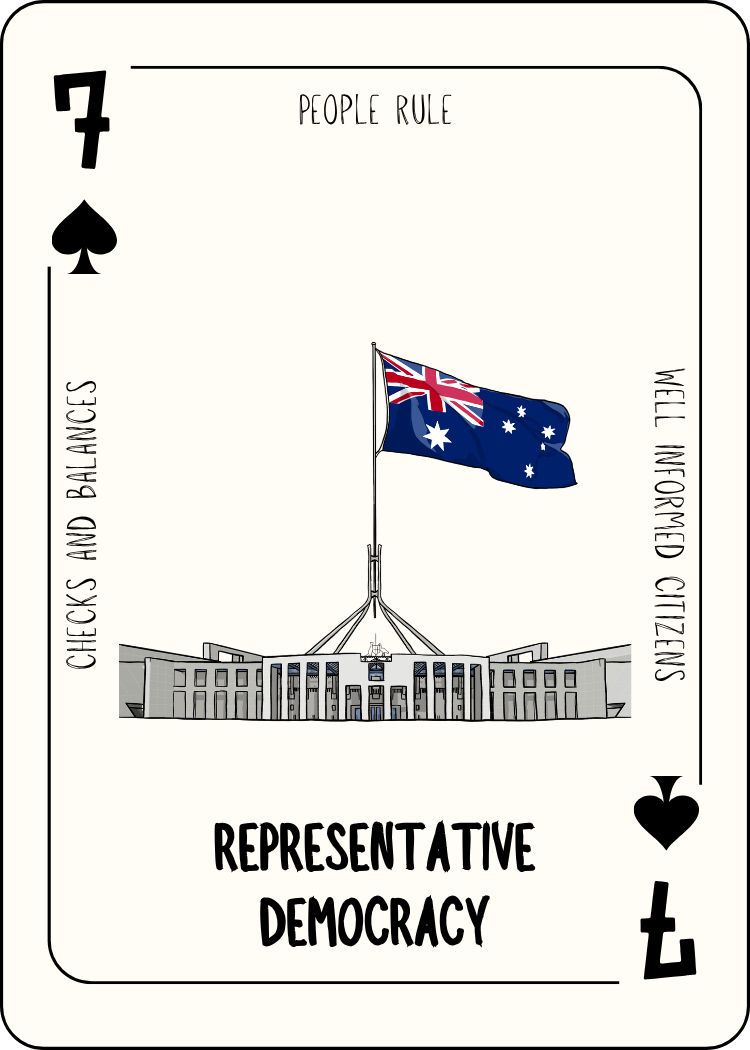
Reflection Activity designed as part of the Informed Civics Competition where students draw on the blank card what they have learned about the concept Representative Democracy.
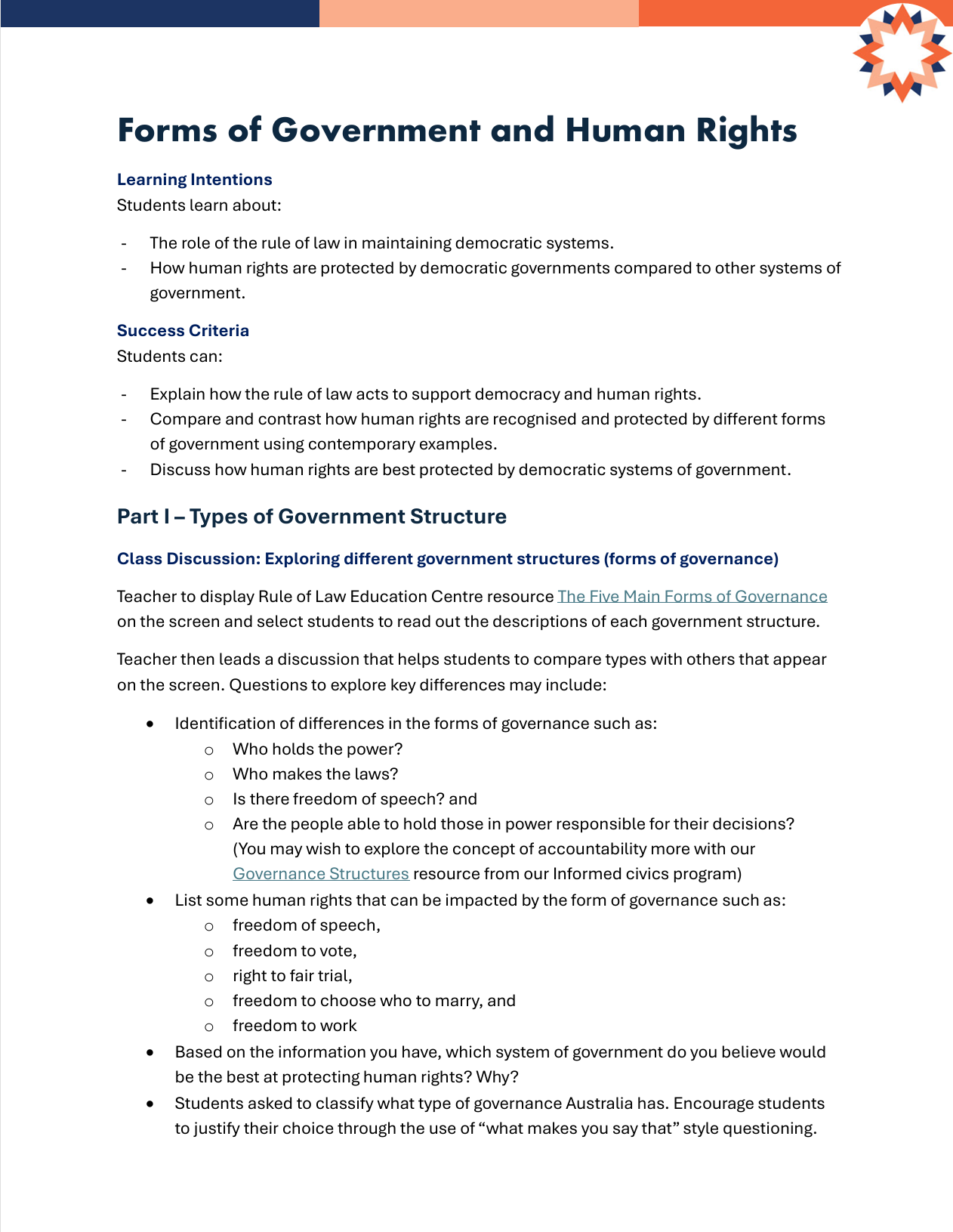
Comparison of Different Forms of Government and the impact on Human Rights
Learning Intentions
Students learn about:
The role of the rule of law in maintaining democratic systems.-
How human rights are protected by democratic governments compared to other systems of government.
Success Criteria
Students can:
Explain how the rule of law acts to support democracy and human rights.
Compare and contrast how human rights are recognised and protected by different forms of government using contemporary examples.
Discuss how human rights are best protected by democratic systems of government.
Part I – Types of Government Structure
Class Discussion: Exploring different government structures (forms of governance)
Teacher to display Rule of Law Education Centre resource The Five Main Forms of Governance on the screen and select students to read out the descriptions of each government structure.

Teacher then leads a discussion that helps students to compare types with others that appear on the screen. Questions to explore key differences may include:
Identification of differences in the forms of governance such as:
Who holds the power?
Who makes the laws?
Is there freedom of speech? and
Are the people able to hold those in power responsible for their decisions? (You may wish to explore the concept of accountability more with our Governance Structures resource from our Informed civics program)
List some human rights that can be impacted by the form of governance such as:
freedom of speech,
freedom to vote,
right to fair trial,
freedom to choose who to marry, and
freedom to work
Based on the information you have, which system of government do you believe would be the best at protecting human rights? Why?•
Students asked to classify what type of governance Australia has. Encourage students to justify their choice through the use of “what makes you say that” style questioning.
Part II – Student Activity - Source-Analysis
Background information
A ceremony and military parade were held on 3rd September 2025 in Beijing, China, to mark 80 years since Japan’s surrender at the end of World War II. Following the military parade, a group photo was taken of the attendees that included Vladimir Putin (Russia), Xi Jinping (China), Kim Jong-Un (North Korea) and Daniel Andrews (former Victorian Premier).
Following the release of the photo, there was significant media attention as to whether the presence of Daniel Andrews was appropriate, standing alongside world leaders considered to be dictators and autocrats.
But who was in the photo and what do we know about the forms of government they represent? Do they come from countries that protect human rights or ignore them?
Source analysis instructions
1. Group Photo:
Share the link below with students so they all have access to the group photo taken following the military parade in Beijing. https://www.theguardian.com/australia-news/2025/sep/04/who-else-dan-andrews-group-photo-xi-putin-kim-china-military-parade2.
Activity 1 - Human Rights Indexes Research
Split the class into groups of 3. Ensure each group has access to a Governance Card Template (see Appendix A to this document for the template for printing or sharing online)
.Using the Who is in Daniel Andrew's Group Photo? part of the article, students are to research the countries represented and the governance type in that country. Teachers can either allocate the countries to groups or students can choose, as long as all countries are researched for comparison.
The countries to be researched are: China, Russia, North Korea, Indonesia, Turkey, Iran, Nicaragua, Kazakhstan, Romania and Brazil.
Once each group has a country, they will be given time to research and fill in the blanks of the card by visiting various democracy / rule of law indexes. The recommended sources are:
World Justice Project Rule of Law Index
Freedom House Freedom Map
Economist Intelligence Unit Democracy Index
World Bank GDP per capita
While students research, they should also consider how the type of governance impacts on the protection of Human Rights. They can use the following questions to guide them:
What are some of the factors that have led to these countries ranking so poorly in these indexes?
Is the right to vote in a democracy the most important way that human rights are protected?
What if the government can send you to jail without a proper and fair trial, what if you cannot speak openly and make criticism of the government and there is no free press?
What if those in power control the judges and the decisions they make?
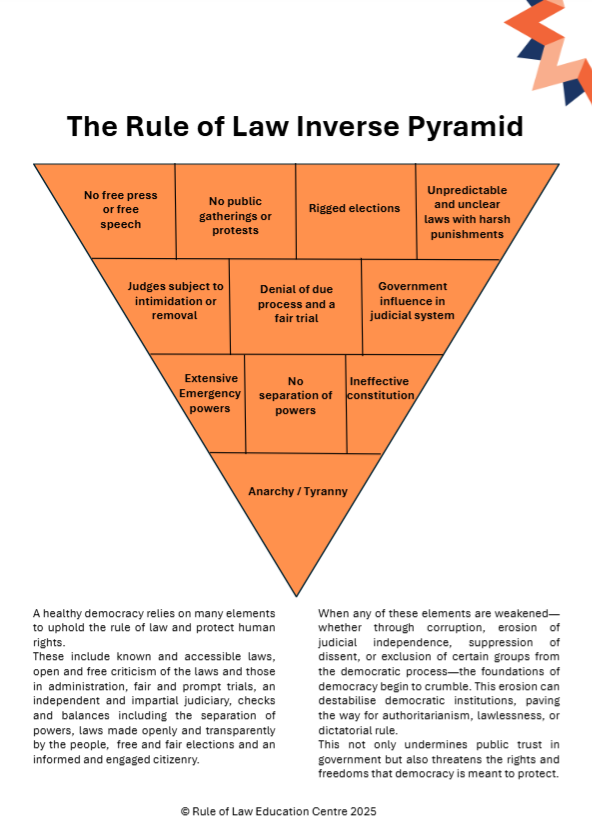
Activity 2 - The Rule of Law Inverse Pyramid
Once they have completed the research task above, this activity then encourages students to considers the different conditions that lead to anarchy and tyranny in a country. Many of these conditions are the opposite of those articulated in the Rule of Law Wheel.
Instructions:
Teacher to introduce students to the idea that there are many elements that are needed to work together to protect the rule of law and democratic systems, and therefore human rights. Teacher should then introduce the Inverse Rule of Law Pyramid and ask students to consider
the information within: then using the Pyramid, teacher encourages students to identify 3 examples from their country case study of where the inverse pyramid conditions have been met and how this has led to a violation of human rights.
Culminating Activity – Group Presentations
Students have the option to present their findings for their case study in a variety of mediums including digital video, news article, news broadcast, digital infographic, physical poster, PowerPoint, and more as per appropriate to the class.
After each group has presented, give students the opportunity to answer 2 reflection questions.
Reflection Activity:
1. Read the following quote from UNESCO.
“Democracy is as much a process as a goal, and only with the full participation of and support by the international community, national governing bodies, civil society and individuals, can the ideal of democracy be made into a reality to be enjoyed by everyone, everywhere.
The values of freedom, respect for human rights and the principle of holding periodic and genuine elections by universal suffrage are essential elements of democracy. In turn, democracy provides the natural environment for the protection and effective realization of human rights.” https://www.unesco.org/en/days/democracy2.
2.Answer the following questions:
How does the type of government influence the protection of human rights
Justify whether a functioning democracy can exist without the rule of law
Related Resources
-
This explainer outlines the core features of democracy, including free and fair elections, accountable government, equal participation and the protection of rights. It shows how democratic systems rely on the rule of law, transparency and active, informed citizens to ensure power is exercised responsibly and in the public interest.
-
The Eureka Stockade had a significant impact on the development of democracy in the colonies and later within the Federation of Australia.
The Eureka Rebellion was a key moment where the people demanded equal and fair treatment and the right to take part in the democratic process.
Not long after Eureka, a new system of administration in the Goldfields of Victoria was introduced that upheld Chartist principles such as: universal male suffrage, secret ballot, abolishment of property qualifications for voting and the system of one man, one vote; and payment of members.
Explore Related Topics
-
Laws
Explore resources on laws, explaining how rules are created, interpreted and enforced to maintain order, protect rights and support a functioning society through clear processes, accountability and fair application.
-
Federation of Australia
Explore resources on Federation, outlining how Australia became a nation, divided powers, and established the constitutional structures & democratic principles that govern today.
-
What is the Rule of Law?
Explore resources explaining the rule of law, showing how a collection of principles works to limit government power and protect rights through clear rules, accountability & fairness.