
Democracy
-
Systems of government affect people’s rights and freedoms. Some protect inherent human dignity, while others prioritise those in power. Monarchy, republic, democracy, dictatorship, and communism are key forms. Democracy, supported by the rule of law, best safeguards human rights by ensuring accountability, transparency, and protection against corruption and disorder.
-
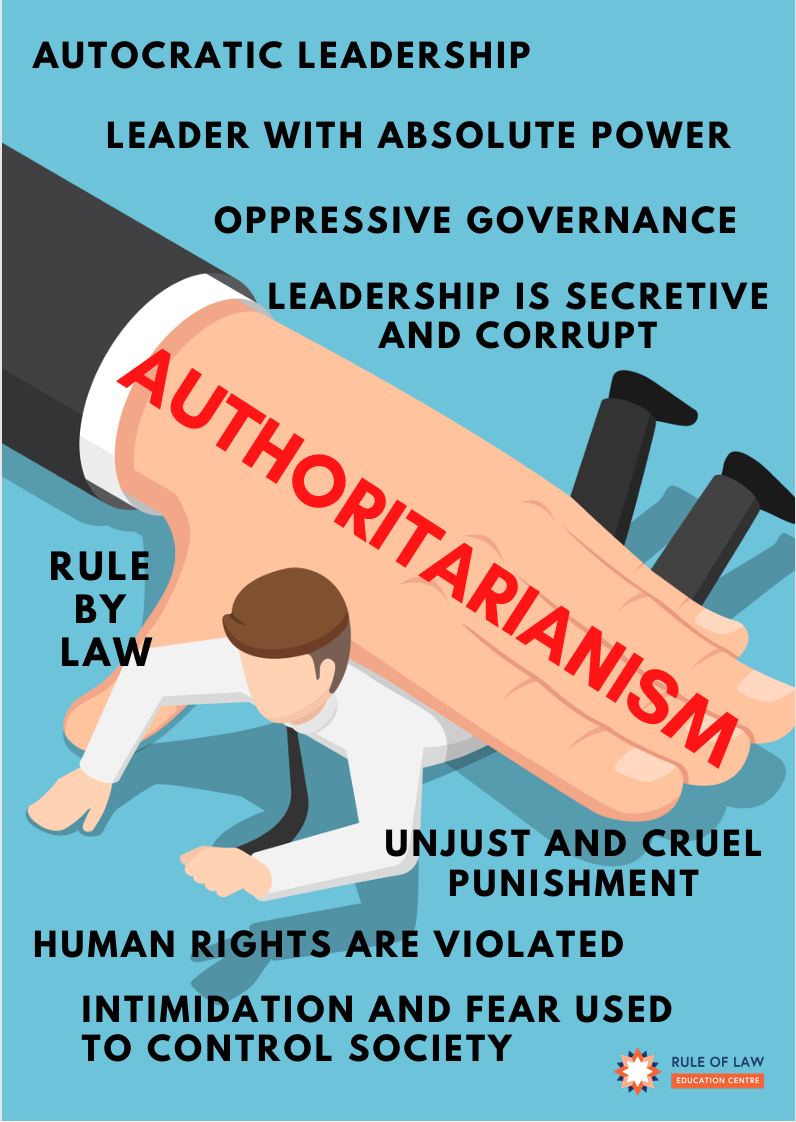
Democracy, supported by the rule of law, protects human rights, freedoms and fair justice through elected representatives and accountable government. In contrast, totalitarianism relies on rule by law, where leaders hold absolute power, restrict freedoms, control information, and enforce obedience through fear, denying citizens equality, rights and genuine political influence.
-
Australia’s path to democracy developed gradually over more than 200 years, influenced by ancient Greek ideas, English legal traditions and the Magna Carta. With key moments such as the arrival of English law with the First Fleet, the introduction of independent judiciary and free press and the chartist movement at the Eureka Rebellion. Democratic features such as voting rights, secret ballots and checks and balances were introduced at different times across the colonies, culminating in Federation in 1901
-
The Eureka Stockade had a significant impact on the development of democracy in the colonies and later within the Federation of Australia.
The Eureka Rebellion was a key moment where the people demanded equal and fair treatment and the right to take part in the democratic process.
Not long after Eureka, a new system of administration in the Goldfields of Victoria was introduced that upheld Chartist principles such as: universal male suffrage, secret ballot, abolishment of property qualifications for voting and the system of one man, one vote; and payment of members.
-
Australia and the United States share British legal roots, valuing individual rights and the rule of law. Their paths to nationhood diverged—America through war and Australia through peaceful federation—shaping different constitutional structures. Despite this, both systems preserve core principles limiting government power and protecting citizens’ freedoms.
-
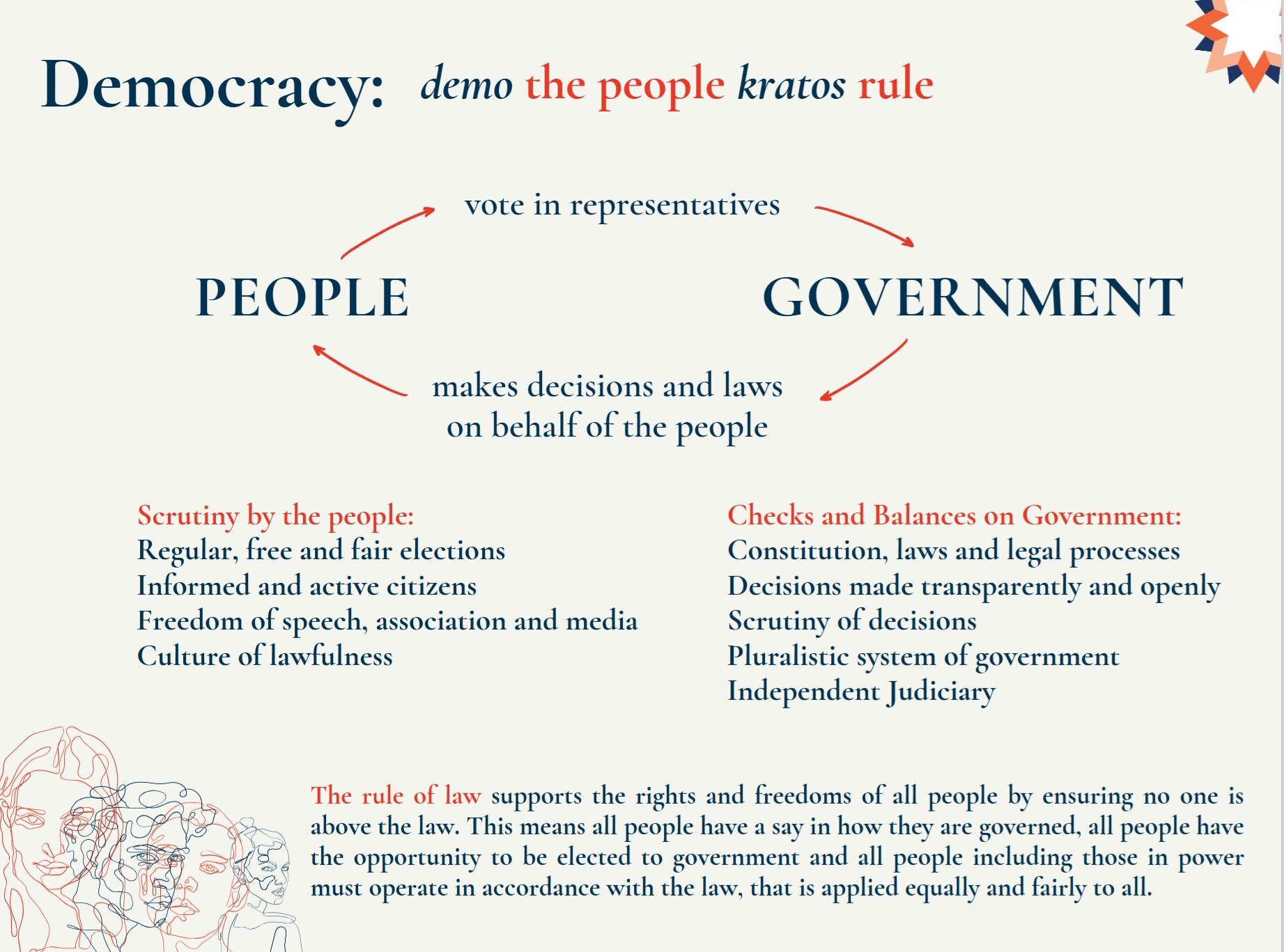
This explainer outlines the core features of democracy, including free and fair elections, accountable government, equal participation and the protection of rights. It shows how democratic systems rely on the rule of law, transparency and active, informed citizens to ensure power is exercised responsibly and in the public interest.

Comparison of different forms of Government
Overview
There are many different ways countries are organised, their systems of government and how leaders make decisions, use their power, and are held responsible for those decisions.
The system of government and the checks and balances on those in power have a significant impact on the lives and human rights of the people they govern. Some systems are designed to protect the basic rights and freedoms of all citizens, recognising that every person has inherent worth and dignity. Other regimes focus more on the needs and interests of those in power, often strengthening their own position instead of supporting everyone’s rights.
There are five primary forms of governance: monarchy, republic, democracy, dictatorship (and authoritarian), and communism. Democracy upholds the fundamental rights and freedoms of all citizens, whereas autocratic and totalitarian regimes often suppress these liberties.
As such, democracy, when supported by the rule of law, is the most effective form of governance for protecting human rights.
The rule of law ensures that those in power are accountable, that laws are transparent and consistently applied, and that society is safeguarded against anarchy, lawlessness, and corruption.
The Five Main Forms of Governance
There are many different types of governments around the world today, but only five form the basic characteristics of rule. Each one has elements that can be found in various government systems, from autocracy to democracy.
1. Monarchy
In an absolute monarchy, the monarch holds supreme autocratic authority. State power is held by a single family that inherits rule from one generation to the next. In recent times, the majority of monarchical governments have transitioned to constitutional monarchies, where the head of state only performs ceremonial roles with limited state powers. The people elect members of a parliament to make laws and form a government.
Examples include the United Kingdom, Denmark and Japan
2. Republic
A republic is a government system without a monarch. Republics can be authoritarian (totalitarian) or democratic. In a democratic republic, laws are made by representatives chosen by the people. Republics usually comply with a constitution, and/or a bill of rights that specifically protects the rights of the minority from the will of majority.
Examples include Argentina, Czechia, France, Brazil and the United States of America.
3. Democracy
A democracy is a government system where the people determine the law of the land. The law holds supreme power under rules set out in a written constitution, underpinned by the rule of law. Laws are made through the parliament, which consists of chosen representatives elected by the people, working for the people. Universal suffrage is conducted regularly by secret ballot. Democracy supports human rights and fundamental freedoms with power limited through checks and balances such as the separation of power between the legislature, executive and an independent judiciary. Decisions are made transparently and are regularly scrutinised by the people and media organisations. Successful democracies educate their citizens in recognising their civic rights and responsibilities, promoting a culture of lawfulness.
Examples include Australia, New Zealand and India.
4. Dictatorship
A dictatorship is where a single person has absolute authority to rule the state. An authoritarian form of government where one person makes the law and controls how the law is enforced, usually through brutal means. This tyrannical regime often includes military organisation and backing, unfair elections (if any) and multiple human rights violations. A dictator seizes control of the state by force or through an election process that is often corrupt. Dictators are not held accountable for their actions, such as the lack of freedom of the press, separation of powers or regular elections.
Examples include Burundi, Chad, Equatorial Guinea and North Korea
5. Communism
Communism is a government system of social organisation based on a particular ideology of a single party or group of people who run the state involving a common vision which collectively serves the interests of the community. All property is owned by the community and citizens are given jobs or life duties. Private ownership is extremely limited or banned altogether, enabling the ruling party to control all resources in the society. Opposition or dissent is not tolerated. The people do not elect party members into power. The party elects itself and usually remains in power for many years.
Examples include China, Cuba and Vietnam.
Australian Curriculum Alignment
Australian Curriculum: AC9HC7K02
NSW Commerce: The Legal and Political Environment CO4-ADJ-01
Related Resources
-
This explainer outlines the core features of democracy, including free and fair elections, accountable government, equal participation and the protection of rights. It shows how democratic systems rely on the rule of law, transparency and active, informed citizens to ensure power is exercised responsibly and in the public interest.
-
Students develop a road map that shows the elements that can lead to the erosion of democracy and the rise of authoritarianism. Adding elements such as stops, landmarks, side roads or scenes to develop understanding of threats to democracy.
-
Explore Related Topics
-
Laws
Explore resources on laws, explaining how rules are created, interpreted and enforced to maintain order, protect rights and support a functioning society through clear processes, accountability and fair application.
-
Federation of Australia
Explore resources on Federation, outlining how Australia became a nation, divided powers, and established the constitutional structures & democratic principles that govern today.
-
What is the Rule of Law?
Explore resources explaining the rule of law, showing how a collection of principles works to limit government power and protect rights through clear rules, accountability & fairness.