
Democracy
-
Systems of government affect people’s rights and freedoms. Some protect inherent human dignity, while others prioritise those in power. Monarchy, republic, democracy, dictatorship, and communism are key forms. Democracy, supported by the rule of law, best safeguards human rights by ensuring accountability, transparency, and protection against corruption and disorder.
-
Democracy, supported by the rule of law, protects human rights, freedoms and fair justice through elected representatives and accountable government. In contrast, totalitarianism relies on rule by law, where leaders hold absolute power, restrict freedoms, control information, and enforce obedience through fear, denying citizens equality, rights and genuine political influence.
-
Australia’s path to democracy developed gradually over more than 200 years, influenced by ancient Greek ideas, English legal traditions and the Magna Carta. With key moments such as the arrival of English law with the First Fleet, the introduction of independent judiciary and free press and the chartist movement at the Eureka Rebellion. Democratic features such as voting rights, secret ballots and checks and balances were introduced at different times across the colonies, culminating in Federation in 1901
-
The Eureka Stockade had a significant impact on the development of democracy in the colonies and later within the Federation of Australia.
The Eureka Rebellion was a key moment where the people demanded equal and fair treatment and the right to take part in the democratic process.
Not long after Eureka, a new system of administration in the Goldfields of Victoria was introduced that upheld Chartist principles such as: universal male suffrage, secret ballot, abolishment of property qualifications for voting and the system of one man, one vote; and payment of members.
-
Australia and the United States share British legal roots, valuing individual rights and the rule of law. Their paths to nationhood diverged—America through war and Australia through peaceful federation—shaping different constitutional structures. Despite this, both systems preserve core principles limiting government power and protecting citizens’ freedoms.
-
This explainer outlines the core features of democracy, including free and fair elections, accountable government, equal participation and the protection of rights. It shows how democratic systems rely on the rule of law, transparency and active, informed citizens to ensure power is exercised responsibly and in the public interest.
Eureka! – Defending Democracy
This resource explains the Eureka Stockade, its causes and consequences, and the impact of the Eureka Stockade on the development of democracy in Australia. Students investigate the role of significant individuals and groups, including miners and government authorities, and evaluate primary and secondary sources to understand different perspectives on this important colonial event.
Overview
The Eureka Stockade had a significant impact on the development of democracy in Australia and was a key moment where the people demanded equal and fair treatment and the right to take part in the democratic process.
This resources follows the development of democracy in Victoria around the time of Eureka.
What was the Eureka Rebellion?
The Eureka Rebellion (or the Eureka Stockade) occurred in Ballarat 1854 during the Victorian gold rush era. In a violent revolt between the Victorian miners and the colony’s military, the rebellion defined one of the most important moments of true representative democracy in Australia, when the people demanded the opportunity to be included – to have a ‘fair go’.
It has often been considered as just a tragic skirmish between miners and a colonial government, but history shows it was much more than that. Through their sacrifice, the miners reinforced key values that are embedded into Australian society today, particularly:
The events that unfolded in Victoria during the 1850s brought about important introductions in the Australian electoral process and reminded the government of the significant principles of justice installed into Australia’s system of law since 1788. It was a time when Australian society recognised the importance of maintaining the rule of law in upholding human rights. Little did they know their actions would help shape how a nation would be governed to this day. By the end of the decade, colonial authorities had finally begun to recognise that colony needed to be run by the people, for the people.
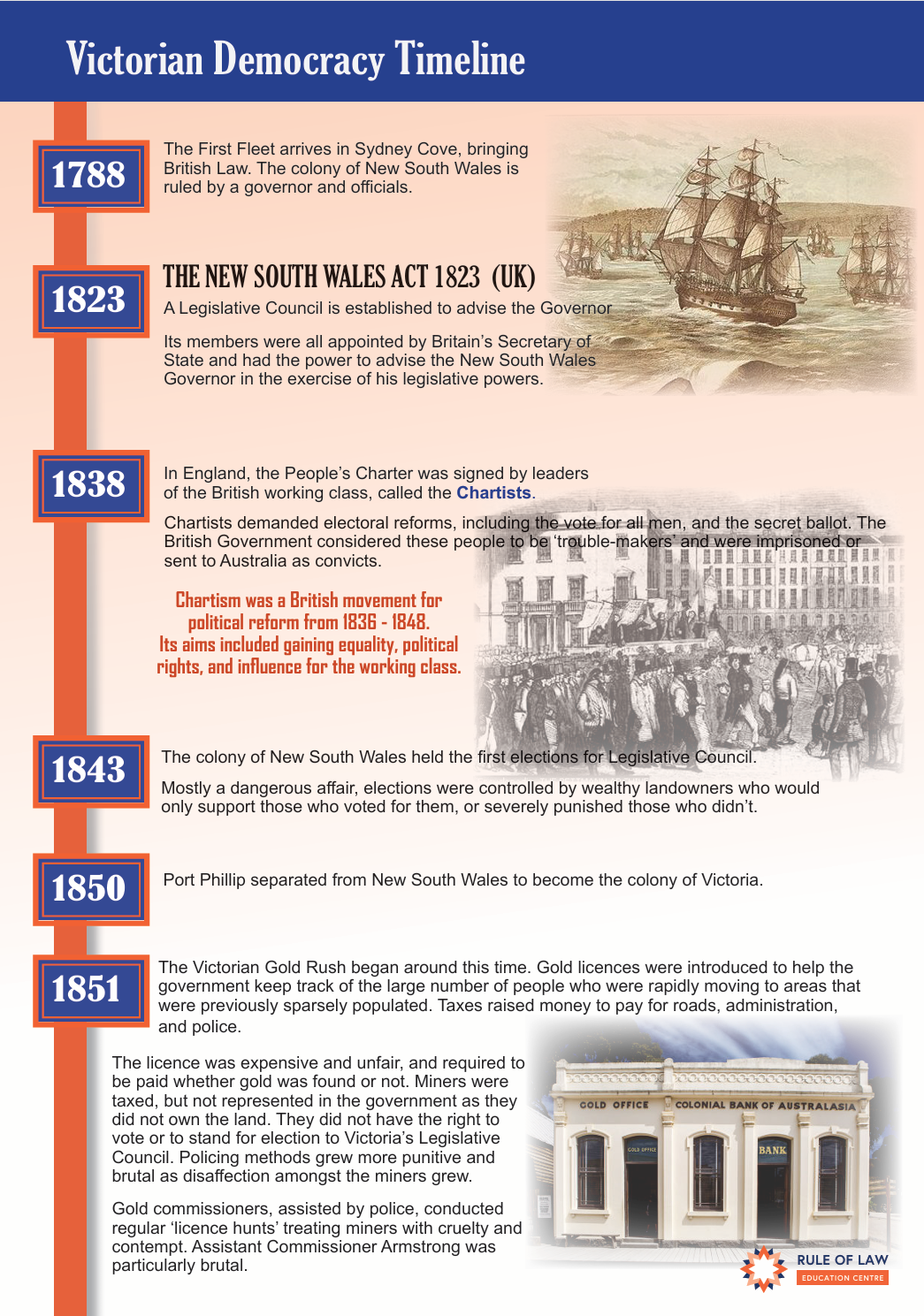
Timeline of Events
-
The First Fleet arrives in Sydney Cove (named after Lord Sydney), bringing British Law to the colony.
The colony of New South Wales is ruled by a governor and officials.
The Commission to Arthur Phillip was to govern the colony with prudence, courage and loyalty. Arthur Phillip was to be subject to the law and his own orders were to be compatible with the law
The First Charter of Justice established courts and attempted to ensure that all persons in the colony were subject to the law.
The first civil case involved 2 convicts and a ship’s Captain in July 1788. The convict couple won the case highlighting the beginnings of the rule of law in the new colony.
-
1823: Under the New South Wales Act (1823) UK, a Legislative Council is established to advise the Governor. Its members were all appointed by Britain’s Secretary of State and had the power to advise the New South Wales Governor in the exercise of his legislative powers. The Act also established the NSW Supreme Court.
1838: In England, the People’s Charter was signed by leaders of the British working class, called the Chartists. Chartists demanded electoral reforms, including the vote for all men, and the secret ballot. The British Government considered these people to be ‘trouble-makers’ and were imprisoned or sent to Australia as convicts.
-
The colony of New South Wales held the first elections for Legislative Council. Mostly a dangerous affair, elections were controlled by wealthy landowners who would only support those who voted for them, or severely punished those who didn’t.
-
In 1850 Port Phillip separated from New South Wales to become the colony of Victoria.
The Victorian Gold Rush began around this time. Gold licences were introduced to help the government keep track of the large number of people who were rapidly moving to areas that were previously sparsely populated. Taxes raised money to pay for roads, administration, and police.
The licence was expensive and unfair, and required to be paid whether gold was found or not.
Miners were taxed, but not represented in the government as they did not own the land. They did not have the right to vote or to stand for election to Victoria’s Legislative Council.
Policing methods grew more punitive and brutal as disaffection amongst the miners grew. Gold commissioners, assisted by police, conducted regular ‘licence hunts’ treating miners with cruelty and contempt. Assistant Commissioner Armstrong was particularly brutal.
-
The British Government gave each colony permission to draw up their own constitutions, with the following requirements:
The constitutions must be bicameral – two houses of parliament.
The Legislative Assembly (the Lower House) and Legislative Council (the Upper House).
The government would no longer be the governor and his officials.
The ministers and premier must all be members of the parliament.
Responsible governance must be followed
Ministers would be responsible to the parliament and have the support of a majority in the Assembly.
-
Gold miners were generally well educated in advocating political ideas surrounding democratic rights. As working-class immigrants, many were members of the Chartist Movement, generally coming from countries where revolutions had occurred, such as France and the American Colonies, and strived to gain individual rights and liberties against the authorities. These workers were informed and alert on the desire to achieve independence, regularly expressing their displeasure and expectations publicly.
Miners included John Basson Humffray, who arrived on the Victorian goldfields in 1853, from Wales.
The Ballarat Reform League was formed in October 1853. Members included John Humffray and George Black, along with Peter Lalor, Frederic Vern, Raffaello Carboni and Timothy Hayes as leading members.
The aims of the League included achieving reform of the administration of the goldfields and to revise the laws relating to access and use of Crown Land.
-
1 November 1854
A mass meeting of miners was held at Bakery Hill on the Ballarat goldfields, where the Ballarat Reform League Charter of Rights was read. This first document in Australia to promote representative democracy was penned by John Basson Humffray.
The People’s Charter demanded:
The right of every citizen to have a voice in making the laws
No taxation without representation
Power to be in the hands of responsible representatives of the people, for honest government
Property qualifications to be abolished for members of the Legislative Council
Full and fair representation
Universal manhood suffrage
Members to be paid to enable less wealthy people to become members of the Legislative Assembly
Short duration of parliament between elections
Total abolition of the diggers’ and storekeepers’ licence tax
27 November 1854
The Ballarat Reform League Charter of Rights was presented to Governor Hotham in Melbourne, along with a petition signed by more than 5,000 people across a large swathe of country from Bendigo to Ballarat.
29 November 1854
The miners were angry that their charter was ignored.
Up to 15,000 people gathered at Bakery Hill. The rebels burned their gold licences in protest and the Southern Cross flag was raised for the first time.
30 November 1854 and Peter Lalor leads the miners
The Officer in Charge James Johnston responded with a massive digger hunt, arresting miners without licences with brutal force. Outraged miners re-gathered at Bakery Hill, where one of the diggers, Peter Lalor took the lead, delivering a rousing speech, swearing an oath to stand together to defend their rights and liberties:
We swear by the Southern Cross to stand truly by each other and find to defend our rights and liberties!
Peter Lalor and the crowd then moved to Eureka Flat and built a makeshift stockade, arming themselves with sticks and metal spikes.
3 December – The Battle
Hotham expected a revolt and sent a large force of soldiers and police to disarm the stockade. Arriving in the early hours of the morning, the size and speed of the response caught the rebels off-guard and they were quickly overwhelmed. Over 20 miners and six soldiers lost their lives. Although, as everyone scattered to hide from the authorities, the true number of lives lost was never confirmed. 113 rebels were detained and 13 miners charged with High Treason.
-
Over the following months, Victorians overwhelmingly supported the defeated miners against the government and the rebels were acquitted after trial by jury.
A Royal Commission investigation found the conditions on the goldfields were unfair. Recommendations included the government abolishing the miner’s licence and twelve new seats be added to the existing Legislative Assembly – eight of them to represent goldfields electorates. An amendment to the Goldfield Act came into effect following the Commission’s Report.
The regime of Goldfields Commissioners, who controlled everything on the goldfields, was removed and replaced with the courts, run by elected miners who held the new Miner’s Right.
Decisions over disputes and claims would now be made by the people, for the people.
The Goldsfields Law Act 1855 (VIC)
Introduction of local courts, with members consisting of people elected by the public, to resolve disputes and claims within the community.
Victoria had produced a mining law, mining judicature, and a mining regulatory system, which was adopted by other Australian colonies and recognised internationally.
The Miner’s Right Act 1855
The Miner’s Right replaced the Gold License on 1 May and cost £1 per annum, instead of the usual £1 per month.
This was historically significant as it gave a miner the right to take a parcel of land to dig for gold, erect a cottage on it, and include a garden. It also gave the right to graze animals on Goldfield land and on vacant Crown Land.
The new system of goldfield’s administration enabled democratic representation leading to:
Universal male suffrage in 1857, giving the holder the right to vote in the Legislative Assembly
Improvements in economical and sustainable operations, which remained substantially unchanged up until 1975
The right to make a residential claim. This led to the development of towns in the gold-mining areas of Victoria, demonstrating the continuation of use of this right within families over many generations
Socially significant developments in symbolising the attachment of miners over several generations to the freedoms and privileges the Miners Right permitted
-
The Victorian Constitution Act 1855(UK)
The Victorian Constitution was proclaimed on 23 November 1855, after approval by the British Parliament and drafted by Victoria’s first Legislative Council in 1853-1854.
-
The Electoral Act 1856 (VIC)
The secret ballot was introduced by the Electoral Act.
Henry Samuel Chapman, the lawyer for the Eureka rebels, drafted the bill which established the new voting system – the Electoral Act 1856 (Vic). Chapman was an Australian and New Zealand judge, colonial secretary, attorney-general, journalist and politician. Government officials released a standard voter form with candidate names printed in alphabetical order. Each voter would enter a private stall and cross out the names of candidates they didn’t support before placing their vote in a sealed box.
Victoria became the first legislature anywhere in the world to adopt this ‘secret voting’ process. An important development in democracy which provided protection for men to cast their vote in secret without recrimination. Britain would adopt the Australian ballot system in 1878, and the United States followed in 1888. The Australian System is used in many countries around the world today.
Peter Lalor was elected to the Victorian Legislative Assembly, remaining a member of parliament until 1887.
John Bassom Humffray became an elected member of the Victorian Legislative Assembly for Ballarat East, representing the interests of the diggers in the seat of North Grant. In 1863, Humffray became Chairman of the Royal Commission on Mining.
-
Property qualifications for members of the Legislative Assembly were abolished and manhood suffrage was granted.
-
As part of the Electoral Act in 1856, elections were now to be held every three years.
By the end of this decade, Victoria had one of the most democratic electoral systems and parliamentary chambers in the world.
-
On 29 December, Victoria became the first Australian colony to introduce payment of Members of Parliament, ensuring all men could stand for parliament and not only affluent and influential men.
The Legislative Assembly was now a parliament for the people. However, the Legislative Council remained dominated by a squatter and merchant oligarchy. The Payment of Members Act was fiercely resisted at first, as only wealthy men could afford to sit in Parliament. It later became permanent.
Equal division of electoral districts came into effect, enforcing the system of one man, one vote.
-
The consultation process for achieving federation was long and arduous, with many conventions and conferences held to determine the will of the people across the nation. People became involved through federal leagues, clubs, and societies advocating for unity and change.
The bill for the Australian Constitution (The Commonwealth of Australia Constitution Act 1900) was passed by the British Parliament on 5 July 1900 and signed by Queen Victoria on 9 July 1900.
The Australian Constitution brought together all the colonies to form one nation and included many of the reforms for representative democracy that came from the Eureka rebellion.
The Commonwealth of Australia was declared on 1 January 1901
The new Australian Parliament held the first federal elections on 29 – 30 March 1901
The first Parliament of the Commonwealth of Australia was opened at noon on 9 May 1901
The First Prime Minister of Australia was Sir Edmund Barton
Australian Curriculum Alignment
National Curriculum: AC9HS5K03, AC9HS5S04
Victorian Curriculum: VCHHC086, VCHHK090
NSW Curriculum: History 7-10 Key Ideas and Movements (1750 - 1918)
Related Resources
-
An overview of the major factors that shaped the development of democracy in Australia, including egalitarian legal ideals shown in cases like Kable v Sinclair, the introduction of checks and balances through institutions such as the Supreme Court and a free press, the influence of immigration and political activism including Chartism and the Eureka Stockade, and the constitutional debates that led the colonies to design their own representative systems of government.
-
This explainer outlines the core features of democracy, including free and fair elections, accountable government, equal participation and the protection of rights. It shows how democratic systems rely on the rule of law, transparency and active, informed citizens to ensure power is exercised responsibly and in the public interest.
-
Students develop a road map that shows the elements that can lead to the erosion of democracy and the rise of authoritarianism. Adding elements such as stops, landmarks, side roads or scenes to develop understanding of threats to democracy.
-
Victoria’s democracy developed through key 19th‑century reforms influenced by Chartism and the Eureka Rebellion. Miners demanded fair representation, leading to secret ballots, expanded voting rights, limits on government power, and a more representative parliament. These milestones strengthened freedoms, accountability, and the rule of law in colonial Victoria.
-
From the classic storybook on Eureka Stockade written by Alan Boardman and illustrated by Roland Harvey and read by David Baldwin learn the events of Eureka Rebellion
Explore Related Topics
-
Laws
Explore resources on laws, explaining how rules are created, interpreted and enforced to maintain order, protect rights and support a functioning society through clear processes, accountability and fair application.
-
Australia: Making a Nation
This collection of resources is aligned to the NSW History 7–10 Depth Study Australia: Making a Nation, supporting student learning from Federation through to World War I.
-
What is the Rule of Law?
Explore resources explaining the rule of law, showing how a collection of principles works to limit government power and protect rights through clear rules, accountability & fairness.