
Democracy
-
Systems of government affect people’s rights and freedoms. Some protect inherent human dignity, while others prioritise those in power. Monarchy, republic, democracy, dictatorship, and communism are key forms. Democracy, supported by the rule of law, best safeguards human rights by ensuring accountability, transparency, and protection against corruption and disorder.
-
Democracy, supported by the rule of law, protects human rights, freedoms and fair justice through elected representatives and accountable government. In contrast, totalitarianism relies on rule by law, where leaders hold absolute power, restrict freedoms, control information, and enforce obedience through fear, denying citizens equality, rights and genuine political influence.
-
Australia’s path to democracy developed gradually over more than 200 years, influenced by ancient Greek ideas, English legal traditions and the Magna Carta. With key moments such as the arrival of English law with the First Fleet, the introduction of independent judiciary and free press and the chartist movement at the Eureka Rebellion. Democratic features such as voting rights, secret ballots and checks and balances were introduced at different times across the colonies, culminating in Federation in 1901
-
The Eureka Stockade had a significant impact on the development of democracy in the colonies and later within the Federation of Australia.
The Eureka Rebellion was a key moment where the people demanded equal and fair treatment and the right to take part in the democratic process.
Not long after Eureka, a new system of administration in the Goldfields of Victoria was introduced that upheld Chartist principles such as: universal male suffrage, secret ballot, abolishment of property qualifications for voting and the system of one man, one vote; and payment of members.
-
Australia and the United States share British legal roots, valuing individual rights and the rule of law. Their paths to nationhood diverged—America through war and Australia through peaceful federation—shaping different constitutional structures. Despite this, both systems preserve core principles limiting government power and protecting citizens’ freedoms.
-
This explainer outlines the core features of democracy, including free and fair elections, accountable government, equal participation and the protection of rights. It shows how democratic systems rely on the rule of law, transparency and active, informed citizens to ensure power is exercised responsibly and in the public interest.
Democracy versus Totalitarianism
Overview
There are many definitions that are used to describe and explain the different forms of governance that exist around the world today. It can get quite confusing as many terms are linked together to describe systems that have evolved over time.
However, it is important to remember they all fall under two main systems of rule: rule of law | rule by law
DEMOCRACY (SUPPORTED BY THE RULE OF LAW)
The word democracy comes from the ancient Greek word meaning people and rule. It is a system of government where the people are sovereign and elect their leaders, with checks and balances to ensure their representatives act lawfully, and in accords with the wishes of the people.
There are many forms of democracies, but all have the main feature of the people being able to decide who will lead and represent their interests and issues of concern in their communities. This happens through the process of free and fair elections.
A parliamentary democracy is a type of democracy where the elected representatives are required to meet regularly in parliament to make laws and be answerable to the people for the decisions they have made. The people also have equal opportunity to become a representative government themselves, regardless of their social status, religious beliefs, or ethnic background. Australia is an example of a parliamentary democracy. Its system is based on the Westminster System, named after the place where the English Parliament meets.
Democracy with the rule of law respects human rights and protects its citizens
A democracy works best when it is supported by the rule of law. That is, all people including the government are ruled by the law and obey it. In such a democracy there are independent judges and an effective legal system, together with a free press that protect human rights and ensure accountability and transparency for those in power.
When a democracy is working well, it protects the peoples’ rights and freedoms to:
Live
Own and control their own property
Have access to fair and transparent justice according to the law
Follow their own beliefs, religion, and customs
Freedom from torture or slavery
TOTALITARIANISM (RULE BY LAW)
The opposite of democratic rule is called totalitarianism.
A totalitarian government, also known as ‘the state’ , is typically led by a dictatorial leader who enforces an official set of beliefs. Citizens are expected to conform, and those who resist, face unpleasant, and often violent consequences. While the state may hold elections or display other features of a democracy, the people have no real power to influence how they are governed.
The state holds absolute power, controlling citizens through harsh laws that ignore basic human rights. This is know as rule by law.
In a totalitarian state:
Individual freedoms or ownership of personal property is restricted or not permitted
Personal beliefs and faith in religion other than the ideals of the state, is met with severe consequences.
Information or any form of media from outside the state is not permitted. The state only releases information that promotes its own point of view or political cause. Citizens are denied access to any information that can cause a revolt.
The leader makes arbitrary and oppressive laws. Decisions and judgements are passed according to the interpretations of the leader and those in power. Those in power do not have to follow the laws, and fair and equal justice is denied.
Opposition to the state is punishable and considered evil. Large scale organised violence is permitted by the state to force the people into conforming.
The supply of food to its citizens may be limited or withheld. The fear of starvation is a powerful strategy that reinforces the reliance of the people on the ruler for all their needs, therefore developing loyalty towards the ideals of the state.
Social gatherings and traditions are banned. The state controls who and when people can visit and for what reason. This suppresses any community discussion and eliminates any forces of influence beyond the control of the state.
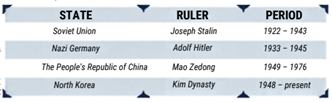
Totalitarianism rules by law as it arbitrarily controls its citizens
A totalitarianism state is ruled by law. The people must obey the law created by the leader whilst the leader and law enforcement are not required to obey. Human rights are ignored.
Related Resources
-
This explainer outlines the core features of democracy, including free and fair elections, accountable government, equal participation and the protection of rights. It shows how democratic systems rely on the rule of law, transparency and active, informed citizens to ensure power is exercised responsibly and in the public interest.
-
Students develop a road map that shows the elements that can lead to the erosion of democracy and the rise of authoritarianism. Adding elements such as stops, landmarks, side roads or scenes to develop understanding of threats to democracy.
Explore Related Topics
-
Laws
Explore resources on laws, explaining how rules are created, interpreted and enforced to maintain order, protect rights and support a functioning society through clear processes, accountability and fair application.
-
Federation of Australia
Explore resources on Federation, outlining how Australia became a nation, divided powers, and established the constitutional structures & democratic principles that govern today.
-
What is the Rule of Law?
Explore resources explaining the rule of law, showing how a collection of principles works to limit government power and protect rights through clear rules, accountability & fairness.