
Laws
-
This poster forms part of the Informed Playing Card Project, showing how laws are made, the different types of laws in Australia, and the features that make laws effective.
-
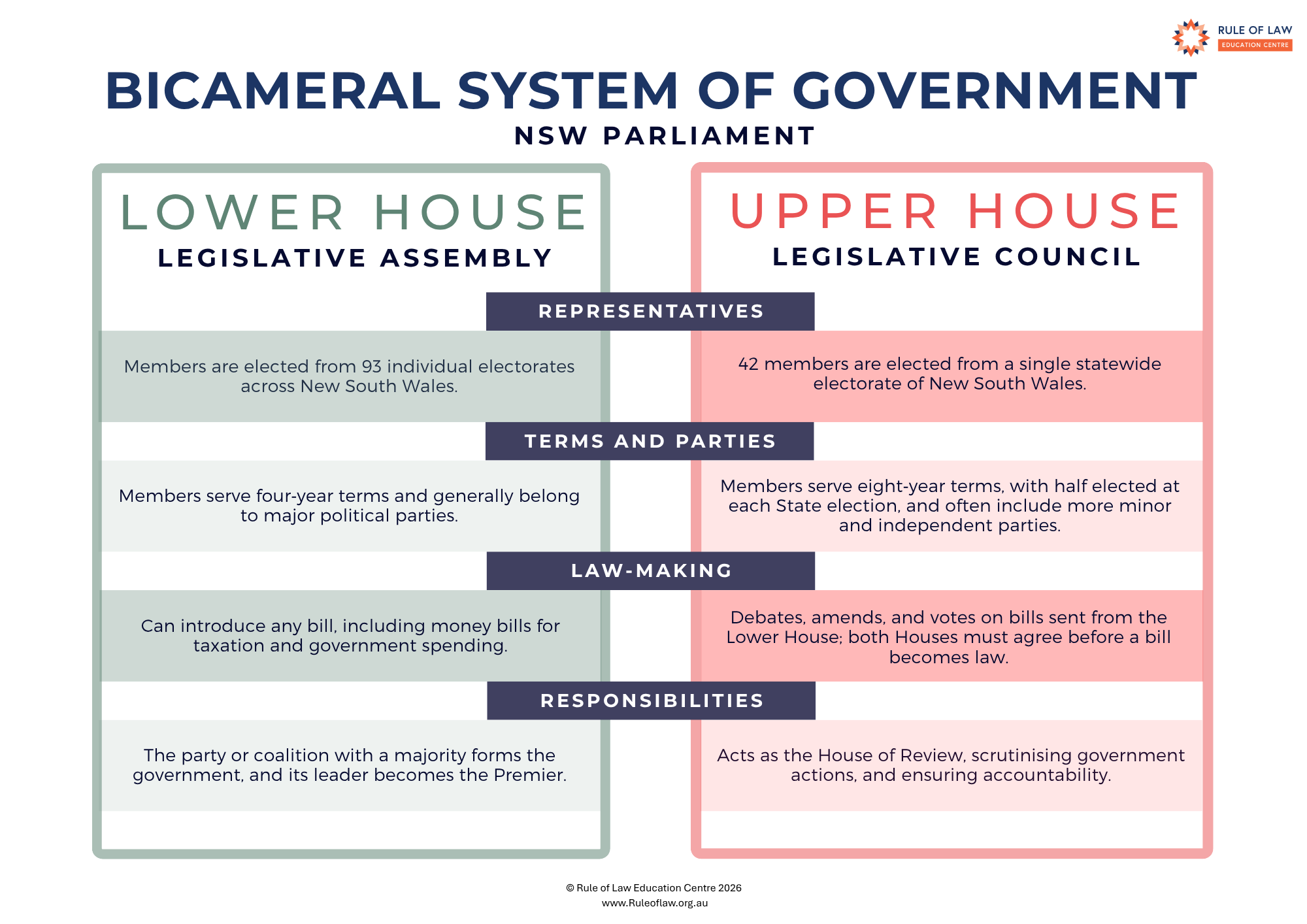
Summary of the different roles of the Lower and Upper houses of Parliament in a Bicameral system of government. The resource pack considers the NSW Bicameral and the Federal Bicameral system and the different representatives, terms, law-making powers and responsibilities.
-
A simple video explainer about why Parliament has two houses under the Westminster system of government, covering the roles of the Lower House (Legislative Assembly/House of Representatives) and Upper House (Legislative Council/Senate) in a bicameral Parliament. Learn why parliamentary scrutiny of laws, government decisions, and the Executive is essential for accountability, transparency, and effective democratic government.
-
Delegated legislation allows Parliament to authorise government departments, councils and other bodies to create detailed rules—such as regulations, by‑laws and ordinances—under powers granted by an Act. It enables laws to be updated quickly, adapted to changing circumstances and informed by specialist expertise, but it also receives less direct democratic scrutiny than primary legislation. This video explores the benefits and risks of delegated law‑making, including concerns about executive overreach, limited public awareness and the use of “Henry VIII clauses” that permit delegated laws to amend Acts. It emphasises the need for strong parliamentary oversight, transparency and safeguards to ensure delegated legislation remains consistent with the rule of law and the separation of powers.
-
This video explains the difference between rules and laws, why societies need them, and how they protect rights and maintain order. It introduces who makes laws, how they are enforced, and how rules and laws work together within Australia’s rule‑of‑law framework.
-
This video explains the features of effective laws and uses the game of Monopoly to show how clear, fair and consistently applied rules create order. It highlights how good laws guide behaviour, prevent conflict and support a fair society.
-
This video uses the Rule of Law Education Centre’s checklist to assess whether proposed hate‑speech laws are clear, fair, enforceable and protective of human rights. It explains how the laws aim to keep Australians safe while balancing freedom of speech, and shows how different types of hate speech attract different penalties depending on their seriousness.
-
This PowerPoint introduces the features that make laws effective—clarity, consistency, fairness and enforceability—and shows how these qualities help laws protect rights, guide behaviour and support the rule of law. It is designed to help Years 9–10 students evaluate real laws using these criteria.
-
This PowerPoint introduces the difference between rules and laws, why societies need them, and how they guide behaviour and keep communities safe. It explains who makes laws, how they are enforced, and how rules and laws work together within Australia’s rule‑of‑law framework.
Video: Why Do we have two Houses of Parliament?
Bicameral Parliamentary System Explained using NSW as a case study
This video explains why Australia uses a bicameral parliamentary system of government and why Parliament is divided into an Upper House and Lower House. Students explore the roles of the Legislative Assembly, Legislative Council, House of Representatives and Senate, and how parliamentary scrutiny, representation and checks on government power help protect Australian democracy.
Why does NSW need 2 Houses of Parliament?
At state elections, residents vote in their representative to Parliament. Those representatives, called Members of Parliament or MPs, meet in Parliament to make laws on behalf of those who voted for them and to keep a check on those who implement the laws to make sure their actions are legal, necessary, proportionate and non discriminatory. Rules and processes ensure the laws are made openly with discussion and deliberation by the Members of Parliament.
This is what the process of passing a law looks like.
Passing a Law with a Bicameral Parliament: NSW Case Study
In NSW we have a bicameral Parliament.
This means that bills, the draft of the proposed law pass through two houses, the lower House Legislative Assembly and the Upper House Legislative Council, before they can become an enforceable law.
In the lower house are all the state MPs who have been voted in during the state election. Based upon the Westminster system, the political party that has the most MPs forms the government and the leader becomes the NSW Premier.
MPs from the same political party usually vote unanimously on laws.
However, this has the potential for the political party in power to hold too much power and make decisions that do not consider all citizens in NSW.
Upper House as a Check on Power
So to provide a balance to the power of those in governments and to ensure the view of all citizens are heard, NSW has an upper house called the House of Review.
The role of the upper house is to:
Represent the people. The upper house provides a diverse group of representatives from many different political parties to represent the whole state.
Scrutinise executive government, that is to keep an eye on the government by debating the merits of government legislation, reviewing delegated legislation and questioning MPs, and
Legislate to review and pass laws.
Each law that is passed should be carefully and impartially reviewed by both houses.
Conclusion
The bicameral system is our nation's way of ensuring that the process of passing laws maintains a fair and democratic society of law abiding citizens.
The Upper house has been described as the most important of the constitutional cheques on balances on excessive concentration of power.
It is the one place where government can be questioned and obliged to answer. Having two houses in NSW Parliament prevents one political party from having too much power.
It holds the government accountable and protects our democracy through fairer representation for all citizens of NSW.
Related Resources
-
This explainer outlines how statute law, common law and delegated legislation are created, changed and applied in Australia, outlining the parliamentary stages of law‑making, the development of common law through judicial decisions and precedent, and the role of executive bodies in making delegated legislation under enabling Acts. It connects directly to syllabus concepts such as the origin and development of common law, features of the doctrine of precedent, steps in the legislative process, parliamentary supremacy, and reasons for changes in the law, including social values, technology and community safety. By showing how each source of law operates within Australia’s democratic framework and the rule of law, the resource helps students understand how legal authority is exercised fairly, transparently and accountably.
-
This factsheet outlines the key characteristics of effective laws in Australia’s representative democracy, explaining how laws must protect the rule of law, uphold human rights, and regulate behaviour in ways that are clear, known, accepted, consistent and fair. It highlights syllabus concepts such as accessibility, enforceability, stability, prospectivity, and the need for laws to be amendable as community values change. By showing how effective laws prevent arbitrary power and support equality before the law, the factsheet helps students understand why legal certainty and accountability are essential in Australia’s legal system.
-
This factsheet provides a clear overview of how laws in Australia are created, applied and enforced, explaining the purpose of laws, the role of statute law, common law and legal precedent, and the importance of the rule of law in a democratic society. It outlines key syllabus concepts including effective law‑making, bicameral and unicameral parliaments, the doctrine of precedent, and major types of law such as criminal, civil, administrative and constitutional. Designed as a concise one‑page resource, it helps students understand how legal institutions operate across different jurisdictions and why fairness, accountability and legal certainty are essential in Australia’s legal system.
-
Simple poster illustrating the different role of the houses in a bicameral system of government.
Explore Related Topics
-
Law is Known and Accessible
Explore resources on accessible law, highlighting why clear, and public rules are essential for fairness and social participation by enabling informed decision‑ making & transparent governance.
-
Democracy
Explore resources on democracy, highlighting how accountability and representative institutions ensure power is exercised fairly and transparently through open processes, civic engagement and responsible governance.
-
Open and Transparent Laws
Explore resources on transparent lawmaking, highlighting how accessible processes strengthen accountability and uphold democratic principles through responsible decision‑making.