
Open Criticism and Freedom of Speech
-
Outlines the core ideas behind the principle that government actions, legal processes, and public officials must be open to scrutiny and free criticism. Explains how transparency, accountability, and the freedom to question authority safeguard against the misuse of power and strengthen public trust in the justice system.
-
Freedom of speech allows people to express opinions, share ideas and participate in public debate without fear of punishment. It is essential to Australia’s democratic system and is protected through clear laws, civic values and constitutional limits on government power. While this freedom is not absolute, any restriction must be reasonable, proportionate and consistent with the rule of law.
-
This article from Robin Speed considers a proposal to make it illegal to talk or write the truth about another person where it “invades” that person’s privacy. It looks at the historical freedom of speech in Australia and how this proposal could restrict our freedoms today.
-
This factsheet outlines the core values that support Australia’s free and democratic society, including equality, freedom, respect and responsibility. It shows how these values guide civic behaviour, protect rights and underpin Australia’s democracy and rule of law.
-
This resource explains why freedom of speech is essential in a democratic society and how the rule of law protects this freedom while allowing for reasonable limits. It highlights the importance of open debate, accountability and informed participation, showing how clear laws help balance individual expression with community safety.
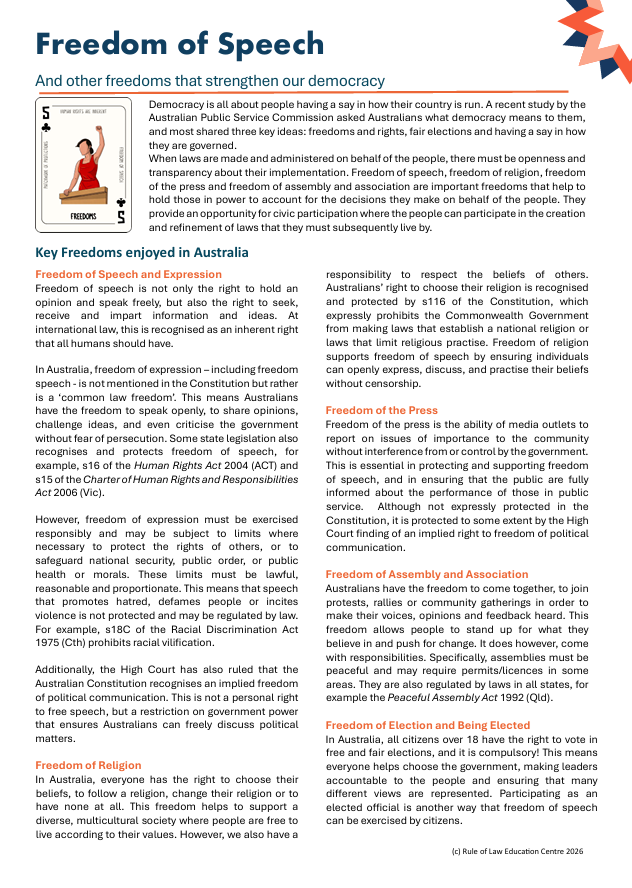
Freedom of Speech
Overview
Democracy is all about people having a say in how their country is run. A recent study by the Australian Public Service Commission asked Australians what democracy means to them, and most shared three key ideas: freedoms and rights, fair elections and having a say in how they are governed.
When laws are made and administered on behalf of the people, there must be openness and transparency about their implementation. Freedom of speech, freedom of religion, freedom of the press and freedom of assembly and association are important freedoms that help to hold those in power to account for the decisions they make on behalf of the people. They provide an opportunity for civic participation where the people can participate in the creation and refinement of laws that they must subsequently live by.
Key Freedoms enjoyed in Australia
Freedom of Speech and Expression
Freedom of speech is not only the right to hold an opinion and speak freely, but also the right to seek, receive and impart information and ideas. At international law, this is recognised as an inherent right that all humans should have.
In Australia, freedom of expression – including freedom speech - is not mentioned in the Constitution but rather is a ‘common law freedom’. This means Australians have the freedom to speak openly, to share opinions, challenge ideas, and even criticise the government without fear of persecution. Some state legislation also recognises and protects freedom of speech, for example, s16 of the Human Rights Act 2004 (ACT) and s15 of the Charter of Human Rights and Responsibilities Act 2006 (Vic).
However, freedom of expression must be exercised responsibly and may be subject to limits where necessary to protect the rights of others, or to safeguard national security, public order, or public health or morals. These limits must be lawful, reasonable and proportionate. This means that speech that promotes hatred, defames people or incites violence is not protected and may be regulated by law. For example, s18C of the Racial Discrimination Act 1975 (Cth) prohibits racial vilification.
Additionally, the High Court has also ruled that the Australian Constitution recognises an implied freedom of political communication. This is not a personal right to free speech, but a restriction on government power that ensures Australians can freely discuss political matters.
Freedom of Religion
In Australia, everyone has the right to choose their beliefs, to follow a religion, change their religion or to have none at all. This freedom helps to support a diverse, multicultural society where people are free to live according to their values. However, we also have a responsibility to respect the beliefs of others. Australians’ right to choose their religion is recognised and protected by s116 of the Constitution, which expressly prohibits the Commonwealth Government from making laws that establish a national religion or laws that limit religious practise. Freedom of religion supports freedom of speech by ensuring individuals can openly express, discuss, and practise their beliefs without censorship.
Freedom of the Press
Freedom of the press is the ability of media outlets to report on issues of importance to the community without interference from or control by the government. This is essential in protecting and supporting freedom of speech, and in ensuring that the public are fully informed about the performance of those in public service. Although not expressly protected in the Constitution, it is protected to some extent by the High Court finding of an implied right to freedom of political communication.
Freedom of Assembly and Association
Australians have the freedom to come together, to join protests, rallies or community gatherings in order to make their voices, opinions and feedback heard. This freedom allows people to stand up for what they believe in and push for change. It does however, come with responsibilities. Specifically, assemblies must be peaceful and may require permits/licences in some areas. They are also regulated by laws in all states, for example the Peaceful Assembly Act 1992 (Qld).
Freedom of Election and Being Elected
In Australia, all citizens over 18 have the right to vote in free and fair elections, and it is compulsory! This means everyone helps choose the government, making leaders accountable to the people and ensuring that many different views are represented. Participating as an elected official is another way that freedom of speech can be exercised by citizens.
Related Resources
-
This explainer outlines how Australian hate‑speech laws work, including the limits on free expression, the protections against vilification, and the role of courts and human rights bodies in resolving complaints. It highlights how the law balances freedom of speech with safeguarding individuals and communities from harm.
-
Lorraine Finlay, Australian Human Rights Commissioner looks at the Contemporary Human Rights Issues in relation to Freedom of Speech. What is Freedom of Speech and how has it developed as a right? How is Freedom of Speech balanced with violations of other human rights such as discrimination or harassment? What are some restrictions of Freedom of Speech? Lorraine also provides an example using s18C of the Racial Discrimination Act 1975 (Cth) and how this impacts freedom of speech.
-
This article from Robin Speed considers a proposal to make it illegal to talk or write the truth about another person where it “invades” that person’s privacy. It looks at the historical freedom of speech in Australia and how this proposal could restrict our freedoms today.
Explore Related Topics
-
Independent and Impartial Judiciary
Explore resources on an open, independent and impartial judiciary and its role in delivering fair justice.
-
Establishment of NSW Supreme Court and Freedom of Speech
The establishment of the NSW Supreme Court and the subsequent battle between Chief Justice Forbes and Governor Darling over press freedom have shaped key democratic principles, including rule of law, separation of powers, and checks and balances. These developments strengthened an independent judiciary, protected rights, and reinforced accountability through a free press in society.
-
First Civil Case in NSW: The Lost Parcel
On the First Fleet, a lost parcel sparked Australia’s first civil lawsuit. In Cable v Sinclair (1788), convicts Henry and Susannah Kable successfully sued a powerful ship’s captain.
Explore Related Resources
-
Coming Soon!
This pilot page uses the conceptual structure and themes from the existing website. Wording can be further refined later, but the framework is aligned with the current website and metadata model.
-
Coming Soon!
This pilot page uses the conceptual structure and themes from the existing website. Wording can be further refined later, but the framework is aligned with the current website and metadata model.
-
Coming Soon!
This pilot page uses the conceptual structure and themes from the existing website. Wording can be further refined later, but the framework is aligned with the current website and metadata model.