
Laws
-
This explainer outlines what laws are, why societies need them, and how they protect rights, ensure safety and guide behaviour. It explains how parliaments make statute law, how courts develop common law through precedent, and how different types of law—criminal, civil, administrative and constitutional—operate within Australia’s rule‑of‑law framework.
-
This explainer outlines the difference between rules and laws, showing how laws are created, enforced and applied to protect rights, maintain order and keep communities safe. It helps students understand why societies need laws, how they guide behaviour and how the rule of law ensures fairness and accountability.
-
This explainer outlines the key features that make laws effective, including clarity, consistency, enforceability and fairness. It shows how well‑designed laws protect rights, guide behaviour and support the rule of law by being known, stable and applied equally to everyone.
-
This explainer outlines how Australian hate‑speech laws work, including the limits on free expression, the protections against vilification, and the role of courts and human rights bodies in resolving complaints. It highlights how the law balances freedom of speech with safeguarding individuals and communities from harm.
Hate Speech Laws
What makes a good law
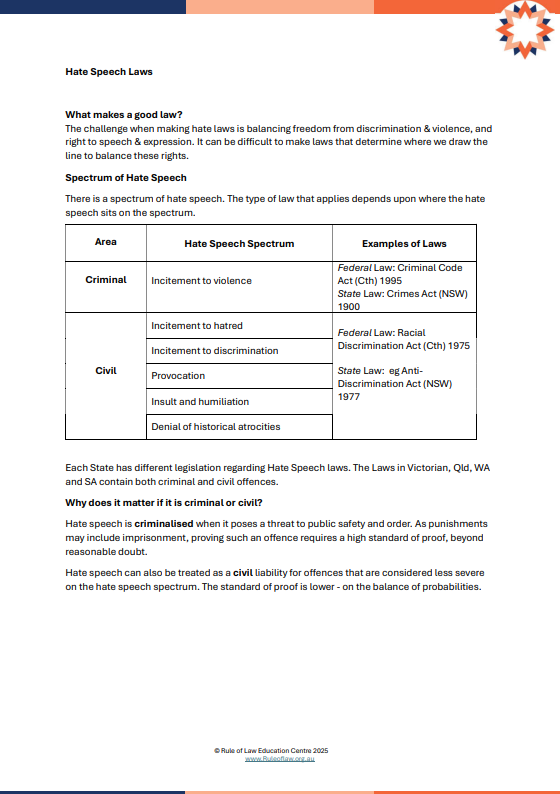
What makes a good law? The challenge when making hate laws is balancing freedom from discrimination & violence, and right to speech & expression. It can be difficult to make laws that determine where we draw the line to balance these rights. Spectrum of Hate Speech There is a spectrum of hate speech. The type of law that applies depends upon where the hate speech sits on the spectrum.
Criminal (e.g., Federal Law: Criminal Code Act (Cth) 1995; State Law: Crimes Act (NSW) 1900)
Incitement to violence
Civil (e.g., Federal Law: Racial Discrimination Act (Cth) 1975; State Law: AntiDiscrimination Act (NSW) 1977)
Incitement to hatred
Incitement to discrimination
Provocation
Insult and humiliation
Denial of historical atrocities
Each State has different legislation regarding Hate Speech laws. The Laws in Victorian, Qld, WA and SA contain both criminal and civil offences.
Why does it matter if it is criminal or civil?
Hate speech is criminalised when it poses a threat to public safety and order. As punishments may include imprisonment, proving such an offence requires a high standard of proof, beyond reasonable doubt.
Hate speech can also be treated as a civil liability for offences that are considered less severe on the hate speech spectrum. The standard of proof is lower - on the balance of probabilities.
Things to consider when evaluating the Hate Speech laws.
The Rule of Law Education Centre has developed a Checklist of Effective Laws. This gives a framework to consider whether a law is good/effective.
The relevant principles to consider for the Hate Speech Laws are:
What is the purpose of the law?
Are they clear? Are the terms and definitions clear enough? They need to be precise and not vague so as to avoid arbitrary application. Will the community understand what types of speech are covered by the laws?
Are they accepted? Are the boundaries of behaviour consistent with community standards? Or do they reflect only one group’s perspective?
Are they fair? Do the punishments fit the crime? Or do they unjustly impact on other important rights? Will everyone be subject to the law and similar penalties applied for similar breaches?
Are they enforceable? Are the laws clear enough so they can be effectively enforced? Are the laws broad enough to cover what the laws are intending to protect against?
Do they protect human rights? Do the laws effectively balance the right to safety and security with the right to freedom of speech?
Will they satisfy their purpose? Will they send a clear message about community expectations regarding certain behaviour?
By evaluating laws through these key characteristics, we can form a critical understanding about whether a particular law achieves its purpose and aligns with the rule of law.
Our laws must protect and advance individual Australians. It is critical that Australians feel safe and free to go about their day-to-day lives.
The question that we need to think about is what restrictions are we willing to accept and where do those lines get drawn?
Related Resources
-
This activity helps students evaluate whether a law is clear, consistent, enforceable and fair by applying a simple checklist. It supports understanding of what makes laws effective and how these features uphold the rule of law.
-
This video uses the Rule of Law Education Centre’s checklist to assess whether proposed hate‑speech laws are clear, fair, enforceable and protective of human rights. It explains how the laws aim to keep Australians safe while balancing freedom of speech, and shows how different types of hate speech attract different penalties depending on their seriousness.
Explore Related Topics
-
Law is Known and Accessible
Explore resources on accessible law, highlighting why clear, and public rules are essential for fairness and social participation by enabling informed decision‑ making & transparent governance.
-
Democracy
Explore resources on democracy, highlighting how accountability and representative institutions ensure power is exercised fairly and transparently through open processes, civic engagement and responsible governance.
-
Open and Transparent Laws
Explore resources on transparent lawmaking, highlighting how accessible processes strengthen accountability and uphold democratic principles through responsible decision‑making.