
Laws
-
This explainer outlines what laws are, why societies need them, and how they protect rights, ensure safety and guide behaviour. It explains how parliaments make statute law, how courts develop common law through precedent, and how different types of law—criminal, civil, administrative and constitutional—operate within Australia’s rule‑of‑law framework.
-
This explainer outlines the difference between rules and laws, showing how laws are created, enforced and applied to protect rights, maintain order and keep communities safe. It helps students understand why societies need laws, how they guide behaviour and how the rule of law ensures fairness and accountability.
-
This explainer outlines the key features that make laws effective, including clarity, consistency, enforceability and fairness. It shows how well‑designed laws protect rights, guide behaviour and support the rule of law by being known, stable and applied equally to everyone.
-
This explainer outlines how Australian hate‑speech laws work, including the limits on free expression, the protections against vilification, and the role of courts and human rights bodies in resolving complaints. It highlights how the law balances freedom of speech with safeguarding individuals and communities from harm.
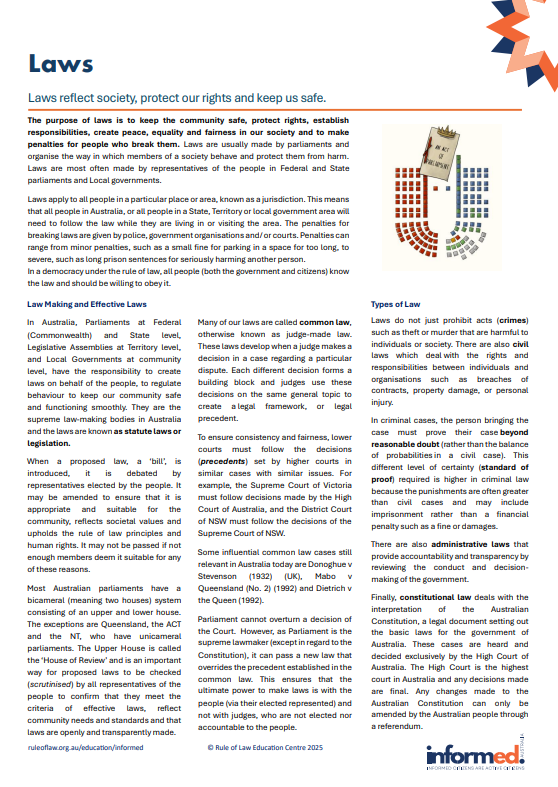
Informed Factsheet: Laws in Australia
Laws reflect society, protect our rights and keep us safe
The purpose of laws is to keep the community safe, protect rights, establish responsibilities, create peace, equality and fairness in our society and to make penalties for people who break them.
Laws are usually made by parliaments and organise the way in which members of a society behave and protect them from harm. Laws are most often made by representatives of the people in Federal and State parliaments and Local governments.
Laws apply to all people in a particular place or area, known as a jurisdiction. This means that all people in Australia, or all people in a State, Territory or local government area will need to follow the law while they are living in or visiting the area. The penalties for breaking laws are given by police, government organisations and/ or courts. Penalties can range from minor penalties, such as a small fine for parking in a space for too long, to severe, such as long prison sentences for seriously harming another person.
In a democracy under the rule of law, all people (both the government and citizens) know the law and should be willing to obey it.
Law Making and Effective Laws
In Australia, Parliaments at Federal (Commonwealth) and State level, Legislative Assemblies at Territory level, and Local Governments at community level, have the responsibility to create laws on behalf of the people, to regulate behaviour to keep our community safe and functioning smoothly. They are the supreme law-making bodies in Australia and the laws are known as statute laws or legislation.
When a proposed law, a ‘bill’, is introduced, it is debated by representatives elected by the people. It may be amended to ensure that it is appropriate and suitable for the community, reflects societal values and upholds the rule of law principles and human rights. It may not be passed if not enough members deem it suitable for any of these reasons.
Most Australian parliaments have a bicameral (meaning two houses) system consisting of an upper and lower house. The exceptions are Queensland, the ACT and the NT, who have unicameral parliaments. The Upper House is called the ‘House of Review’ and is an important way for proposed laws to be checked (scrutinised) by all representatives of the people to confirm that they meet the criteria of effective laws, reflect community needs and standards and that laws are openly and transparently made
Many of our laws are called common law, otherwise known as judge-made law. These laws develop when a judge makes a decision in a case regarding a particular dispute. Each different decision forms a building block and judges use these decisions on the same general topic to create a legal framework, or legal precedent.
To ensure consistency and fairness, lower courts must follow the decisions (precedents) set by higher courts in similar cases with similar issues. For example, the Supreme Court of Victoria must follow decisions made by the High Court of Australia, and the District Court of NSW must follow the decisions of the Supreme Court of NSW.
Some influential common law cases still relevant in Australia today are Donoghue v Stevenson (1932) (UK), Mabo v Queensland (No. 2) (1992) and Dietrich v the Queen (1992).
Parliament cannot overturn a decision of the Court. However, as Parliament is the supreme lawmaker (except in regard to the Constitution), it can pass a new law that overrides the precedent established in the common law. This ensures that the ultimate power to make laws is with the people (via their elected represented) and not with judges, who are not elected nor accountable to the people.
Types of Law
Laws do not just prohibit acts (crimes) such as theft or murder that are harmful to individuals or society. There are also civil laws which deal with the rights and responsibilities between individuals and organisations such as breaches of contracts, property damage, or personal injury.
In criminal cases, the person bringing the case must prove their case beyond reasonable doubt (rather than the balance of probabilities in a civil case). This different level of certainty (standard of proof) required is higher in criminal law because the punishments are often greater than civil cases and may include imprisonment rather than a financial penalty such as a fine or damages.
There are also administrative laws that provide accountability and transparency by reviewing the conduct and decisionmaking of the government.
Finally, constitutional law deals with the interpretation of the Australian Constitution, a legal document setting out the basic laws for the government of Australia. These cases are heard and decided exclusively by the High Court of Australia. The High Court is the highest court in Australia and any decisions made are final. Any changes made to the Australian Constitution can only be amended by the Australian people through a referendum.
Related Resources
-
This activity helps students evaluate whether a law is clear, consistent, enforceable and fair by applying a simple checklist. It supports understanding of what makes laws effective and how these features uphold the rule of law.
-
This video uses the Rule of Law Education Centre’s checklist to assess whether proposed hate‑speech laws are clear, fair, enforceable and protective of human rights. It explains how the laws aim to keep Australians safe while balancing freedom of speech, and shows how different types of hate speech attract different penalties depending on their seriousness.
Explore Related Topics
-
Law is Known and Accessible
Explore resources on accessible law, highlighting why clear, and public rules are essential for fairness and social participation by enabling informed decision‑ making & transparent governance.
-
Democracy
Explore resources on democracy, highlighting how accountability and representative institutions ensure power is exercised fairly and transparently through open processes, civic engagement and responsible governance.
-
Open and Transparent Laws
Explore resources on transparent lawmaking, highlighting how accessible processes strengthen accountability and uphold democratic principles through responsible decision‑making.