
Governor General
-
This explainer outlines how the first five Governors of New South Wales—Arthur Phillip, John Hunter, Philip Gidley‑King, William Bligh, and Lachlan Macquarie—worked to build a functioning colony from a population of transported convicts. It highlights their efforts to apply fairness, justice, and emerging ideas about individual rights while managing a settlement that began as a prison. It also provides context on Britain’s overcrowded prisons, the shift to transporting convicts to Australia, and the role of the Charter of Justice in shaping early governance.
-
This explainer outlines Arthur Phillip’s leadership of the First Fleet, his establishment of British law in the new colony, and his efforts to ensure survival, fairness, and stability while navigating conflict with military officers and tensions with Indigenous peoples.
-
This explainer highlights William Bligh’s brief, turbulent governorship, focusing on his attempts to break the New South Wales Corps’ control over trade, end the rum economy, and support struggling farmers. His reforms provoked the Corps, leading to the Rum Rebellion and his arrest, though he was later cleared. Despite lasting controversy, his actions helped re‑establish lawful authority in the colony.
-
This explainer shows how Lachlan Macquarie stabilised New South Wales by restoring law and order, redirecting convict labour to public works, and supporting emancipists. It highlights his major building program with Francis Greenway, the introduction of official currency, and reforms that helped shift the colony toward a free, organised society. It also notes how opposition from wealthy settlers and the Bigge Inquiry forced his resignation, even though his leadership laid foundations for future self‑government.
-
This explainer outlines how John Hunter struggled to regain control of New South Wales after years of unchecked power by the New South Wales Corps. It highlights the Corps’ corruption, its dominance over trade and law, and the obstacles Hunter faced as they blocked information and undermined his authority. Despite being recalled to England over false accusations, his reputation was later restored, and his writings became valuable records of early colonial life.
-
This explainer outlines how Philip Gidley‑King worked to strengthen and expand the colony between 1800 and 1806. It highlights his efforts to build the economy through coal, whaling, and farming, his support for emancipists, and his push for fair opportunity. It also shows how constant resistance from the New South Wales Corps—especially John Macarthur—undermined his authority, eventually damaging his reputation and forcing his resignation.
-
This explainer shows how Lord Sydney, Thomas Townshend, shaped the principles that guided the founding of New South Wales. It outlines why he adopted the name Sydney in honour of Algernon Sidney, whose ideas about liberty, equality, and the rule of law deeply influenced him. It also highlights his key decisions as Home Secretary: choosing Arthur Phillip as governor, creating the First Charter of Justice, and ensuring the new colony offered convicts the chance for rights, reform, and eventual freedom.
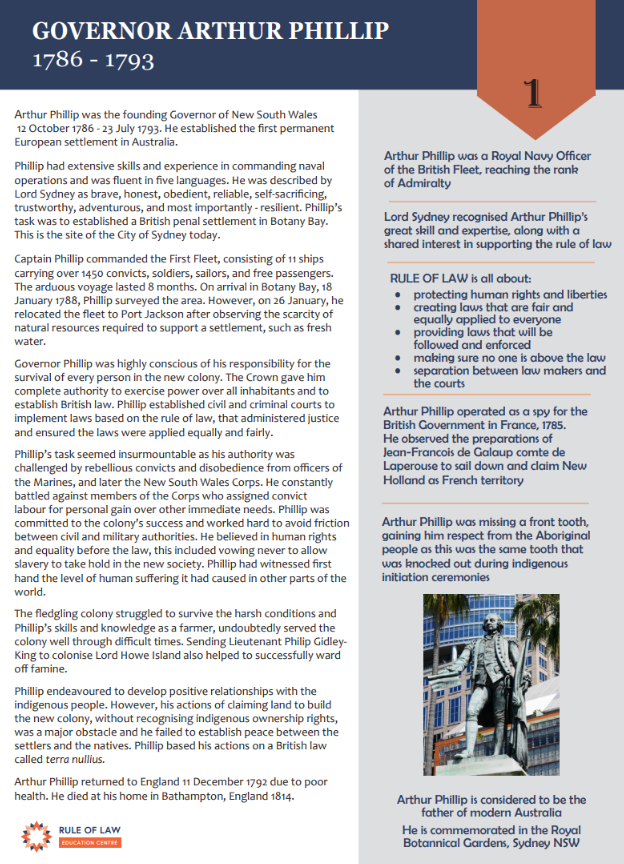
Governor Arthur Phillip
1786 - 1793
Arthur Phillip was the founding Governor of New South Wales 12 October 1786 – 23 July 1793. He established the first permanent European settlement in Australia.
Phillip had extensive skills and experience in commanding naval operations and was fluent in five languages. He was described by Lord Sydney as brave, honest, obedient, reliable, self-sacrificing, trustworthy, adventurous, and most importantly – resilient. Phillip’s task was to established a British penal settlement in Botany Bay. This is the site of the City of Sydney today.
Captain Phillip commanded the First Fleet, consisting of 11 ships carrying over 1450 convicts, soldiers, sailors, and free passengers. The arduous voyage lasted 8 months. On arrival in Botany Bay, 18 January 1788, Phillip surveyed the area. However, on 26 January, he relocated the fleet to Port Jackson after observing the scarcity of natural resources required to support a settlement, such as fresh water.
Governor Phillip was highly conscious of his responsibility for the survival of every person in the new colony. The Crown gave him complete authority to exercise power over all inhabitants and to establish British law. Phillip established civil and criminal courts to implement laws based on the rule of law, that administered justice and ensured the laws were applied equally and fairly.
Phillip’s task seemed insurmountable as his authority was challenged by rebellious convicts and disobedience from officers of the Marines, and later the New South Wales Corps. He constantly battled against members of the Corps who assigned convict labour for personal gain over other immediate needs. Phillip was committed to the colony’s success and worked hard to avoid friction between civil and military authorities. He believed in human rights and equality before the law, this included vowing never to allow slavery to take hold in the new society. Phillip had witnessed first hand the level of human suffering it had caused in other parts of the world.
The fledgling colony struggled to survive the harsh conditions and Phillip’s skills and knowledge as a farmer, undoubtedly served the colony well through difficult times. Sending Lieutenant Philip Gidley-King to colonise Lord Howe Island also helped to successfully ward off famine. Phillip endeavoured to develop positive relationships with the indigenous people.
However, his actions of claiming land to build the new colony, without recognising indigenous ownership rights, was a major obstacle and he failed to establish peace between the settlers and the natives. Phillip based his actions on a British law called terra nullius.
Arthur Phillip returned to England 11 December 1792 due to poor health. He died at his home in Bathampton, England 1814.
Related Resources
-
This explainer shows how Lord Sydney, Thomas Townshend, shaped the principles that guided the founding of New South Wales. It outlines why he adopted the name Sydney in honour of Algernon Sidney, whose ideas about liberty, equality, and the rule of law deeply influenced him. It also highlights his key decisions as Home Secretary: choosing Arthur Phillip as governor, creating the First Charter of Justice, and ensuring the new colony offered convicts the chance for rights, reform, and eventual freedom.
-
This resource explains how the British applied the doctrine of terra nullius to justify claiming sovereignty over Australia, based on assumptions about agriculture, population, and Indigenous law. It outlines the profound impacts on Indigenous peoples and shows how Mabo (No 2) overturned the fiction, recognising ongoing connection to Country and leading to the Native Title Act 1993.
Explore Related Topics
-
Law is Known and Accessible
Explore resources on accessible law, highlighting why clear, and public rules are essential for fairness and social participation by enabling informed decision‑ making & transparent governance.
-
Democracy
Explore resources on democracy, highlighting how accountability and representative institutions ensure power is exercised fairly and transparently through open processes, civic engagement and responsible governance.
-
Open and Transparent Laws
Explore resources on transparent lawmaking, highlighting how accessible processes strengthen accountability and uphold democratic principles through responsible decision‑making.