
Governor General
-
This explainer outlines how the first five Governors of New South Wales—Arthur Phillip, John Hunter, Philip Gidley‑King, William Bligh, and Lachlan Macquarie—worked to build a functioning colony from a population of transported convicts. It highlights their efforts to apply fairness, justice, and emerging ideas about individual rights while managing a settlement that began as a prison. It also provides context on Britain’s overcrowded prisons, the shift to transporting convicts to Australia, and the role of the Charter of Justice in shaping early governance.
-
This explainer outlines Arthur Phillip’s leadership of the First Fleet, his establishment of British law in the new colony, and his efforts to ensure survival, fairness, and stability while navigating conflict with military officers and tensions with Indigenous peoples.
-
This explainer highlights William Bligh’s brief, turbulent governorship, focusing on his attempts to break the New South Wales Corps’ control over trade, end the rum economy, and support struggling farmers. His reforms provoked the Corps, leading to the Rum Rebellion and his arrest, though he was later cleared. Despite lasting controversy, his actions helped re‑establish lawful authority in the colony.
-
This explainer shows how Lachlan Macquarie stabilised New South Wales by restoring law and order, redirecting convict labour to public works, and supporting emancipists. It highlights his major building program with Francis Greenway, the introduction of official currency, and reforms that helped shift the colony toward a free, organised society. It also notes how opposition from wealthy settlers and the Bigge Inquiry forced his resignation, even though his leadership laid foundations for future self‑government.
-
This explainer outlines how John Hunter struggled to regain control of New South Wales after years of unchecked power by the New South Wales Corps. It highlights the Corps’ corruption, its dominance over trade and law, and the obstacles Hunter faced as they blocked information and undermined his authority. Despite being recalled to England over false accusations, his reputation was later restored, and his writings became valuable records of early colonial life.
-
This explainer outlines how Philip Gidley‑King worked to strengthen and expand the colony between 1800 and 1806. It highlights his efforts to build the economy through coal, whaling, and farming, his support for emancipists, and his push for fair opportunity. It also shows how constant resistance from the New South Wales Corps—especially John Macarthur—undermined his authority, eventually damaging his reputation and forcing his resignation.
-
This explainer shows how Lord Sydney, Thomas Townshend, shaped the principles that guided the founding of New South Wales. It outlines why he adopted the name Sydney in honour of Algernon Sidney, whose ideas about liberty, equality, and the rule of law deeply influenced him. It also highlights his key decisions as Home Secretary: choosing Arthur Phillip as governor, creating the First Charter of Justice, and ensuring the new colony offered convicts the chance for rights, reform, and eventual freedom.
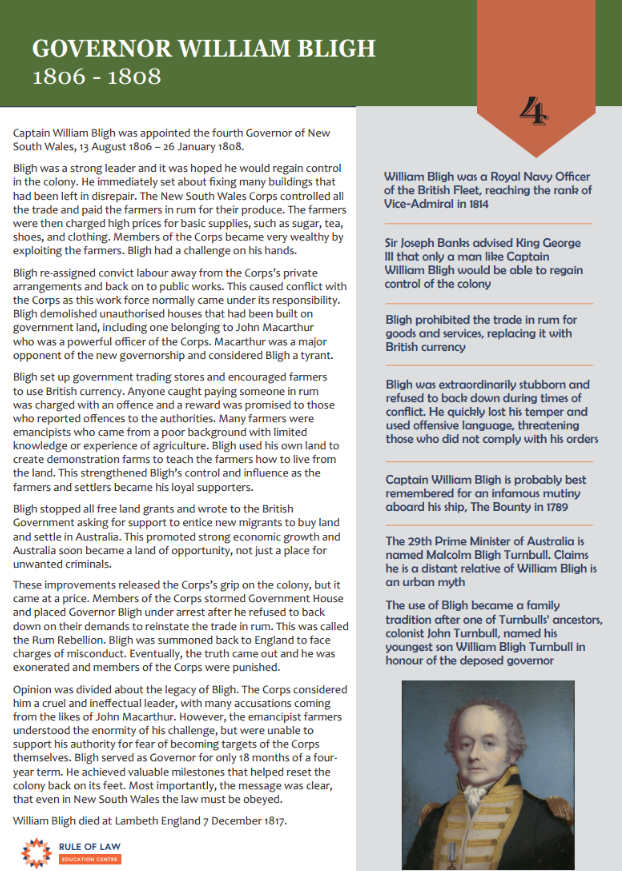
Governor William Bligh
1806 - 1808
Captain William Bligh was appointed the fourth Governor of New South Wales, 13 August 1806 – 26 January 1808. Bligh was a strong leader and it was hoped he would regain control in the colony. He immediately set about fixing many buildings that had been left in disrepair. The New South Wales Corps controlled all the trade and paid the farmers in rum for their produce. The farmers were then charged high prices for basic supplies, such as sugar, tea, shoes, and clothing. Members of the Corps became very wealthy by exploiting the farmers. Bligh had a challenge on his hands.
Bligh re-assigned convict labour away from the Corps’s private arrangements and back on to public works. This caused conflict with the Corps as this work force normally came under its responsibility. Bligh demolished unauthorised houses that had been built on government land, including one belonging to John Macarthur who was a powerful officer of the Corps. Macarthur was a major opponent of the new governorship and considered Bligh a tyrant.
Bligh set up government trading stores and encouraged farmers to use British currency. Anyone caught paying someone in rum was charged with an offence and a reward was promised to those who reported offences to the authorities. Many farmers were emancipists who came from a poor background with limited knowledge or experience of agriculture. Bligh used his own land to create demonstration farms to teach the farmers how to live from the land. This strengthened Bligh’s control and influence as the farmers and settlers became his loyal supporters.
William Bligh died at Lambeth England 7 December 1817.
Fun Facts
William Bligh was a Royal Navy Officer of the British Fleet, reaching the rank of Vice Admiral in 1814
Sir Joseph Banks advised King George III that only a man like Captain William Bligh would be able to regain control of the colony
Bligh prohibited the trade in rum for goods and services, replacing it with British currency
Bligh was extraordinarily stubborn and refused to back down during times of conflict. He quickly lost his temper and used offensive language, threatening those who did not comply with his orders
Captain William Bligh is probably best remembered for an infamous mutiny aboard his ship, The Bounty in 1789
The 29th Prime Minister of Australia is named Malcolm Bligh Turnbull. Claims he is a distant relative of William Bligh is an urban myth. The use of Bligh became a family tradition after one of Turnbulls’ ancestors, colonist John Turnbull, named his youngest son William Bligh Turnbull in honour of the deposed governor
Related Resources
-
This explainer outlines how Philip Gidley‑King worked to strengthen and expand the colony between 1800 and 1806. It highlights his efforts to build the economy through coal, whaling, and farming, his support for emancipists, and his push for fair opportunity. It also shows how constant resistance from the New South Wales Corps—especially John Macarthur—undermined his authority, eventually damaging his reputation and forcing his resignation.
-
This explainer outlines how John Hunter struggled to regain control of New South Wales after years of unchecked power by the New South Wales Corps. It highlights the Corps’ corruption, its dominance over trade and law, and the obstacles Hunter faced as they blocked information and undermined his authority. Despite being recalled to England over false accusations, his reputation was later restored, and his writings became valuable records of early colonial life.
Explore Related Topics
-
Law is Known and Accessible
Explore resources on accessible law, highlighting why clear, and public rules are essential for fairness and social participation by enabling informed decision‑ making & transparent governance.
-
Democracy
Explore resources on democracy, highlighting how accountability and representative institutions ensure power is exercised fairly and transparently through open processes, civic engagement and responsible governance.
-
Open and Transparent Laws
Explore resources on transparent lawmaking, highlighting how accessible processes strengthen accountability and uphold democratic principles through responsible decision‑making.